📋 Table of Contents
According to a 2024 survey by Wyzowl, 88% of marketers say video is an essential part of their strategy, yet many Bay Area shoots are derailed by avoidable technical friction. When you are filming in a high-rise in the Financial District or a glass-walled startup hub in SOMA, a pre-production technical audit is the difference between a polished brand film and a $10,000 day of troubleshooting.
Key Takeaways for Decision-Makers
- Acoustic Reality: Glass-walled offices require specialized dampening to avoid the ‘hollow’ sound that plagues amateur corporate video.
- Power Stability: Modern cinema lighting can easily trip breakers in older SF infrastructure; a load-bearing audit is non-negotiable.
- Connectivity: For hybrid-ready sets, broadcast-grade internet redundancy is the baseline, not the exception.
1. The Acoustic Audit: Navigating Glass and HVAC
The most expensive mistake in SF corporate video production is assuming your office ‘sounds fine’ because it feels quiet to the human ear. In our experience with Series B SaaS founders, the high-frequency hum of a server room or the rhythmic cycling of a modern HVAC system is often imperceptible until it is captured by a $5,000 shotgun microphone.
Here’s the thing: San Francisco’s modern architecture loves glass, but microphones hate it. Hard surfaces create sound reflections that make your CEO sound like they are speaking inside a fishbowl. During your on-site technical scout checklist, you must identify these ‘sonic traps’ early.
- HVAC Control: Can the building manager kill the air conditioning for 60-minute blocks?
- Glass Dampening: Will the production team need to bring ‘sound blankets’ or acoustic foam to kill reflections?
- Street Noise: In SOMA or FiDi, the 10:00 AM trash pickup or emergency sirens can ruin a perfect take.
2. Power Grid Stability and Load Management
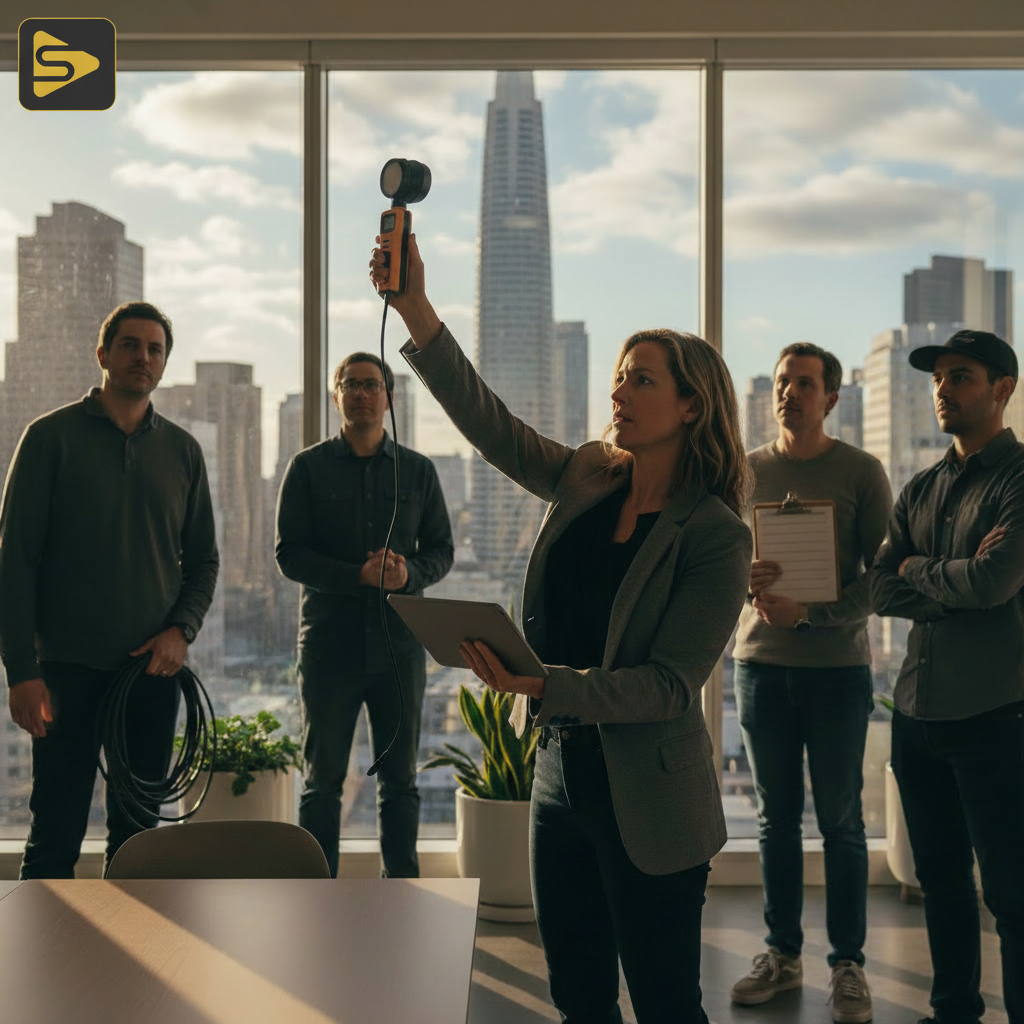
What most people miss is that a pre-production technical audit isn’t just about where the camera goes; it’s about the juice behind it. While many freelance videographers might just plug into the nearest wall outlet, a professional crew calculates the total amperage draw of the lighting grid to prevent a total office blackout.
In older SF buildings, the power infrastructure is often shared across multiple suites. If your neighbor decides to run a high-capacity espresso machine at the same time your 1200D LED light kicks on, you’re looking at a blown fuse and 45 minutes of downtime. According to Energy.gov, commercial buildings often have complex circuit mapping that requires a professional walkthrough.
| Equipment Type | Typical Power Draw (Amps) | Audit Requirement |
|---|---|---|
| LED Lighting Kit | 5-15 Amps | Check for dedicated 20A circuits |
| Cinema Camera Station | 2-4 Amps | Battery backups recommended |
| Live Stream Rack | 8-12 Amps | Requires UPS (Uninterruptible Power Supply) |
Need a professional team to handle the technical heavy lifting? Schedule a free consultation to discuss your next SF office shoot.
3. Natural Light Cycles and the ‘Glass Office’ Challenge
The real kicker about filming in the Bay Area is the fog—or rather, the sudden disappearance of it. A pre-production technical audit must account for the sun’s path throughout the day, especially in offices with floor-to-ceiling windows.
But wait—natural light is free, right? Yes, but it’s also inconsistent. If you start an interview at 9:00 AM under cloud cover and the sun breaks through at 10:30 AM, your white balance and exposure will be completely mismatched between takes. For a consistent, high-end look, we often recommend ‘blacking out’ windows or using high-output lights that can compete with the sun.
- Orientation: Does the office face East (morning glare) or West (harsh afternoon sun)?
- Window Treatments: Are there existing blinds, or do we need to bring 12×12 ‘solids’ to block the light?
- Color Temperature: Mixing 3200K indoor lights with 5600K daylight creates a ‘muddy’ look that is difficult to fix in post-production.
4. AV Infrastructure and Broadcast-Grade Connectivity
As of 2025, the demand for hybrid-ready sets has skyrocketed. If you are planning a global town hall or a high-stakes product launch, your AV infrastructure audit must prioritize upload speeds over download speeds. Most corporate IT departments optimize for the latter, which is useless for high-fidelity streaming.
In our work with mid-market clients, we find that guest Wi-Fi is rarely sufficient. A professional pre-production technical audit identifies the nearest hardline ethernet drop. We also look for fiber-optic availability to ensure live streaming stability. If your office lacks the bandwidth, we may need to deploy a bonded cellular solution or a satellite backup like Starlink.
For brands looking to scale their content velocity through automated workflows, we leverage Ingest.blog, our internal AI content engine, to ensure that once the video is captured, it is distributed across all channels with maximum SEO impact.
5. SOMA and FiDi Production Logistics
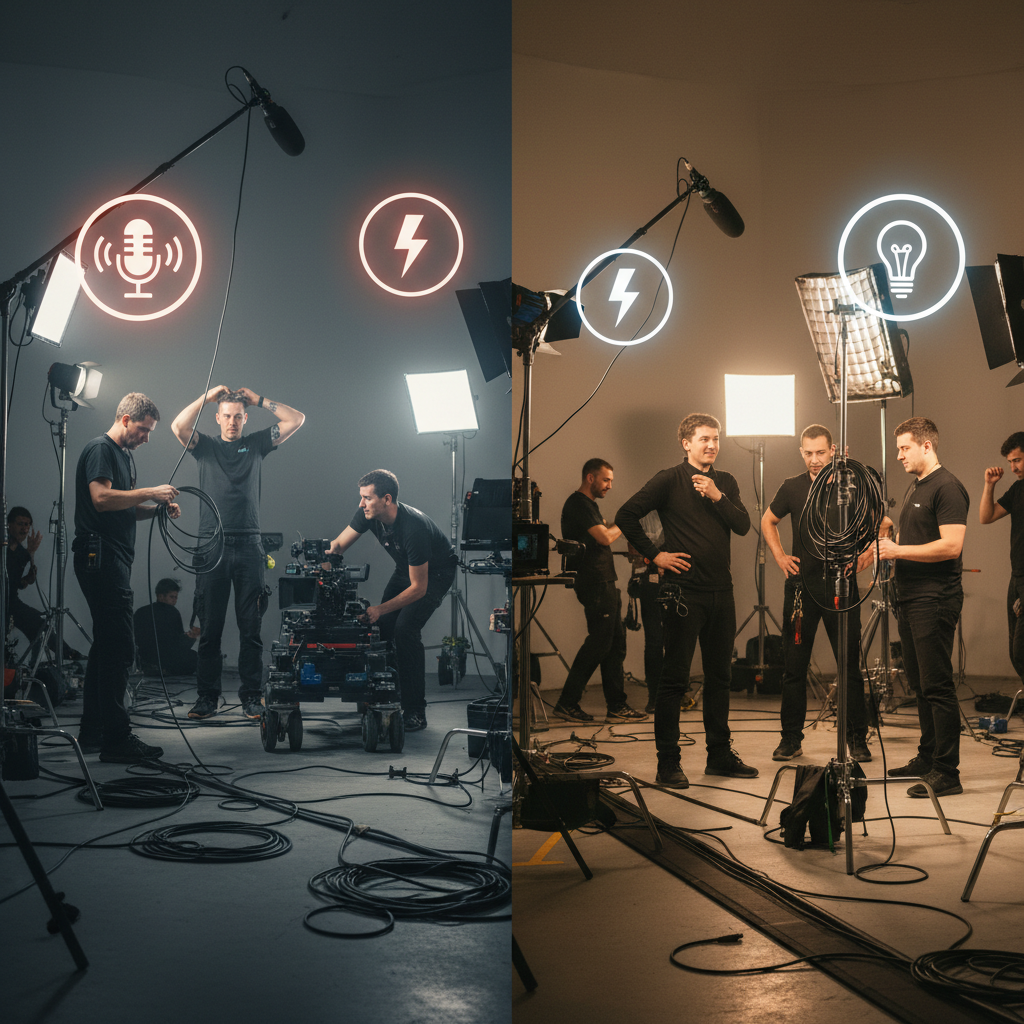
The ‘Historic Building Challenge’ is real in San Francisco. If you’re filming in a SOMA warehouse conversion or a FiDi skyscraper, your pre-production technical audit must include a ‘load-in’ survey. A one-off video shoot can be ruined before it starts if the crew can’t get their gear into the building.
Here is an honest, contrarian insight: The freight elevator is more important than the view. Many SF buildings require COIs (Certificates of Insurance) specifically for the elevator and loading dock, and some only allow gear load-in during ‘off-hours’ like 6:00 AM. If you haven’t cleared this with building security, your crew might be stuck on the sidewalk with $50,000 worth of equipment.
- Security Clearance: Does the building require a list of names 24 hours in advance?
- Loading Zone: Is there a dedicated spot for the production van, or do we need to permit a street space via the SF Film Commission?
- Freight Access: Are there size or weight limitations on the elevators?
Ready to upgrade from ‘Zoom-quality’ to broadcast-grade? Contact iStudios Media for a structured, scalable approach to corporate production.
Conclusion: Moving Beyond the ‘Freelance’ Mindset
Relying on a freelance videographer to ‘figure it out on the day’ is a high-risk strategy for any growth-stage company. A pre-production technical audit is a strategic investment that protects your budget and your brand’s reputation. By evaluating acoustics, power, light, and logistics well in advance, you ensure that the production day is spent on creativity, not crisis management.
Frequently Asked Questions
How long does a pre-production technical audit typically take?
For a standard SF office shoot, a thorough audit takes between 90 minutes and 3 hours. This allows the production lead to map the electrical circuits, test the acoustic floor, and observe the light cycle. For complex multi-camera live streams, a half-day scout is often required to coordinate with the building’s IT and facilities teams.
What is the most common technical failure in SF office shoots?
Audio interference from HVAC and server hum is the most frequent issue. While many offices look ‘modern,’ their internal climate control systems are often loud enough to trigger background noise filters in post-production, which can make voices sound robotic or compressed. Identifying these sounds during the audit allows us to bring proper dampening tools.
Do I need to be present for the on-site technical scout?
An operations lead or office manager should be present to provide access to secure areas like the electrical closet, the server room, and the loading dock. However, the marketing director or founder does not necessarily need to be there, provided the production team has a clear understanding of the creative goals for the shoot.
How does building security in the Financial District affect production?
Building security in FiDi often requires a Certificate of Insurance (COI) that lists the building owner as ‘additionally insured.’ This must be processed days before the shoot. Additionally, many buildings have strict rules regarding when equipment can be moved through the lobby, often requiring the use of a freight elevator that must be reserved in advance.