📋 Table of Contents
According to Wyzowl’s 2024 State of Video Marketing report, 88% of marketers say video is a vital part of their strategy, yet most SF startups lose 30% of their budget to inefficient revision cycles. For a Series B SaaS team, a pre-production framework isn’t just a creative luxury—it is the operational backbone that prevents your GTM alignment from collapsing under the weight of stakeholder feedback.
Here’s the reality: most teams treat video like a one-off project rather than a scalable asset. They hire a freelance videographer for a one-off video shoot, only to realize during the first edit that the messaging doesn’t align with the product roadmap. This lack of a repeatable tech video strategy creates a ‘creative debt’ that slows down product launches and inflates costs. At iStudios Media, we’ve seen that the most successful SF startup marketing teams don’t work harder during the shoot; they work smarter during the prep.
By shifting to a ‘studio mindset,’ high-growth companies can move from concept to a production-ready script in days, not weeks. This guide breaks down the 3-phase blueprint designed for velocity-based production and long-term ROI.
Key Takeaways for Executive Leaders
- Eliminate Feedback Loops: Use a ‘Default to Async’ model to cut pre-production meetings by up to 40%.
- Strategic Alignment: Ensure every video asset serves a specific stage of the funnel before a single camera is rented.
- Cost Efficiency: Typical Bay Area corporate video production ranges from $2,500 to $15,000; a structured framework keeps you on the lower end by preventing overages.
Phase 1: Strategic Extraction and GTM Alignment
The biggest mistake in SF startup marketing is starting with ‘what should the video look like’ instead of ‘what business metric must this move?’
In our experience with Series C fintech clients, the most expensive delays happen when the Product team and the Marketing team haven’t agreed on the ‘hero feature’ of a launch. Phase 1 is about GTM alignment. We use a ‘Zero-Waste’ creative brief that forces stakeholders to define a single primary KPI and a single target audience. If you try to speak to everyone, you end up speaking to no one—and spending twice as much to do it.
Consider these elements during strategic extraction:
- The MVC (Minimum Viable Content) Approach: What is the simplest way to communicate this value proposition?
- Resource Allocation Optimization: Identifying which assets require high-end corporate video production and which can be handled via rapid-turnaround vlogs.
- Cross-functional Synergy: Bringing Engineering and Product into the brief early to avoid technical inaccuracies in the script.

Phase 2: The Agile Creative Workflow and Scripting
Creative freedom actually increases when the boundaries are clearly defined by a pre-production framework.
Instead of the traditional agency model where you wait two weeks for a ‘big reveal’ of a script, we advocate for an agile creative workflow. This involves rapid prototyping of scripts using ‘Sprint’ methodologies. For a typical Bay Area mid-market services client, this means 48-hour turnaround times on script drafts with asynchronous feedback via tools like Frame.io or Notion. This prevents the dreaded ‘design by committee’ where scripts become bloated and lose their punch.
The real kicker? You don’t need a freelance videographer to tell you your story; you need a partner who understands creative operations. This is where we often leverage Ingest.blog, our internal AI content engine, to analyze high-performing industry trends and ensure the script is optimized for both human engagement and SEO distribution velocity.
| Feature | Traditional Agency Model | Pre-Production Framework |
|---|---|---|
| Feedback Loops | Synchronous / Meeting-heavy | Asynchronous / Sprint-based |
| Revision Cycles | 3-5 rounds | 1-2 rounds |
| Strategic Focus | Aesthetic-first | Performance-first |
| Cost Predictability | Low (Overage prone) | High (Fixed scope) |
Need help streamlining your next campaign? Schedule a free consultation with our production leads to audit your current workflow.
Phase 3: Scalable Content Infrastructure and Logistics
Logistics are where one-off video shoots go to die, but a scalable content infrastructure ensures every dollar spent on-site is maximized.
What most people miss is ‘batching’ for ROI. In the Bay Area, studio photography sessions or event coverage can be expensive. A pro-level pre-production framework plans for secondary and tertiary assets during the primary shoot. If we are filming a brand film, we are simultaneously capturing social clips, high-res headshots, and b-roll for future paid advertising campaigns on LinkedIn or Meta.
Logistics planning should include:
- Technical Scoping: Ensuring audio and lighting requirements match the location (critical for SF’s unique office layouts).
- Talent and Crew Sync: Moving beyond the freelance videographer to a structured team with clear roles (Director, DP, Audio Tech).
- Risk Mitigation: Having ‘Plan B’ scenarios for outdoor shoots in the micro-climates of the Peninsula or East Bay.
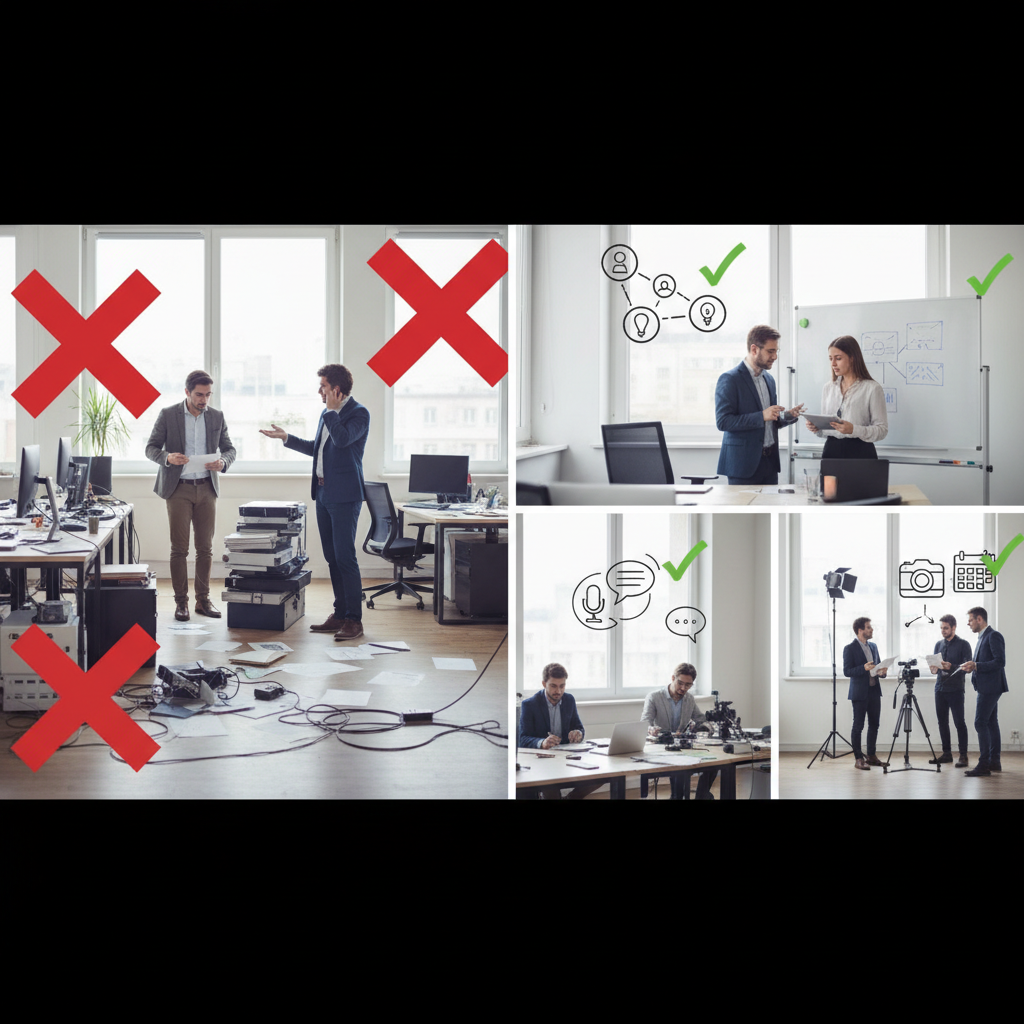
Why Traditional Agency Models Fail SF Tech
The standard agency ‘retainer’ model is often too slow for the velocity-based production needs of a Series B startup.
Here’s a contrarian insight: Most agencies want you to spend more time in pre-production because they bill by the hour. We believe the goal should be to spend less time in meetings and more time in execution. High-growth teams need a partner that functions as a fractional creative lead—someone who understands scalable content engines and can integrate with existing CRM & Marketing Automation systems to track ROI from the jump.
But wait—don’t mistake speed for sloppiness. A pre-production framework provides the safety net that allows for high-velocity output without the brand-damaging errors common in ‘cheap’ production alternatives. Whether it is event live streaming for a conference at Moscone Center or a product demo, the prep determines the performance.
Maximizing ROI Through Integrated Performance
Production shouldn’t exist in a vacuum; it should be fueled by data from your paid advertising and SEO efforts.
When we work with SF startup marketing directors, we look at search intent data before a single frame is shot. According to HubSpot’s Marketing Trends, video is the #1 format for lead generation. By aligning your pre-production framework with your Google Ads management strategy, you ensure that the video content produced is actually what your customers are searching for. This is the difference between a ‘pretty video’ and a ‘performance asset.’
- Data-Driven Storyboarding: Using search volume to dictate script topics.
- Multi-Channel Versatility: Designing assets that work for social media marketing and email nurture sequences.
- Automation Integration: Using your marketing automation platform to deliver the right video to the right lead at the right time.
Applying the Framework This Week
You don’t need to overhaul your entire department to see results. Start by auditing your last production: how many hours were spent in meetings versus on set? If the ratio is higher than 2:1, your pre-production framework is broken.
The first step is to consolidate your creative and performance goals. Stop looking for a freelance videographer for a one-off video shoot and start looking for a growth partner. A structured approach to tech video strategy will not only save your budget but will also give your team the creative space to actually innovate.
Ready to scale your content without scaling your headcount? Contact iStudios Media today for a strategic audit of your production workflow and let’s build your scalable content infrastructure together.
Frequently Asked Questions
How much does corporate video production typically cost in the Bay Area?
Industry-reported ranges for Bay Area corporate video production typically fall between $2,500 and $15,000 per project. Premium brand films or high-end commercials can range from $8,000 to $50,000 per finished minute, depending on the complexity of the crew, talent, and post-production requirements.
How can a pre-production framework reduce revision cycles?
A framework reduces revisions by enforcing GTM alignment and stakeholder sign-off during the scripting phase, before expensive production begins. By using a ‘Zero-Waste’ creative brief, teams identify potential messaging conflicts early, often reducing post-production edits by 50% or more.
What is the difference between a freelance videographer and a production partner?
A freelance videographer typically executes a specific shot list for a one-off video shoot. A production partner like iStudios Media provides a full-stack pre-production framework, integrating video with SEO, paid media, and CRM automation to ensure the content delivers a measurable ROI and aligns with long-term growth.
Why is ‘Default to Async’ important for SF tech teams?
High-growth SF tech teams often face meeting fatigue. A ‘Default to Async’ pre-production model uses collaborative tools for script reviews and storyboarding, allowing stakeholders to provide feedback on their own time. This typically cuts meeting requirements by 40%, speeding up the overall production timeline.