
Commercial video production usually stalls in post-production for three reasons: social cut-downs were never scoped, senior stakeholders give feedback only on the “final” cut, and nobody owns the final decision. Fix it by agreeing a delivery matrix before the shoot, naming one final decider, and editing every aspect ratio in parallel.
In San Francisco tech and biotech, speed is a competitive advantage. A project that takes three months to edit is often obsolete by the time it hits LinkedIn. Whether you are a Series B founder needing an investor deck video or a CMO managing a mid-market brand film, understanding why the gears grind to a halt at the finish line is the first step toward fixing your ROI.
The Versioning Hell: How 9:16 Assets Kill Your 16:9 Deadline
The biggest lie in modern production is that social media cut-downs are ‘just a quick export’ after the main commercial is finished. In reality, a single 30-second commercial now requires 20+ variations: different aspect ratios for TikTok, Instagram Stories, and LinkedIn, plus various lengths and CTA overlays.
On a single-shoot engagement, the scope often focuses on the ‘hero’ film. But when you realize you need a 9:16 version for Meta Ads, the editor has to re-frame every single shot. This isn’t just a technical task; it’s a creative one that requires new color grading and graphics placement. To avoid this, you must plan for ‘Parallel Post-Production.’ Instead of waiting for the hero edit to be perfect, start the social versioning as soon as the rough cut is approved.
Try this: Define your delivery matrix—the exact list of sizes, lengths, and file types—before the shoot begins. This prevents the ‘just one more version’ request that adds three days to your timeline every time it happens.
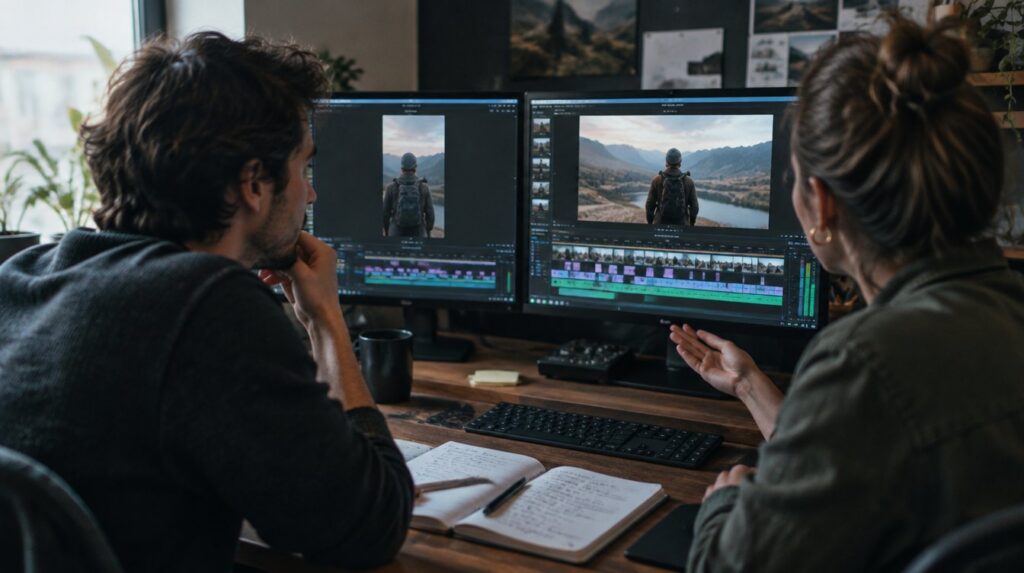
The CMO Bottleneck: Why the Final 5% Takes 50% of the Time
Decision paralysis usually strikes when the finish line is in sight because that is when the highest-level stakeholders finally weigh in. Projects often stall because a VP or Founder sees the ‘final’ cut and decides the brand voice isn’t quite right, leading to expensive re-edits.
The ‘Hidden Tax’ of late-stage feedback is real. Feedback cycles that involve more than three people without a designated ‘Final Decider’ reliably add time to delivery. To keep your commercial production timeline on track, establish a clear hierarchy. One person owns the creative vision; everyone else provides ‘input’ that the owner filters.
If you’re managing multiple vendors for video production and SEO, ensure your production partner understands the final destination of the content. A video that looks great but isn’t optimized for your paid advertising strategy is a wasted asset.
AI-Assisted Editing: A Speed Boost or a Speed Bump?
Contrary to the hype, AI-powered marketing tools can actually slow down a commercial video production if not managed by experts. While AI can help with transcription and basic rough cuts, the ‘learning curve’ of integrating these tools mid-project often causes more friction than it solves.
AI is currently best at the boring work: noise reduction, color matching, and file organization. If an agency is trying to use AI to “generate” your brand story, expect delays while you fix the uncanny-valley mistakes it makes.
Need a partner who actually hits deadlines? Schedule a free consultation to discuss your next project.
The Post-Mortem: Identifying Your Production Stalls
If your project is currently stuck, use this framework to identify the root cause. Most video production bottlenecks fall into one of three categories:
| Type of Stall | The Symptom | The Fix |
|---|---|---|
| Technical | “The files are too big/wrong format for our CRM.” | Pre-define a technical delivery spec sheet. |
| Emotional | “I’ll know it when I see it” feedback. | Use visual references (moodboards) early. |
| Structural | Waiting 4 days for a 1-hour edit change. | Move to a dedicated production partner, not a freelancer. |
Fast Turn Video Editing in SF: The 48-Hour Pre-Flight Checklist
To ensure your assets are delivered in days rather than months, you need a ‘Pre-Flight’ mindset. This is how fast turn video editing in SF gets done on tight launch schedules.
- Day -2: Finalize all legal and compliance approvals for on-screen talent and locations.
- Day -1: Lock the music track. Changing music in the final edit is the fastest way to break your budget.
- Shoot Day: Ensure the DIT (Digital Imaging Technician) is backing up and proxying footage in real-time.
- Wrap + 24 Hours: First rough cut delivered for structural feedback only.
By moving from a linear workflow (Shoot -> Edit -> Review -> Version) to a parallel one, you can have your LinkedIn, Instagram, and YouTube assets ready almost simultaneously. This is especially critical for event live streaming where the ‘hype’ window closes within 48 hours of the event ending.
Why Integrated Production Beats Vendor Fragmentation
Marketing Directors often suffer from ‘vendor fragmentation.’ They have one person for the shoot, another for SEO, and a third for their marketing automation platform. When these systems don’t talk, the video sits on a hard drive because no one knows how to embed it properly or track the ROI.
iStudios Media is built to solve this. We don’t just film; we integrate. We ensure your video assets are formatted for your CRM nurture sequences and optimized for your Google Ads campaigns before we even hit ‘record.’ That integration is what keeps commercial video production moving at startup speed. Every project is quoted to its scope; call (669) 287-2700 to talk through yours.
Avoid the ‘freelancer lag.’ When a solo creator gets sick or takes another gig, your project stops. A structured agency provides the redundancy needed to ensure that ‘Finish Line’ actually exists.
Key Takeaways for a Faster Delivery
- Stop the ‘Final Polish’ Creep: Set a limit of two rounds of revisions. Extra rounds should require a budget change order to keep stakeholders focused.
- Parallel Versioning: Edit for 9:16 and 16:9 at the same time to avoid re-framing delays.
- Centralize Feedback: Use tools like Frame.io to keep comments timestamped and actionable, avoiding messy email chains.
Ready to scale your content without the headache? Contact iStudios Media today for a production strategy that actually delivers.
Related reading: Why Your Video Production Team Misses the Mark on ROI and Corporate Video Lighting Fix for San Jose Office Shoots.
Frequently Asked Questions
How long does a typical commercial video production take in the Bay Area?
A standard project usually spans 4 to 8 weeks from discovery to final delivery. However, high-velocity teams can shorten this considerably by using parallel post-production workflows and pre-approved creative templates. The complexity of VFX and stakeholder count are the primary variables.
Why is my videographer taking so long to deliver the final edit?
Most independent creators lack a dedicated post-production team. When they move to their next shoot, your edit becomes a ‘night and weekend’ project. To get faster turns, you need a partner with dedicated editors who aren’t splitting their time between the camera and the computer.
What is the typical cost for premium commercial production?
Cost depends on crew size, shoot days, locations, talent, motion graphics and how many platform versions you need. Rather than a fixed rate card, we build each quote around the project; call (669) 287-2700 to scope yours.
How can I reduce video production bottlenecks in my marketing department?
The most effective way is to appoint a single ‘Creative Lead’ with final approval authority. Additionally, defining your technical delivery specs (aspect ratios, file sizes, and CTA variations) before the shoot begins eliminates the ‘versioning hell’ that typically stalls projects at the finish line.