📋 Table of Contents
In the San Francisco Bay Area, where Google Ads CPCs for legal and medical keywords frequently exceed $100 per click, a technical SEO roadmap isn’t just a marketing task—it’s a critical financial hedge against skyrocketing customer acquisition costs. According to recent data from WordStream, professional services face some of the highest competition in digital auctions, making organic technical excellence mandatory for survival.
Most firms treat SEO as a creative exercise in blogging, but the real winners in Silicon Valley treat their websites like high-performance software. If your site takes four seconds to load on a 5G connection in Palo Alto, your high-intent lead has already bounced to a competitor. This guide moves beyond the “one-off video shoot” mentality to help you build a scalable, technical foundation.

1. Auditing the Technical SEO Framework for High-Compliance Industries
A technical SEO framework for professional services must prioritize security and data integrity above all else, especially for medical and legal practices.
- HIPAA and Privacy Compliance: Ensure your lead capture forms and tracking pixels don’t leak Protected Health Information (PHI).
- Site Architecture: Use a flat hierarchy where any practice area page is no more than three clicks from the homepage.
- SSL and Security: Beyond a basic certificate, implement HSTS (HTTP Strict Transport Security) to signal maximum reliability to Google’s crawlers.
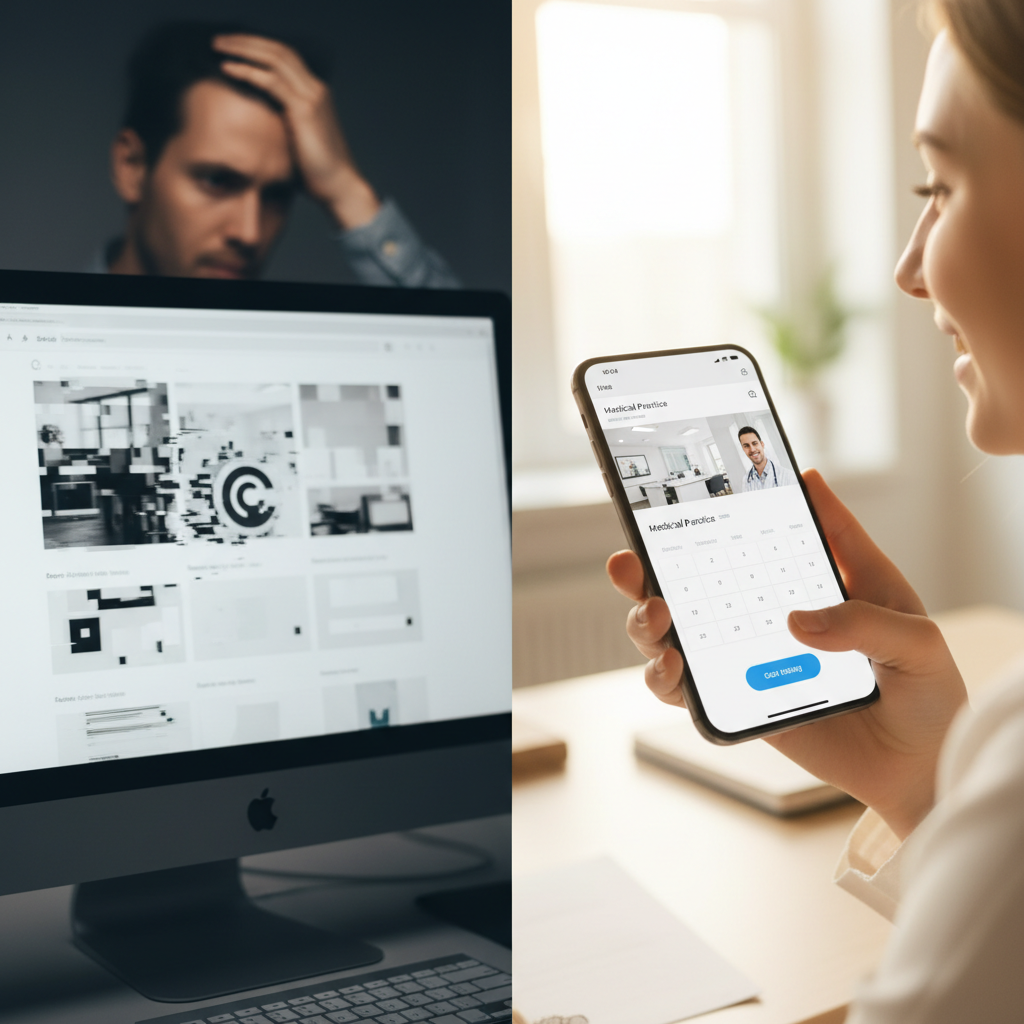
In our experience with mid-market clients, the biggest bottleneck isn’t usually content—it’s a “frankenstack” of plugins that slow down the server response time (TTFB). We often see medical practices using outdated scheduling widgets that tank their mobile performance scores. The real kicker? Google’s 2024 Core Updates have doubled down on “page experience,” meaning technical debt now directly suppresses your rankings.
2. Local SEO for Medical Practices: Beyond Google Business Profiles
Local SEO for medical practices requires a sophisticated “Entity-based” approach to prove to Google that your clinic is the most authoritative answer for a specific geography.
- LocalBusiness Schema: Use JSON-LD to define your specific medical specialty, operating hours, and geo-coordinates.
- Provider-Level Pages: Create individual technical profiles for every doctor or partner, linked via ‘Physician’ schema to the main clinic.
- Service-Area Optimization: For Bay Area firms serving multiple cities (e.g., San Jose, Oakland, Walnut Creek), build dedicated landing pages with unique technical metadata.
What most people miss is that local authority is now tied to “Local Entity Optimization.” This means your website needs to mention local landmarks and neighboring businesses in a way that helps Google’s Knowledge Graph verify your physical presence. If you’re struggling to manage this at scale, marketing automation can help synchronize your provider data across the web.
3. Advanced Schema Markup for Law Firms and Professional Services
Schema markup for law firms is the secret weapon for winning “Zero-Click” searches and appearing in AI-driven search generative experiences (SGE).
| Schema Type | Business Value | Technical Requirement |
|---|---|---|
| LegalService | Increases Trust & CTR | JSON-LD in Header |
| FAQPage | Dominates SERP Real Estate | Specific Q&A Properties |
| ReviewSnippet | Displays Star Ratings | AggregateRating Property |
Here’s the thing: most generic marketing agencies just install a plugin and hope for the best. A true technical SEO roadmap involves custom-coding nested schema that connects your attorneys (Person schema) to their specific legal cases (Article or Event schema). This level of detail is exactly what Google’s Search Liaison recommends for demonstrating Experience, Expertise, Authoritativeness, and Trustworthiness (E-E-A-T).
Need a partner to handle the heavy lifting? Schedule a free consultation with our technical team today.
4. Optimizing Core Web Vitals for the Commuter Audience
In a Bay Area digital marketing strategy, you must optimize for the “Caltrain User”—the professional browsing your site on a mobile device with fluctuating signal strength.
- Largest Contentful Paint (LCP): Ensure your hero image (often a high-end corporate video) is optimized or lazy-loaded to appear within 2.5 seconds.
- Cumulative Layout Shift (CLS): Fix jumping elements like late-loading fonts or ad banners that frustrate users.
- Interaction to Next Paint (INP): This new 2024 metric measures how quickly your site responds to a user’s click—crucial for lead forms.
A typical Bay Area mid-market client often thinks they need a “freelance videographer” to fix their site engagement. While high-quality video is vital, if that video isn’t served via a fast CDN (Content Delivery Network) like Cloudflare, it will actually hurt your SEO. At iStudios Media, we integrate video production with technical performance to ensure your brand films don’t compromise your speed.
5. SGE Optimization Strategy: Preparing for AI-Driven Search
The Search Generative Experience (SGE) is changing how professional services are discovered by summarizing web content directly on the results page.
To stay relevant, your technical SEO roadmap must include “LLM-readiness.” This involves structuring your site so Large Language Models can easily parse your data. We use Ingest.blog, our internal AI content engine, to help select clients produce high-velocity, technically structured content that AI engines love to cite.
- Direct Answer Syntax: Use H3 headings that mirror common client questions.
- Data Tables: AI models prefer structured data over long-form paragraphs.
- Internal Linking: Build a dense web of topical relevance to prove you are the definitive source on a subject.
6. Integrating CRM and Marketing Automation for ROI Visibility
Technical SEO shouldn’t end at the click; it should extend into your lead management system to ensure every organic visit is tracked.
Many firms fall into the trap of a “one-off video shoot” or a siloed SEO campaign. Instead, connect your SEO efforts to a marketing automation platform. This allows you to see exactly which technical optimizations led to a high-value consultation. By using UTM parameters and server-side tracking, you can attribute a $50k legal retainer back to the specific technical whitepaper the client first downloaded.
Key Takeaways for Your Monday Morning
- Run a PageSpeed Insights report and prioritize “Interaction to Next Paint” (INP).
- Audit your Schema Markup to ensure it includes ‘LocalBusiness’ and ‘ProfessionalService’ types.
- Check your mobile site for layout shifts that might be scaring away high-intent leads.
Ready to scale your organic presence without the guesswork? Contact iStudios Media for a comprehensive technical audit and growth plan tailored for the Bay Area market.
Frequently Asked Questions
How long does it take to see results from a technical SEO roadmap?
While content-based SEO can take 6-12 months, technical fixes often yield results much faster. Improving your site speed and fixing crawl errors can result in ranking improvements within 4-6 weeks as Google re-indexes your optimized pages. For competitive Bay Area markets, consistent technical maintenance is required to maintain these gains.
Why is schema markup so important for law firms?
Schema markup allows law firms to tell search engines exactly what they do, who their attorneys are, and what areas they serve. This structured data increases the likelihood of appearing in rich snippets, such as star ratings and FAQ boxes, which significantly improves click-through rates (CTR) in crowded legal search results.
Do I need a local SEO strategy if I have a national professional services firm?
Yes. Even national firms benefit from a “Local-First” technical approach. Search intent is increasingly localized; a user in San Francisco searching for “Series B legal counsel” will see different results than a user in New York. Optimizing for local entities helps you capture high-value regional traffic.
What is the difference between a freelance videographer and a full-stack agency for SEO?
A freelance videographer focuses on the aesthetic quality of a single project. A full-stack agency like iStudios Media ensures that your video content is technically optimized for search, hosted on fast servers, and integrated into a broader digital marketing strategy that drives measurable ROI and lead conversion.