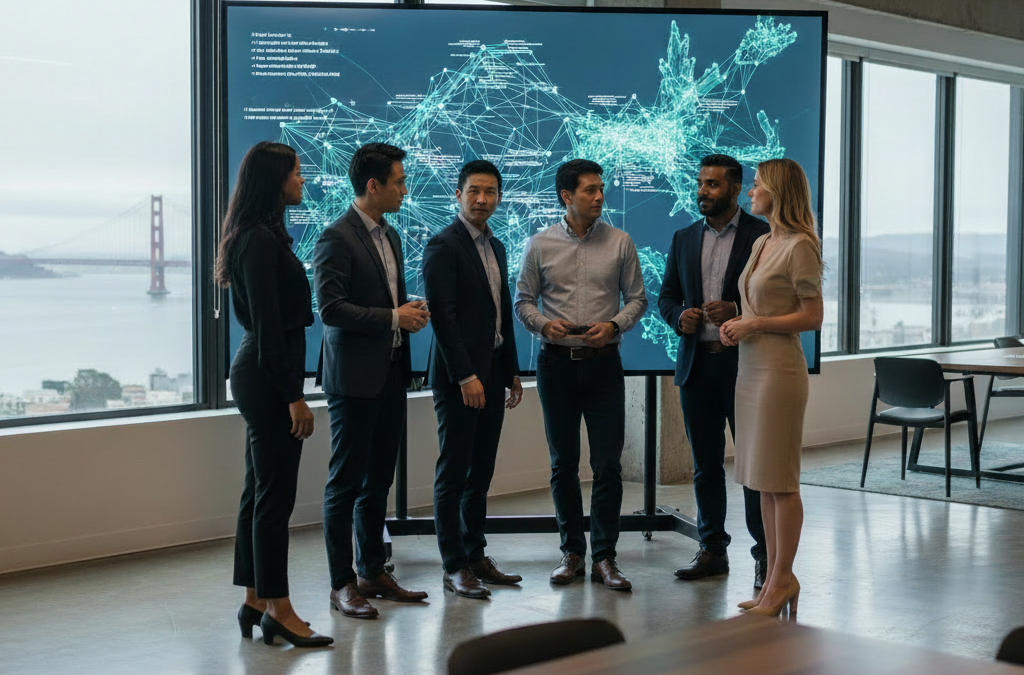
In 2026, B2B buyers start their journey by asking AI models for vendor recommendations and only return to traditional search results to validate those options with reviews and video demos. This shift means your brand must prioritize generative engine optimization to ensure your solutions are the ones cited in the initial AI-generated answer.
The Hybrid Journey: Discovery via AI, Validation via Search
The 2026 B2B funnel has split: AI engines handle the high-level research, while Google and LinkedIn serve as the final proof-of-life for your business. For a CMO at a mid-market Bay Area firm, this means the “first touch” is no longer a click on a blue link; it is a brand mention in a Perplexity summary or a SearchGPT response.
Buyers use AI because it filters the noise of low-quality SEO blogs. However, they still suffer from a trust gap. When an AI recommends three software platforms, the buyer immediately heads to Google or YouTube to find a brand film or a product demo. They want to see the people behind the tech. If your geo marketing strategy lands you the AI citation but your video presence is non-existent, you lose the lead at the finish line.

Why Citations Are the New Domain Authority
In the era of ai search optimization, the goal isn’t just to rank #1; it’s to be the primary data source for the Large Language Model (LLM). AI agents don’t just guess; they use Retrieval-Augmented Generation (RAG) to pull facts from the web. If your content is structured correctly, the AI will quote you directly.
To win these citations, your content needs to be high-authority and technically accessible. This involves:
- Structured Data: Using advanced schema so AI understands exactly what your product does.
- Expert Density: Moving away from generic fluff and toward data-backed white papers.
- Brand Citations: Getting mentioned on reputable industry sites that AI models use as “ground truth” sources.
Video-First SEO: Feeding the AI Agents
AI models in 2026 are increasingly multimodal, meaning they “watch” video content by processing transcripts and visual metadata to form their answers. A high-quality corporate video is no longer just for your homepage; it is a rich data source for ai search optimization.
When we produce a brand film for a Bay Area client, we aren’t just thinking about the human viewer. We optimize the video’s transcript and metadata so AI agents can parse the technical specifications and unique value propositions. This makes your video content a primary reference point for AI answers. A professional video production partner ensures these assets are both cinematically excellent and machine-readable.
| Feature | Traditional SEO | Generative Engine Optimization (GEO) |
|---|---|---|
| Primary Goal | Click-through rate (CTR) | Brand Citation & Inclusion |
| Content Type | Keyword-optimized blogs | RAG-friendly technical data & Video |
| Success Metric | Page 1 Rankings | Share of Model Voice (SoMV) |
How to Reallocate Your 2026 Marketing Budget
Stop spending 100% of your search budget on traditional keyword targeting and start allocating a portion to geo marketing and high-authority production. The “zero-click” journey is real; if the buyer gets their answer from the AI, they won’t visit your site until they are ready to buy. You need to influence the AI’s training data and real-time search results.
For example, a typical Bay Area SaaS company might shift 30% of their SEO budget into creating “authority assets”—deep-dive technical videos and original research papers—that are specifically designed to be cited by LLMs. This isn’t just about being found; it’s about being the trusted answer.
Try this Monday morning: Audit your top-performing blog posts. If you paste the content into ChatGPT and ask it to summarize your product’s unique benefits, does it get them right? If not, your content isn’t optimized for the AI era.
Partnering with an AI Marketing Agency
Navigating this shift requires a partner that understands both the creative side of production and the technical side of automation. We don’t just film videos; we build integrated systems that include CRM automation and cold outreach to capture the demand that AI discovery creates. As a full-stack ai marketing agency, we bridge the gap between being a name in a search list and being the recommended solution in an AI conversation.
Ready to secure your brand’s visibility in the age of AI? Schedule a free consultation with our team to review your GEO strategy.
Frequently Asked Questions
What is the difference between SEO and GEO?
Traditional SEO focuses on ranking websites in search engine results pages. Generative Engine Optimization (GEO) focuses on making your brand the cited source in AI-generated answers provided by tools like Perplexity, ChatGPT, and Google AI Overviews.
How do B2B buyers use AI in 2026?
Buyers use AI for the initial discovery phase to compare vendors and summarize solutions. They return to traditional search engines or social platforms like LinkedIn to validate those findings through video demos, case studies, and peer reviews.
Does video help with AI search visibility?
Yes. Modern AI engines process video transcripts and structured metadata. High-quality video assets provide rich, original data that AI models use to verify facts and recommend vendors to users.
Is traditional SEO dead?
No, but it has evolved. While informational queries are moving to AI, high-intent “validation” searches still happen on Google. A successful 2026 strategy requires a hybrid approach of both SEO and GEO.