📋 Table of Contents
A Series C fintech unicorn in San Francisco recently spent $82,000 on a single-day multi-camera broadcast that went dark for forty minutes. Despite paying for ‘triple redundancy,’ the entire system collapsed because the primary and backup encoders were plugged into the same unconditioned power circuit in a SOMA warehouse.
The real kicker? SF live streaming production has become a playground for legacy AV companies to hide 30% markups in ‘technical fees’ that offer zero protection against modern failure points. While CMOs are told they are buying ‘insurance,’ they are actually just subsidizing a warehouse full of obsolete hardware racks that haven’t been relevant since 2018.
The Post-Mortem: Anatomy of an $82k Multi-Camera Broadcast Strategy Failure
Most event producers bill for redundancy that is actually just a collection of extra points of failure. In the case of our fintech client, their previous production partner insisted on a hardware-heavy stack that cost more than a luxury SUV but lacked basic cloud-based failover protocols.
- The Hardware Hoax: They deployed three physical switchers when one software-defined instance would have been more stable.
- The Bandwidth Blunder: They relied on a single fiber drop without a bonded cellular backup (Starlink or 5G).
- The Labor Bloat: Six technicians were on-site to manage gear that a streamlined three-person crew from a full-service marketing agency could have handled with better tech.
Here’s the thing: more gear doesn’t equal more safety. In the modern SF live streaming production landscape, technical debt is the silent budget killer. When you see a line item for ‘Signal Distribution Management’ that costs $5,000, you’re likely paying for a technician to watch a monitor that hasn’t flickered in a decade.
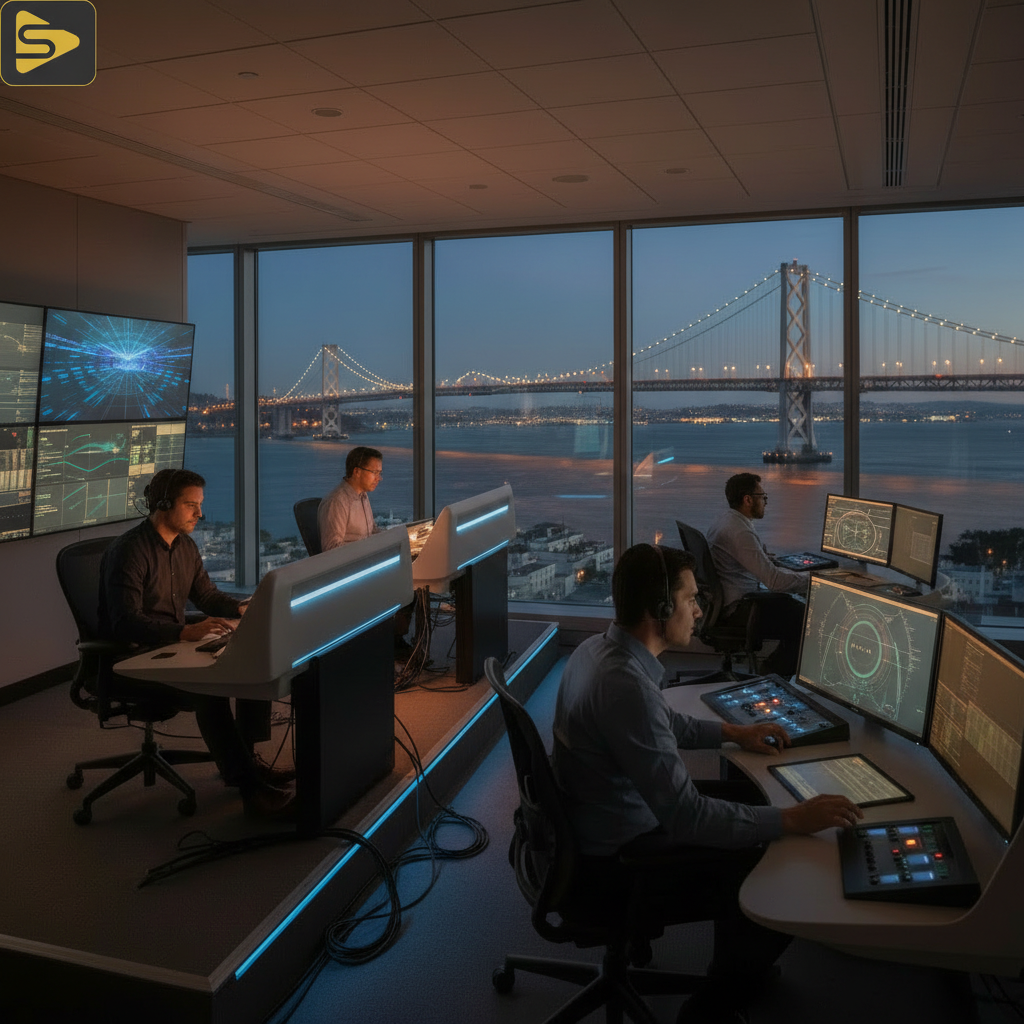
According to Forbes, the shift toward ‘Lean Production’ is now a requirement for B2B brands looking to maintain high engagement without the post-pandemic bloat. If your producer isn’t talking about SRT protocols or NDI workflows, they are anchoring your budget to the past.
Why Your Event AV Cost Breakdown is 30% ‘Ghost Fees’
Every SF event producer has a ‘standard’ rack they bring to venues like the Moscone Center or Pier 27, regardless of whether the event actually requires it. This ‘Safety Buffer’ is often just a way to maintain high day rates for depreciating assets.
- Redundant Encoders: Often just two identical boxes on the same network switch. If the switch fails, both fail.
- Manual Camera Operators: In many 10×10 stage setups, AI-automated camera tracking can replace two manual ops, saving $2,400 in labor.
- Proprietary Intercoms: Charging $1,500 for headsets when mobile-based digital comms are virtually free.
What most people miss is the ‘Insurance Paradox.’ By adding more physical hardware, you increase the heat load, the power draw, and the cable complexity. One of our clients, a medical practice group in Palo Alto, was quoted $15k for a 2-camera stream. We cut it to $9k by moving the switching to a cloud-based VM, which actually increased their uptime by removing the local venue’s power grid as a single point of failure.
The Technical Redundancy ROI Reality
| Feature | Legacy AV Cost | Modern iStudios Approach | Savings |
|---|---|---|---|
| Switching | $4,500 (Hardware) | $1,200 (Software-Defined) | $3,300 |
| Redundancy | $3,000 (Local Backup) | $800 (Cloud Failover) | $2,200 |
| Connectivity | $2,500 (Dedicated Fiber) | $1,100 (Bonded 5G/Starlink) | $1,400 |
Need a transparent audit of your next event? Schedule a free technical review with our engineers to spot the bloat before you sign the contract.
The Shift to Software-Defined SF Live Streaming Production
The most sophisticated CMOs in Silicon Valley are moving away from ‘Iron’ (hardware) and toward ‘Code’ (Cloud-based production). This isn’t just about saving money; it’s about Hybrid Event Scalability. When your production lives in the cloud, you can push to LinkedIn, YouTube, and a private CRM portal simultaneously without adding a single box on-site.

But wait—isn’t cloud production risky? Actually, it’s the opposite. Using protocols like SRT (Secure Reliable Transport), we can ensure that even if the venue’s Wi-Fi hiccups, the broadcast remains rock solid. This is the difference between an award-winning agency and a guy with a van full of cables.
- Distributed Teams: Your director can be in Hayward while your cameras are in San Francisco, reducing travel costs.
- Instant Clips: AI-powered tools can cut social media highlights in real-time, increasing your campaign’s ROI.
- Lower Latency: Modern protocols beat traditional satellite trucks for speed and clarity.
A surprising insight: The ‘Creator Economy’ has forced corporate AV to evolve. A $500 mobile-first setup often has better autofocus and low-light performance than the $20,000 broadcast cameras SF producers have been renting out since 2015. We don’t use iPhones for enterprise events, but we do use the same agile philosophy to keep costs down.
The Modern Producer’s Audit: 5 Questions for your SF Partner
Before you approve your next $50k+ quote, you need to grill your production lead on their actual failover protocols. If they give you vague answers about ‘backups,’ they don’t have a plan—they have a prayer.
- Question 1: Is the redundancy ‘Hot’ or ‘Cold’? (Hot means the backup is already running; cold means you wait 5 minutes for a reboot).
- Question 2: Are you using bonded internet or just the venue’s Ethernet?
- Question 3: What is the specific ‘Technical Redundancy ROI’ of the second switcher?
- Question 4: How are you handling remote speakers to ensure sub-second latency?
- Question 5: Can we move the recording to a decentralized cloud instance?
If you’re managing a Series A-C startup, you don’t have the luxury of wasting $20k on ‘just in case’ fees. You need a multi-camera broadcast strategy that prioritizes the viewer’s experience over the producer’s equipment rental margins. We’ve seen too many marketing directors burned by ‘Old Guard’ AV companies that treat every ballroom like a 1990s television studio.
Stop overpaying for legacy hardware. Explore our performance-driven production services and see how we integrate video with your broader growth strategy.
The Contrarian Truth: Why ‘Perfect’ is the Enemy of ROI
Here is an insight most agencies won’t tell you: A slightly ‘unpolished’ stream that feels authentic often outperforms a high-gloss broadcast in terms of audience trust. In the ‘Efficiency Era,’ your audience values low-latency interaction more than cinematic color grading. If you are spending $10k to make the SF live streaming production look like a Hollywood movie, but your Q&A has a 5-second delay, you’ve failed.
The real goal isn’t ‘Broadcast Quality’—it’s ‘Business Outcome Quality.’ Whether you are a medical practice owner looking for patient acquisition or a VP of Marketing at an enterprise firm, your video content should be a lead-generation tool, not a vanity project. By reallocating that $20k in ‘technical debt’ into SEO or paid media, you turn a one-day event into a year-long revenue driver.
Final Takeaway: The Lean Production Pivot
The era of the $100k ‘safety net’ is over. Modern SF live streaming production is about intelligence, not inventory. If your producer is more interested in showing you their gear list than your ROI dashboard, it’s time to move on. True technical redundancy isn’t found in a second box; it’s found in a smarter process. Don’t let your marketing budget become a donation to an AV company’s retirement fund.
Frequently Asked Questions
What is the average cost for SF live streaming production?
For a professional multi-camera setup in San Francisco, budgets typically range from $15,000 to $45,000 per day. However, by utilizing software-defined production and remote engineering, iStudios Media often reduces these costs by 25-30% while increasing stream stability and engagement metrics.
How do I know if I’m overpaying for my event AV cost breakdown?
Look for ‘General Session Labor’ and ‘Technical Fees’ that exceed 40% of the total quote. If your provider cannot explain the specific failover protocol for each piece of redundant gear, you are likely paying for ‘Ghost Fees’ designed to pad the agency’s margins.
What are the most common failure points in SF venues?
Most failures in places like SOMA or the Financial District stem from poor power conditioning and lack of outbound bandwidth. Relying solely on venue Wi-Fi is the biggest risk; always ensure your producer uses bonded cellular or satellite backups for critical broadcasts.
Can a full-service marketing agency handle high-end livestreaming?
Yes, and often more effectively than a standalone AV company. A full-stack partner like iStudios Media integrates the livestream into your CRM and SEO strategy, ensuring the content generates ROI long after the cameras are turned off, rather than just delivering a raw video file.