📋 Table of Contents
A $68K tech summit in SOMA collapsed last month not because the speakers were bad, but because a 3-second ‘latency lag’ turned a high-stakes keynote into a glorified tech support nightmare. When your remote VIP speaker is talking over the local moderator due to synchronous latency, your brand prestige evaporates faster than a seed round in a high-interest rate environment.
As we move into 2026, SF event video production is undergoing a radical correction. The era of ‘Zoom-in-a-ballroom’ is dead. Sophisticated marketing directors and CMOs are realizing that trying to bridge the gap between a physical audience and a remote one using consumer-grade software is a recipe for technical debt and attendee resentment. At iStudios Media, we’ve seen the ‘Hybrid Tax’ bankrupt mid-sized budgets while delivering a second-class experience to everyone involved.
The $68K Autopsy: How Hidden AV Fees Kill ROI
The real kicker about the $68K disaster wasn’t the upfront cost; it was the fact that 40% of that budget went to ‘legacy infrastructure surcharges’ at a historic San Francisco venue that couldn’t handle a 4K stream.
Most enterprise planners overlook the technical failover protocols required to maintain a broadcast-grade signal. When you hire a full-service marketing agency that understands the intersection of production and performance, you stop paying for ‘hope’ and start paying for redundancy. Here is a breakdown of where that $68K actually went—and why it failed:
| Line Item | Cost | The Failure Point |
|---|---|---|
| Venue Wi-Fi Buy-out | $12,000 | Shared bandwidth caused packet loss during peak usage. |
| Basic AV Labor | $22,000 | Generalists unfamiliar with low-latency encoding. |
| Hybrid Platform License | $8,500 | Software-based switching introduced 400ms of lag. |
| Equipment Rental | $25,500 | Non-broadcast cameras with poor low-light performance. |
What most people miss is that high-end production isn’t just about ‘better cameras.’ It’s about signal flow and engineering. A $5M manufacturing company in San Jose recently spent $15k on a ‘DIY’ hybrid setup for their annual kickoff, only to have the CEO’s audio drop for the first 20 minutes. They lost more in employee productivity than they saved in production costs.
Why Livestream Production Services Are Shifting to ‘Broadcast-First’
The most successful events in 2026 treat the remote audience as a television viewership, not a group of voyeurs peering through a webcam.
The industry is moving toward ‘Intentional Exclusivity.’ This means either going 100% digital with cinematic quality or 100% physical with high-end, asynchronous content capture for later distribution. Here is why the middle ground is a trap:
- The Psychology of the Second Class: Hybrid models often make remote viewers feel like an afterthought, diluting brand prestige.
- Production Overhead: Running two simultaneous shows (one for the room, one for the web) doubles your failure points.
- Latency-Induced Fatigue: Real-time interaction over Zoom is cognitively taxing when it isn’t frame-accurate.
- Technical Debt: Relying on venue Wi-Fi in Silicon Valley is a gamble that Forbes contributors have warned against for years.
Need to avoid a technical catastrophe at your next Q1 summit? Schedule a production audit with our team to ensure your hardware stack is 2026-ready.
The Hardware Stack Required for SF Event Video Production
If you aren’t using hardware encoders and dedicated bonded cellular backhaul, you aren’t actually providing livestream production services; you’re just hosting a very expensive video call.
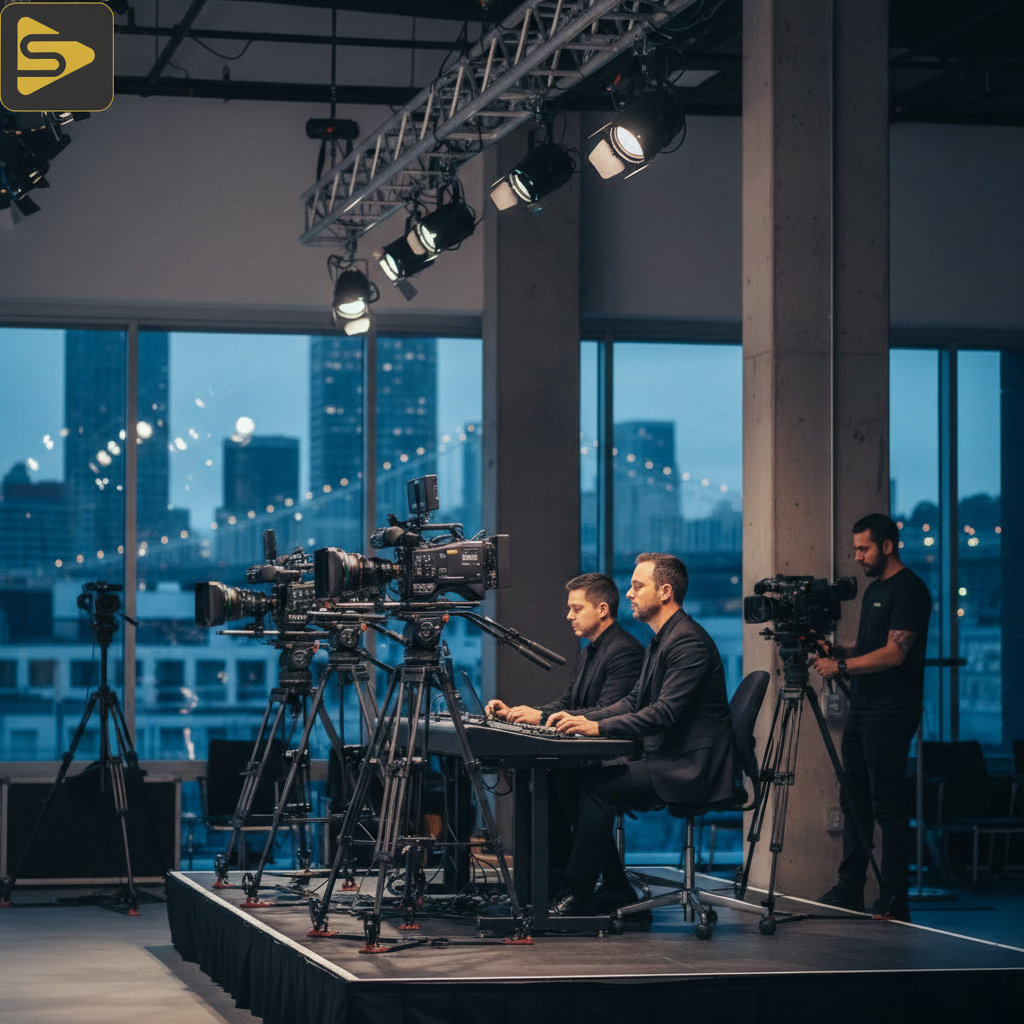
But wait—the hardware is only half the battle. The other half is the crew. In San Francisco, the difference between an ‘award-winning agency’ and a group of freelancers is the presence of a dedicated Technical Director (TD) and a redundant failover switch. We utilize Blackmagic Constellation switchers and Teradek encoders to ensure that even if the venue’s fiber line goes dark, the stream stays live via 5G bonding.
According to HubSpot, 47% of B2B buyers consume 3-5 pieces of content before engaging with sales. If your event video looks like it was shot on an iPhone from 2019, you aren’t just losing viewers; you’re losing mid-funnel leads.
From ‘Hybrid Fatigue’ to Asynchronous Excellence
The contrarian truth that most SF producers won’t tell you is that your livestream might not need to be live at all.
We are seeing a massive shift toward ‘Broadcast-Quality On-Demand.’ Instead of spending $30k on a live bridge for 100 remote viewers, savvy CMOs are reallocating that budget into multi-camera 4K capture and ‘fast-turn’ highlights. By capturing the energy of a ‘dark-room’ invite-only experience and turning it into a premium content series, you extend the ROI of the event from 4 hours to 4 months.
One of our clients, a Series B startup in Hayward, replaced their global livestream with three localized ‘micro-satellite’ events. They used our performance partner model to capture high-end keynotes in SF and then ‘simul-live’ the content to hubs in London and NYC. The result? A 40% increase in attendee engagement metrics and zero technical glitches.
Strategic Implementation: How to Pivot Your 2026 Budget
Transitioning away from failing hybrid models requires a shift in how you view your production partner. You need an automation partner and a creative lead in the same room.
- Audit Your Venue: Never trust a venue’s ‘High-Speed’ claim without a literal stress test.
- Prioritize Audio: People will forgive a blurry frame; they will quit a stream with buzzing audio in seconds.
- Invest in Bonding: Use Peplink or Teradek hardware to combine multiple internet sources.
- Repurpose Everything: Ensure your contract includes a post-production strategy to turn keynotes into SEO-driven video assets.
The goal isn’t just to ‘go live.’ The goal is to create a measurable pipeline. As an award-winning agency, iStudios Media focuses on the technical precision that allows your message to land without the ‘Zoom fatigue’ that has plagued the last three years of corporate events.
Ready to elevate your next San Francisco keynote? Contact iStudios Media today for a comprehensive broadcast strategy that guarantees zero-lag delivery.
FAQs About SF Event Video Production
Why is Zoom failing for enterprise hybrid events?
Zoom is a communication tool, not a broadcast platform. It lacks the bit-rate capacity and professional color-sampling required for large-scale displays. Furthermore, its ‘best-effort’ latency management often leads to desynchronization between audio and video when piped through professional AV switchers in large SF venues.
What is ‘Bonded Cellular’ and why do I need it?
Bonded cellular technology combines multiple 5G and LTE signals from different carriers into one stable ‘super-connection.’ In venues like those in Silicon Valley where legacy Wi-Fi is notoriously unreliable, this provides a critical failover protocol that ensures your livestream remains uninterrupted even if the primary ISP fails.
How do I calculate the ROI of high-end livestream production services?
ROI should be measured by ‘Cost Per Quality Minute’ watched and lead conversion post-event. By using broadcast-grade production, you increase average watch time by up to 300% compared to standard webcasts. This translates to higher brand recall and more significant movement through your CRM automation funnels.
Is asynchronous content better than a live hybrid event?
For many SF brands, yes. Asynchronous content allows for ‘TV-grade’ editing, color correction, and perfect audio. Unless your event requires real-time remote participation for Q&A, a ‘Live-to-Tape’ approach often yields higher engagement and better long-term SEO value for your marketing site.
What should I look for in a San Francisco production partner?
Look for a partner that owns their gear and has a background in both cinematography and network engineering. Avoid ‘vendors’ who just rent equipment; look for ‘growth partners’ who understand how your event video integrates into your broader Google Ads and SEO strategy to drive actual business outcomes.