📋 Table of Contents
According to Wyzowl’s 2024 State of Video Marketing report, 85% of marketers say video is an effective way to get attention online, yet the #1 barrier remains a lack of time and budget. For most Bay Area marketing directors, the struggle isn’t wanting more video—it’s the fear that implementing a scaling video production framework will require a massive headcount expansion or a bloated agency retainer.
Here’s the reality: you don’t need a bigger team; you need a better architecture. Most companies treat video as a series of one-off projects, hiring a freelance videographer for a single event or a one-off video shoot for a product launch. This “project-based” thinking is the fastest way to burn through your Series B funding with very little to show for it in terms of long-term organic growth.
To move from sporadic uploads to a sustainable content engine, you must transition from creative production to enterprise content operations (VidOps). This framework allows a single marketing manager to oversee the creation of 50+ assets from a single day of filming. In this guide, we’ll break down the 4-Quadrant Framework that we use at iStudios Media to help scaling businesses dominate their category without the overhead.
The Shift from Production to Architecture
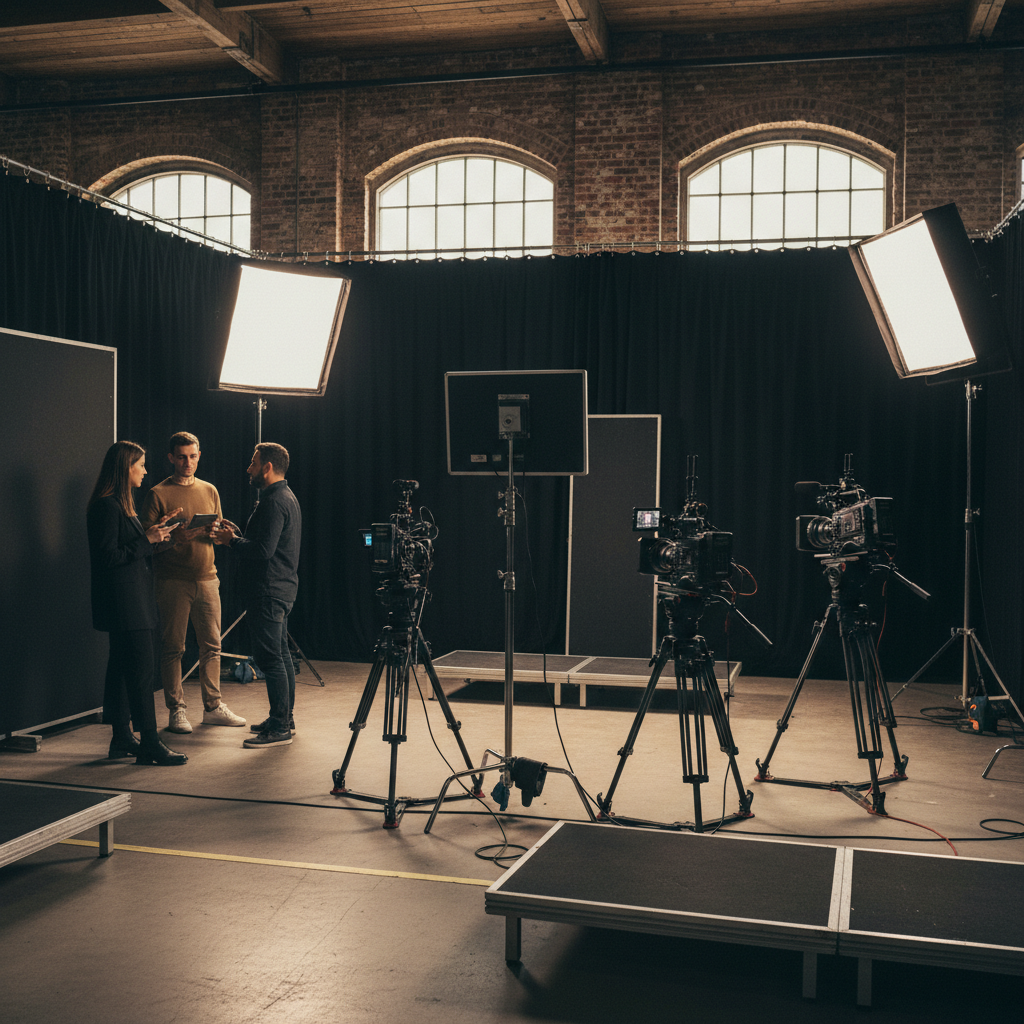
The most successful CMOs don’t view video as a creative deliverable; they view it as a data-driven asset class that can be subdivided and reinvested across multiple channels.
In our experience with mid-market clients, the bottleneck is rarely the filming itself—it’s the post-production and distribution logic. When you approach video with a scaling video production framework, you stop asking “What video are we making?” and start asking “What library of assets are we building?”
- Modular Filming: Capturing content in segments that can be rearranged for different platforms.
- Asset Tagging: Organizing raw footage so it can be accessed by AI tools for rapid repurposing.
- Distribution Logic: Mapping every 60 seconds of high-production footage to 10 pieces of micro-content.
What most people miss is that high-production value doesn’t always equal high engagement. Sometimes, a raw, authentic clip from a full-service podcast session outperforms a $20,000 brand film because it feels more native to the platform. The goal is to balance both.
Quadrant 1: High-Value Keystone Content
Keystone content is the foundational pillar of your brand, designed for high-intent conversion and long-term trust building.
Think of this as your “Hero” content—brand films, high-end corporate videos, or investor-facing product demos. These typically cost between $8,000 and $50,000 per finished minute because they require professional lighting, sound design, and strategic scripting. However, in a scaling video production framework, this high-cost investment is justified because it serves as the source material for everything else.
For a typical Bay Area Series C SaaS company, a single “Day in the Life” brand film can be deconstructed into:
- A 2-minute website hero video.
- Three 30-second LinkedIn Ads focusing on specific pain points.
- Five 15-second Instagram Stories showcasing company culture.
Need help planning your next shoot? Schedule a free consultation with our production team to see how we can maximize your budget.
Quadrant 2: High-Volume Educational Assets
Educational content drives your SEO and organic search strategy by answering the specific questions your prospects are asking during the discovery phase.
This is where content repurposing automation shines. Instead of filming 20 separate tutorials, you film one 60-minute “Masterclass” or webinar. By using our internal AI content engine, Ingest.blog, and other VidOps tools, you can automatically transcribe, summarize, and slice that long-form session into a month’s worth of blog posts and social clips.
| Workflow Step | Traditional Method | 4-Quadrant Framework |
|---|---|---|
| Planning | Scripting 10 separate videos | One thematic long-form session |
| Filming | 3-4 separate shoot days | 1-day modular studio session |
| Editing | Manual cutting per platform | AI-augmented batch processing |
| ROI | Single use per video | Multi-channel asset distribution |
Quadrant 3: Agile Social & Community Content
Agile content is designed for speed and relevance, often leveraging trending topics or timely industry shifts to keep your brand top-of-mind.
The real kicker? You don’t need a full crew for this. In a robust scaling video production framework, you empower your subject matter experts (SMEs) to record raw insights using high-quality mobile setups or remote recording platforms. This “Lean Video” movement for B2B SaaS focuses on the 80/20 rule: 20% of the production effort drives 80% of the social engagement.
But wait—don’t let “raw” mean “low quality.” We often provide our clients with “Creator Kits” (lighting and audio) and then handle the professional post-production. This ensures that even a 30-second LinkedIn insight maintains the brand’s visual integrity without requiring a one-off video shoot every time someone has an idea.
Quadrant 4: Automated Performance Creative
Performance creative is specifically designed to feed your paid media engines, such as Google Ads and Meta campaigns.
In this quadrant, the focus is on scalable video infrastructure. You aren’t just making a commercial; you are making a “creative matrix.” This involves filming multiple “hooks,” multiple “body segments,” and multiple “calls to action.” You then use automated tools to mix and match these segments to find the highest-converting combination.
What most people miss is that AI-powered marketing automation can now handle the localization and captioning of these ads for global reach. This allows a small team to manage dozens of ad variations across different regions without increasing headcount.
The Tech Stack of the 1-Person Video Department
To execute this framework effectively, your team needs a stack that prioritizes VidOps efficiency over manual labor.
- Descript: For text-based video editing—turning a 10-minute interview into a 1-minute highlight just by deleting text.
- Munch or OpusClip: For content repurposing automation that identifies viral-ready moments in long-form video.
- Wistia/Vimeo: For professional hosting and detailed analytics that integrate directly with your marketing automation platform.
- Apollo: For integrating video into B2B cold outreach systems.
By centralizing your assets in a scaling video production framework, you ensure that every piece of content is searchable and reusable. This is especially critical for medical practice owners or corporate comms teams who must maintain strict compliance and brand consistency across all channels.
Ready to build your content engine? Contact iStudios Media today for a strategic consultation on how to scale your production without the overhead.
Summary: Moving Toward Video Maturity
The transition from “making videos” to “operating a video engine” is what separates category leaders from everyone else in the Bay Area. By adopting a scaling video production framework, you stop being a victim of your production schedule and start becoming the architect of your brand’s digital presence.
The most important step you can take this week is to audit your last three video projects. Did they exist in a vacuum, or were they deconstructed into 10+ assets? If the answer is the former, it’s time to rethink your enterprise content operations. Start by filming one modular session next month—a deep dive with your CEO or a product demo—and commit to squeezing every ounce of value out of that single day of production.
Frequently Asked Questions
How do I start a scaling video production framework with a small budget?
Focus on Quadrant 2 (Educational Content). Use a single day to film a series of “Frequently Asked Questions” with your subject matter experts. Use affordable AI tools for editing and focus on distribution over high-end cinematic flair. As ROI increases, reinvest into Quadrant 1 for brand-building assets.
What is the difference between a freelance videographer and a VidOps partner?
A freelance videographer usually focuses on the technical act of filming a single project. A VidOps partner, like iStudios Media, builds a scaling video production framework that includes strategy, modular filming, automated repurposing, and integration with your CRM and paid media systems to ensure measurable ROI.
How does modular filming work in practice?
Modular filming involves scripting content in independent “blocks” rather than a linear narrative. For example, you might film five different introductions and three different conclusions for a single product demo. This allows you to swap segments to create tailored versions for different audiences or platforms without re-filming.
Can AI replace my video production team?
AI is a powerful multiplier, not a replacement. In our scaling video production framework, AI handles the repetitive tasks—like generating captions, resizing for social, and basic rough cuts—allowing your human talent to focus on high-level strategy, creative direction, and authentic storytelling that AI cannot replicate.