📋 Table of Contents
According to a 2024 report by HubSpot, 87% of video marketers say video has directly increased sales, yet the high-stakes environment of a live stage remains the ultimate test of brand authority. For San Francisco event producers, the choice between multi-camera livestreaming and high-polish recorded keynotes isn’t just a technical decision—it is a strategic pivot between real-time community building and long-term brand storytelling.
The Strategic Divide: Real-Time Multi-Camera Livestreaming vs. Post-Produced Perfection
The real kicker is that while livestreaming offers the raw energy of an ‘unfiltered’ moment, recorded keynotes provide the safety net required for high-stakes IPO-readiness or product launches. In our experience with Series B SaaS founders, the ‘Apple Event’ effect has led many to favor the control of pre-recorded content, even when the audience believes they are watching a live broadcast.
- Multi-camera livestreaming: Best for interactive Q&A, breaking news, and community-driven summits where ‘The Glitch’ factor actually humanizes your brand.
- Recorded Keynotes: Ideal for high-gloss product demos, investor-facing content, and evergreen educational tracks.
- Simulive: The middle ground where pre-recorded content is streamed as if it were live to maximize engagement without the technical risk.
Technical Requirements and Latency-Free Streaming
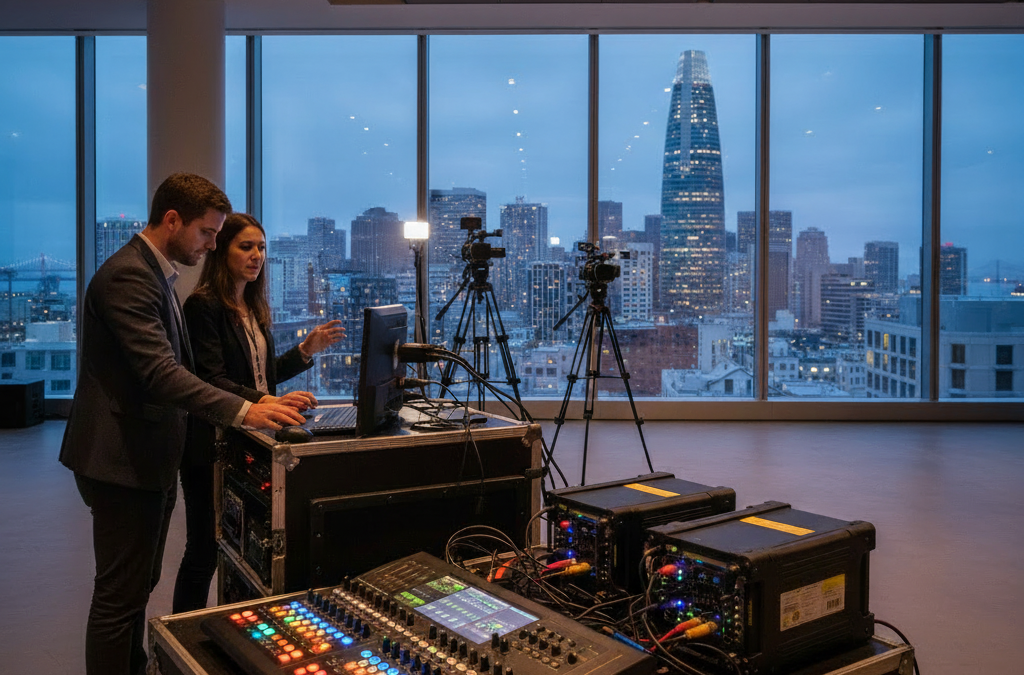
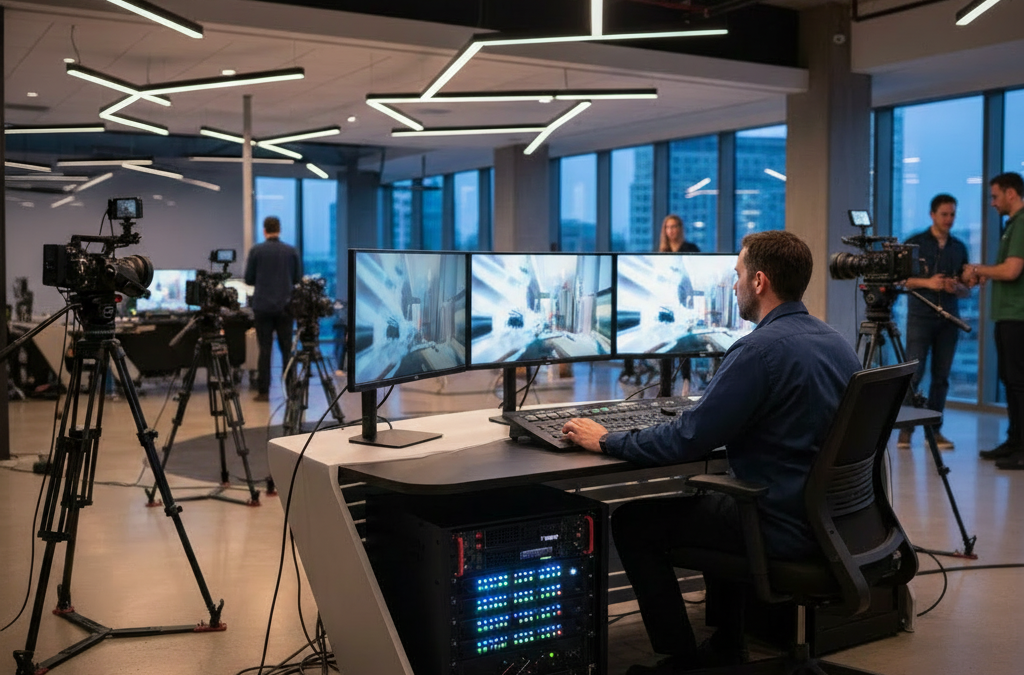
Most people miss the fact that broadcast quality isn’t just about the resolution; it’s about the switching. SF event production demands a level of redundancy that one-off video shoots simply cannot provide. For a typical Bay Area mid-market client, we recommend a minimum of a three-camera setup to ensure visual variety and to hide the inevitable ‘human’ moments of a live presenter.
But wait—latency is the silent killer of interactivity. If your remote audience is 30 seconds behind your live Q&A, the engagement falls off a cliff. High-end event live streaming solutions utilize dedicated bonded cellular or fiber lines to keep latency under 5 seconds, ensuring your hybrid event strategy actually works in practice.
Cost-Benefit Analysis: Production Value ROI in the SF Market
Industry-reported ranges for conference video coverage in the Bay Area vary wildly, but quality usually scales with the size of the crew and the complexity of the signal path. While a freelance videographer might charge a day rate, a professional production partner brings the engineering redundancy required for enterprise-grade reliability.
| Feature | Multi-Camera Livestreaming | Recorded Keynotes |
|---|---|---|
| Typical Cost Range | $1,500–$8,000 per day | $2,500–$15,000 per project |
| Engagement Style | Active / Real-time | Passive / High-retention |
| Risk Level | High (Technical/Human) | Low (Controlled) |
| Post-Event Utility | Moderate (Needs editing) | High (Ready for social) |
The real value of multi-camera livestreaming is the immediate feedback loop. According to Forbes, live video grows at a rate of 113% year-over-year, largely because it forces the audience to pay attention now. If you are debating the investment, consider the lifecycle of your content. If you need 50 micro-clips for LinkedIn over the next quarter, recorded keynotes offer a cleaner starting point.
Need help choosing the right setup for your next San Francisco summit? Schedule a free consultation with our production leads to map out your technical rider and ROI goals.
The ‘San Francisco Aesthetic’: Minimalist Tech vs. High-Production Gloss
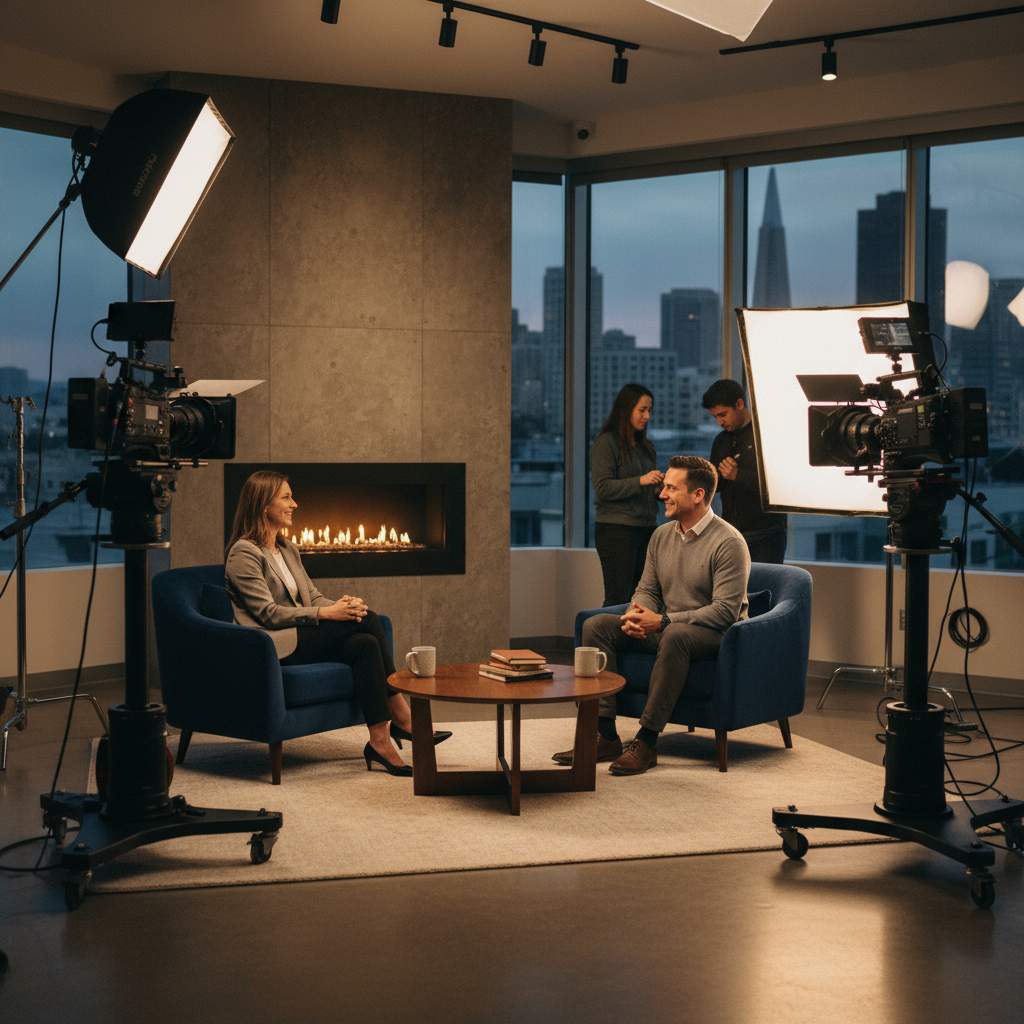
What most people miss is that the ‘Silicon Valley look’ has shifted from over-produced sets to minimalist, high-tech environments that prioritize clarity over flash. In our work with Series C startups, we’ve found that a well-executed corporate livestreaming session with clean lighting and crisp audio often outperforms a flashy, over-edited commercial.
Repurposing Content for Social Media Marketing
The real kicker? Your event shouldn’t end when the stream stops. We use Ingest.blog, our internal AI content engine, to help select clients transform long-form event transcripts into SEO-optimized blog posts and social threads in record time. This increases the velocity of your content distribution without scaling your headcount.
- Raw Capture: Record every ISO (independent camera feed) during the livestream.
- AI Slicing: Use automated tools to identify high-engagement segments.
- Distribution: Re-package those segments into 9:16 vertical video for LinkedIn and Instagram.
Engagement Metrics: How Live Interactivity Affects Lead Conversion
Interactive realism is the new gold standard for B2B marketing. When we manage paid advertising for event-driven campaigns, we see significantly higher conversion rates when the landing page features a live countdown or a ‘Join the Conversation’ CTA rather than a ‘Watch the Replay’ button.
Here’s the thing: people want to be part of a moment. Multi-camera switching allows you to capture the speaker’s expressions, the audience’s reactions, and the product’s details in a way that feels cinematic and urgent. This ‘FOMO’ economy drives real-time sign-ups that static videos simply can’t match.
Choosing Based on Funding Stage: From Seed to IPO
Your production choices should reflect your company’s maturity. A Series A startup needs the ‘raw’ energy of a live, multi-cam stream to show they are building in public. Conversely, a pre-IPO company often requires the polished precision of recorded keynotes to ensure every word is compliant and every frame is on-brand.
- Series A-B: Focus on multi-camera livestreaming to build community and show authentic progress.
- Series C-IPO: Pivot to high-production recorded keynotes or ‘Simulive’ to manage brand risk.
- Enterprise: Utilize a hybrid approach with live executive Q&A and pre-recorded, high-gloss product reveals.
Ready to elevate your event production? Call iStudios Media at (510) 838-0401 for a technical walkthrough of our San Leandro studio and on-site capabilities.
Sustainability and Technical Redundancy in SF Event Production
Beyond the visuals, the logistical footprint of your production matters. Remote production (REMI) setups for multi-camera livestreaming allow for a smaller on-site crew, reducing the carbon footprint of your event while maintaining broadcast quality. This is increasingly important for SF-based tech companies focusing on ESG (Environmental, Social, and Governance) goals.
What most people miss is that technical redundancy is the most expensive—and most critical—part of the budget. We don’t just bring one encoder; we bring three. We don’t just rely on the venue’s Wi-Fi; we bring dedicated hardware. When you move beyond a cheap explainer video or a freelance videographer, you are paying for the peace of mind that the screen won’t go black when the CEO walks on stage.
FAQs
What is the difference between multi-camera livestreaming and a simple one-camera feed?
A single-camera feed is static and often leads to viewer fatigue within minutes. Multi-camera livestreaming uses a vision mixer to switch between wide shots, close-ups, and slide inserts, maintaining a cinematic rhythm that mimics professional television. This keeps the audience engaged longer and allows for better storytelling during complex technical presentations.
Is ‘Simulive’ better than a 100% live broadcast for tech summits?
Simulive offers the best of both worlds: the engagement of a ‘live’ event with the polish of a pre-recorded video. It eliminates the risk of technical glitches or presenter errors on stage. For high-stakes SF tech summits, we often recommend recording the keynote in advance and then hosting a live, multi-camera Q&A immediately following the playback.
How much should I budget for professional conference video coverage in the Bay Area?
While industry-reported ranges for basic coverage start around $1,500 per day, a full-scale multi-camera production for a major summit typically ranges from $5,000 to $15,000 per day. This includes the crew (director, camera ops, audio engineer), equipment (4K cameras, switchers, encoders), and the necessary redundancy for a stable broadcast.
Can livestreamed footage be used for SEO and content marketing later?
Absolutely. The most efficient way to handle this is to capture high-quality ISO recordings of each camera during the stream. These can be edited into polished highlight reels, customer testimonials, or educational snippets. When paired with a CRM and marketing automation platform, these assets become powerful lead-nurturing tools for months after the event ends.
Don’t leave your event’s digital legacy to chance. Contact iStudios Media today to discuss how we can integrate multi-camera livestreaming into your growth strategy.