📋 Table of Contents
According to a 2024 survey by Wyzowl, 88% of marketers say video is a vital part of their strategy, yet most C-suite executives still approach the lens with the same rigid discomfort as a 1990s local news interview. Effective executive video coaching isn’t about teaching someone to act; it’s about removing the technical and psychological friction that prevents their natural authority from translating to a 16:9 frame.
Key Takeaways for Marketing Directors
- Cognitive Presence: Shift the focus from looking professional to projecting strategic energy.
- Technical Synchronicity: Align wardrobe contrast and teleprompter pacing with the executive’s natural cadence.
- Neuro-Aesthetics: Use lighting and framing to trigger psychological trust in stakeholders.
- The Vulnerability Paradox: Balancing high-polish production with authentic, unfiltered delivery.
1. Visual Authority: The Science of Neuro-Aesthetics
Your executive’s physical appearance on camera should be a deliberate extension of their brand’s strategic positioning, not an afterthought. Here’s the thing: the human brain decides whether to trust a speaker within milliseconds of the video starting, long before they finish their first sentence.
In our experience with Series B SaaS founders, we often see leaders default to “safe” blues and greys that wash out under high-intensity studio lights. To establish visual authority, you must manage the contrast ratio between the subject and the background. High-contrast environments—think a dark charcoal suit against a softly lit, warm wood background—create depth and signal importance to the viewer’s subconscious.
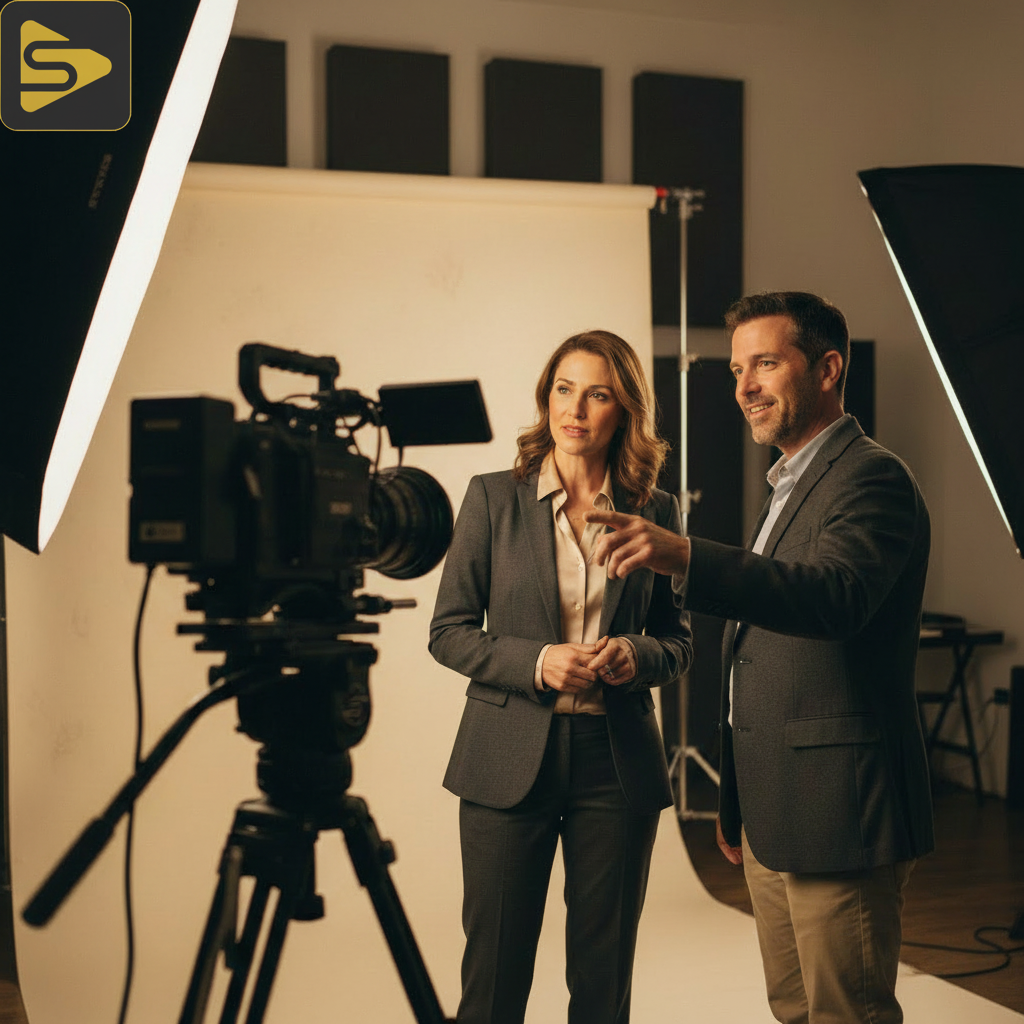
What most people miss is the “Digital First” impression. Your CEO’s presence in a brand film or LinkedIn Live stream is the new boardroom. To bridge the “Hybrid Charisma” gap, ensure the camera is positioned slightly above eye level. This prevents the “looking down at the audience” effect common in laptop-webcam setups and maintains a sense of equal-footing partnership.
- Wardrobe Tip: Avoid fine patterns (moiré effect) and stick to solid jewel tones or deep neutrals.
- Framing: Use the rule of thirds, but keep the executive centered for direct-to-camera addresses to maximize Virtual Command.
- Lighting: Three-point lighting is standard, but a soft “Rembrandt” key light adds a sophisticated, cinematic edge that a one-off video shoot usually lacks.
2. Vocal Command and Teleprompter Pacing
A script is a liability if the executive is merely reading words rather than delivering insights. The real kicker? Most leaders read 20% faster when they are nervous, leading to a “robotic” delivery that kills leadership presence on camera.
Effective executive video coaching involves setting the teleprompter to 110-130 words per minute, but allowing for “planned pauses.” Encourage your leader to treat the teleprompter as a guide, not a master. In our work with Bay Area mid-market clients, we’ve found that the best takes happen when the executive breaks the fourth wall to emphasize a point with a hand gesture or a momentary break in eye contact.
Transitioning from “Bedroom Backgrounds” to professional studio environments requires a shift in vocal projection. If you are recording in our San Leandro studio, the acoustics allow for a conversational, intimate tone that builds 1:1 trust with the viewer. This is far more effective than the “shouting at the balcony” style often seen at large conferences.
- Warm-up: Use vocal resonance exercises to lower pitch, which signals authority.
- Pacing: Practice the “breath at the comma” technique to ensure natural phrasing.
- Emphasis: Bold the 2-3 “power words” in each paragraph of the script.
Need help refining your executive’s delivery? Schedule a free consultation with our production team to discuss on-site coaching packages.
3. The Active Listening Interview Technique
For high-stakes corporate interview preparation, the biggest mistake is focusing solely on the answers. The most compelling executive videos are often those where the leader is in dialogue, even if the interviewer is edited out. This is where Digital Gravitas is truly forged.
We teach the “Active Listening” technique: the executive should physically react to the question before answering. A slight nod or a thoughtful “That’s a critical point” creates a psychological bridge of empathy with the audience. This combats the “Zoom Fatigue” that many stakeholders feel when watching dry corporate updates.
| Feature | Freelance Videographer Approach | iStudios Strategic Framework |
|---|---|---|
| Focus | Technical settings (ISO/Shutter) | Psychological Safety & Strategic Energy |
| Guidance | “Just be yourself” | Structured 4-Pillar Coaching |
| Outcome | A pretty video | Measurable ROI & Executive Branding |
Contrary to popular belief, you shouldn’t aim for a perfect, flawless take. The “Vulnerability Paradox” suggests that a minor slip-up or a moment of genuine laughter can actually increase trust. It proves the executive is a human leader, not a PR-controlled avatar. This is especially vital for Harvard Business Review-level thought leadership.
4. Psychological Safety and Virtual Command
High-stakes communication requires a high degree of psychological safety. If an executive feels judged by the crew or pressured by the clock, their performance will suffer. This is why a one-off video shoot with a random freelance videographer often fails; there is no rapport or established trust.

As a Marketing Director, your role is to act as the buffer. Create a “closed set” environment where only essential personnel are present. This allows the leader to experiment with their delivery without fear of judgment from their subordinates. In our work with medical practice owners, creating this safe space is essential for maintaining professional composure while discussing sensitive patient acquisition goals.
But wait—don’t forget the tech-stack as a leadership tool. Using high-quality video production isn’t just an IT requirement; it’s a non-negotiable marketing asset. When the video quality matches the level of the executive’s insights, it reinforces their Visual Authority. For clients looking to scale this content, we often utilize Ingest.blog, our internal AI content engine, to distribute these high-level insights across multiple SEO-optimized channels.
- Pre-shoot briefing: Send a 60-second Loom video to the executive the day before to set expectations.
- On-set morale: Keep the energy high but focused; avoid over-correcting minor details in the first 15 minutes.
- Post-production: Use asynchronous video tools to gather feedback rather than long, draining meetings.
The Strategic Shift: From ‘Looking Professional’ to ‘Projecting Energy’
The final pillar is the most intangible but the most important: Strategic Energy. This is the difference between an executive who is “getting through the shoot” and one who is commanding the 16:9 aspect ratio. It requires the leader to visualize the end-user—the Series C investor, the prospective patient, or the global marketing team.
The real secret? Most executives are terrified of looking incompetent on camera. By providing them with a structured framework—rather than just a list of talking points—you give them the confidence to lead. This is the core of executive video coaching. It’s about transforming a daunting task into a repeatable system for growth.
Ready to elevate your leadership team’s digital presence? Our team at iStudios Media specializes in integrated production and performance. Contact us today for a free consultation on how we can support your next high-stakes video project.
FAQs About Executive Video Coaching
How long does a typical executive video coaching session take?
While a one-off video shoot might take hours of trial and error, a structured coaching session usually requires 60 to 90 minutes of dedicated prep before filming. This includes wardrobe review, vocal warm-ups, and teleprompter rehearsal to ensure the executive feels confident and prepared once the cameras start rolling.
What is the best wardrobe for a corporate brand film?
We recommend solid, mid-to-dark tones like navy, charcoal, or forest green. Avoid white, which can blow out under studio lights, and black, which can appear too somber. Most importantly, avoid small patterns or stripes, as they cause a distracting visual flicker known as the moiré effect on digital sensors.
How do you handle an executive who is nervous or stiff on camera?
The best approach is to shift from a scripted delivery to an interview-style format. By having a trusted partner ask questions off-camera, the executive can focus on the conversation rather than the lens. We also utilize the “Active Listening” technique to help them maintain a natural, engaging energy throughout the session.
Is a teleprompter always necessary for leadership videos?
Not necessarily. While a teleprompter is excellent for precise messaging (like earnings calls or crisis comms), it can sometimes hinder leadership presence on camera if the executive isn’t trained to use it. For more authentic “brand films,” we often prefer a bulleted outline and a conversational interview approach to capture genuine passion.