📋 Table of Contents
According to a 2024 report by HubSpot, video remains the highest ROI media format for the fourth year running, yet most marketing teams struggle to produce it consistently without burning out their C-suite. The reality is that your CEO doesn’t have time for weekly shoots, and your budget shouldn’t be drained by a revolving door of a freelance videographer or a disjointed one-off video shoot.
The solution isn’t more filming; it’s a more sophisticated executive interview strategy. By treating a single, high-fidelity interview as an “A-Roll Anchor,” you can extract 52 weeks of high-value touchpoints—from LinkedIn clips to white papers—without ever asking for another hour on the executive’s calendar. This is the efficiency mandate in action: moving from a blog-first strategy to a video-first waterfall.
The A-Roll Anchor: Why Video is the New SEO Cornerstone
Successful content marketing in 2025 isn’t about volume; it’s about the density of insight captured in a single, high-fidelity source. Here’s the thing: Google’s Search Generative Experience (SGE) and AI-driven answer engines are prioritizing unique, human-led perspectives over generic, AI-written text.
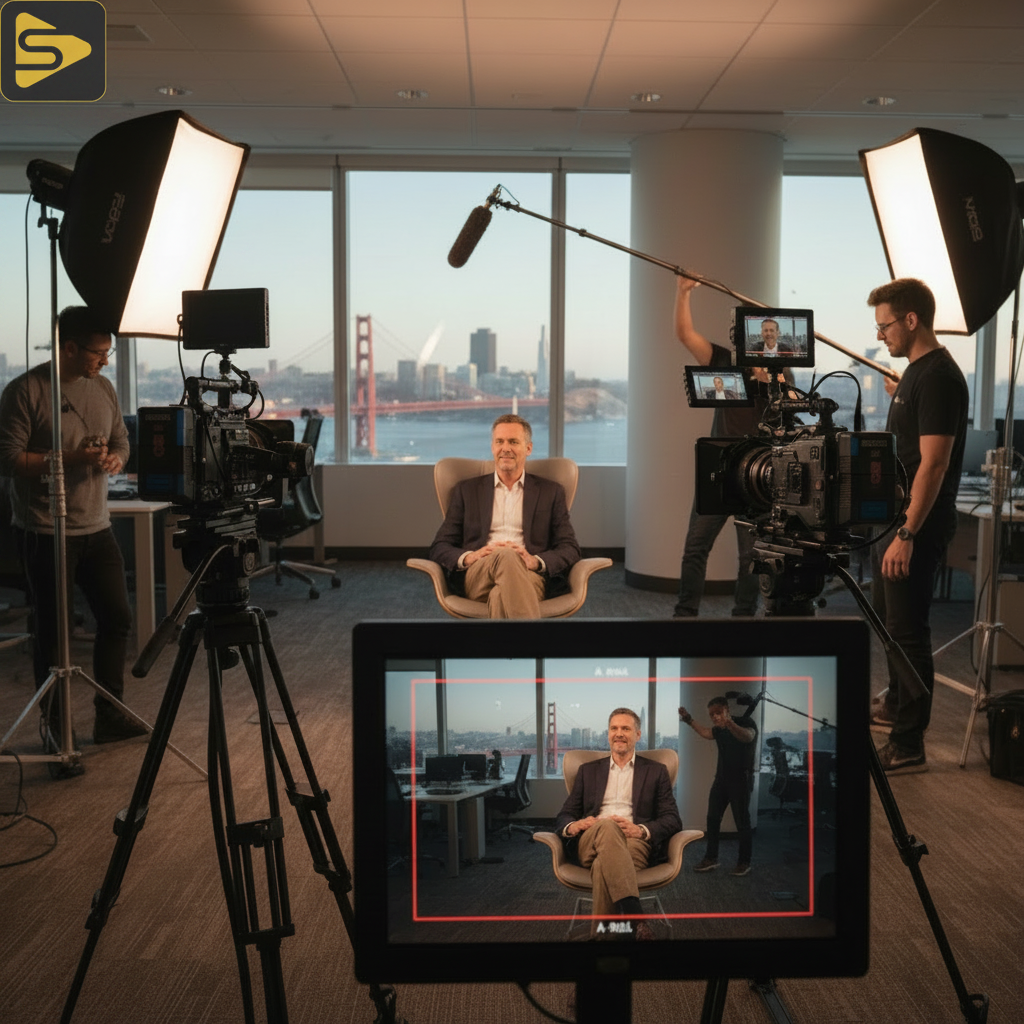
When you record an executive interview strategy session, you aren’t just making a video; you are creating a proprietary data set. Most people miss that a 60-minute transcript contains roughly 9,000 to 12,000 words of expert-level insights. That is enough raw material to fuel your entire digital presence if you have the right content strategy framework in place.
- Authenticity at Scale: Raw A-roll captures nuances, tone, and authority that AI cannot replicate.
- Zero-Click Optimization: Video clips allow for in-feed consumption, keeping users engaged on their platform of choice.
- Cost Efficiency: One production day replaces months of individual content brainstorming sessions.
The Shift from ‘Blog-First’ to ‘Video-First’
In the old model, you wrote a blog and then tried to make a video about it. Today, that’s backwards. A video-first approach ensures that your social clips, newsletters, and articles all share the same authoritative “voice.” For a typical Bay Area Series B SaaS company, this shift often reduces content production overhead by 30-40% while increasing engagement rates across LinkedIn and YouTube.
The Technical Framework for Content Atomization
To turn one interview into a year of content, you need a repeatable content repurposing framework that treats video as a “waterfall.” The goal is to move from high-fidelity long-form content down to micro-moments. This ensures that every piece of content, no matter how small, is rooted in the executive’s original vision.
The real kicker? You don’t need a massive team to execute this if you leverage the right tech stack. At iStudios Media, we use Ingest.blog, our internal AI content engine, to help select clients transform these video transcripts into SEO-optimized long-form articles at a velocity that traditional writing teams can’t match.
- The Pillar: The full 45-60 minute interview (YouTube/Webinar).
- The Splinters: 4-6 thematic “chapters” (5-7 minutes each) for mid-form consumption.
- The Micro-Clips: 20-30 vertical shorts (30-90 seconds) for LinkedIn, Reels, and Shorts.
- The Textual Assets: 12 blog posts, 4 white papers, and 52 newsletters derived from the transcript.
| Content Tier | Format | Platform Focus | Frequency |
|---|---|---|---|
| Anchor | Full Interview | YouTube / Site | 1x Quarterly |
| Educational | Thematic Chapters | LinkedIn / Email | 1x Bi-Weekly |
| Engagement | Short-form Clips | TikTok / Reels | 2x Weekly |
Need help building your content engine? Schedule a free consultation with our production leads to map out your 12-month calendar.
Maximizing Executive Time: The ‘Minimum Viable Input’ Model
CMOs often face the “Executive Gap”—the space between needing thought leadership and having an executive who is too busy to provide it. But wait—what if you only needed 60 minutes of their time every quarter? The B2B video marketing landscape is moving toward this “Minimum Viable Input” model.
In our experience with mid-market clients, the key is psychological safety. Turning a dry corporate interview into high-retention “edutainment” requires a director who understands business, not just a cameraman. You aren’t just filming; you’re extracting the mental models that make the company unique. This is why a one-off video shoot usually fails—it lacks the strategic depth to sustain a year of marketing.
- Pre-Interview Briefing: Focus on 4 core themes per session.
- The ‘Double-E’ Approach: Every segment must be either Educational or Entertaining.
- The ‘No-Script’ Rule: Use guided prompts to get natural, passionate responses rather than robotic teleprompter reads.
Humanizing the C-Suite in the Age of AI
One contrarian insight we’ve noticed: the more “perfect” a video looks, the less people trust it. In an era of deepfakes and AI-generated avatars, raw A-roll with minor imperfections often performs better. It signals that there is a real human behind the brand. For a Bay Area medical practice owner or a startup founder, this vulnerability builds more trust than a polished, $50k-per-minute commercial ever could.
The Tech Stack: AI-Enabled Human Creativity
You cannot scale a micro-content strategy manually. To execute a video-to-everything pipeline, you need tools that bridge the gap between production and distribution. While we recommend high-end video production services for the initial capture, the repurposing can be semi-automated.
What most people miss is that AI shouldn’t write your content—it should reformat your original thoughts. Tools like Descript for editing, OpusClip for short-form extraction, and our own automation platforms allow a small marketing team to function like a 20-person agency. You can even feed your A-roll transcript into a marketing automation platform to trigger lead nurture sequences based on the specific topics discussed.
- Transcription: Otter.ai or Rev for accuracy.
- Social Repurposing: Munch or Munch.io for identifying viral-ready hooks.
- SEO Content: Leveraging the raw interview transcript for Google-friendly long-form articles.
Ready to stop overspending on fragmented content? Connect with iStudios Media to see how we integrate production with performance marketing.
Measuring ROI: From Views to Pipeline Impact
The biggest mistake in B2B video marketing is measuring success by “views.” For a Series C founder or a Marketing Director at an enterprise firm, the only metric that matters is pipeline contribution. An A-Roll Anchor strategy allows for better tracking because you are distributing the same message across multiple stages of the funnel.
Consider a typical Bay Area fintech client: they might use a 30-second clip to drive awareness on LinkedIn, a 5-minute chapter to nurture leads in an email sequence, and the full interview to close a deal during a high-intent sales call. By using a unified executive interview strategy, you ensure the messaging is consistent at every touchpoint, which Forbes reports can increase revenue by up to 23% through brand consistency.
- Top of Funnel: Social clips optimized for reach and engagement.
- Middle of Funnel: Thematic videos embedded in blog posts and newsletters.
- Bottom of Funnel: Full-length interviews used as “proof of expertise” in sales decks.
The Death of Fragmented Content Production
The days of hiring a freelance videographer for a single event and then wondering what to do with the footage are over. Integrated production and performance agencies—like iStudios Media—are replacing the vendor-fragmentation model. We don’t just film; we architect the entire distribution system, from paid media management to CRM automation.
Take Action This Week
Don’t wait for your next big product launch to start filming. Identify one core topic your executive is passionate about and schedule a 60-minute interview session. Use that transcript to generate your next month of social posts. You’ll quickly see that the “A-Roll Anchor” isn’t just a content tactic—it’s the most scalable way to build a brand in a video-first world.
Frequently Asked Questions
How long should a typical executive interview session last?
For a robust executive interview strategy, we recommend a 60-to-90 minute session. This allows enough time for the executive to move past scripted talking points and into deep, insightful territory. Typically, this results in 10-15 high-quality micro-clips and enough transcript data for 3-4 months of written content.
Can we use this strategy for remote executives?
While high-fidelity, in-studio production in places like our San Leandro studio offers the best visual impact, the framework works for remote sessions too. The key is ensuring high-quality audio and a stable connection. The logic of the “Anchor” remains the same: capture the insight once, distribute it everywhere.
What is the typical cost for an A-Roll Anchor production?
In the Bay Area, professional corporate video production for an anchor session typically ranges from $2,500 to $15,000 depending on the number of cameras and the depth of post-production. Compared to the cost of individual shoots for every social post, this offers a significantly higher ROI for scaling businesses.
How do I ensure the executive doesn’t sound robotic?
The best B2B video marketing comes from conversation, not scripts. We use a “guided interview” technique where a strategist asks provocative questions off-camera. This triggers the executive’s natural expertise and passion, which is far more engaging for viewers than reading from a teleprompter or a slide deck.