📋 Table of Contents
According to Wyzowl’s 2024 State of Video Marketing report, 87% of marketers say video has directly increased sales, yet many Bay Area founders still struggle to choose between high-gloss cinematic stories and raw, face-to-camera transparency. The choice between direct-to-camera vs. narrative brand films isn’t just a creative preference; it’s a performance-driven decision that dictates your trust-building velocity and cost-per-acquisition.
At iStudios Media, we see Series B SaaS companies and medical practice owners alike get paralyzed by this choice. They often default to a one-off video shoot with a freelance videographer because it feels safer, but without a strategic framework, they end up with a beautiful asset that fails to convert. The real kicker? The brain processes these two formats in fundamentally different ways, triggering either ‘observation’ (narrative) or ‘connection’ (direct-to-camera).
The Neuro-Marketing of Direct-to-Camera vs. Narrative Brand Films
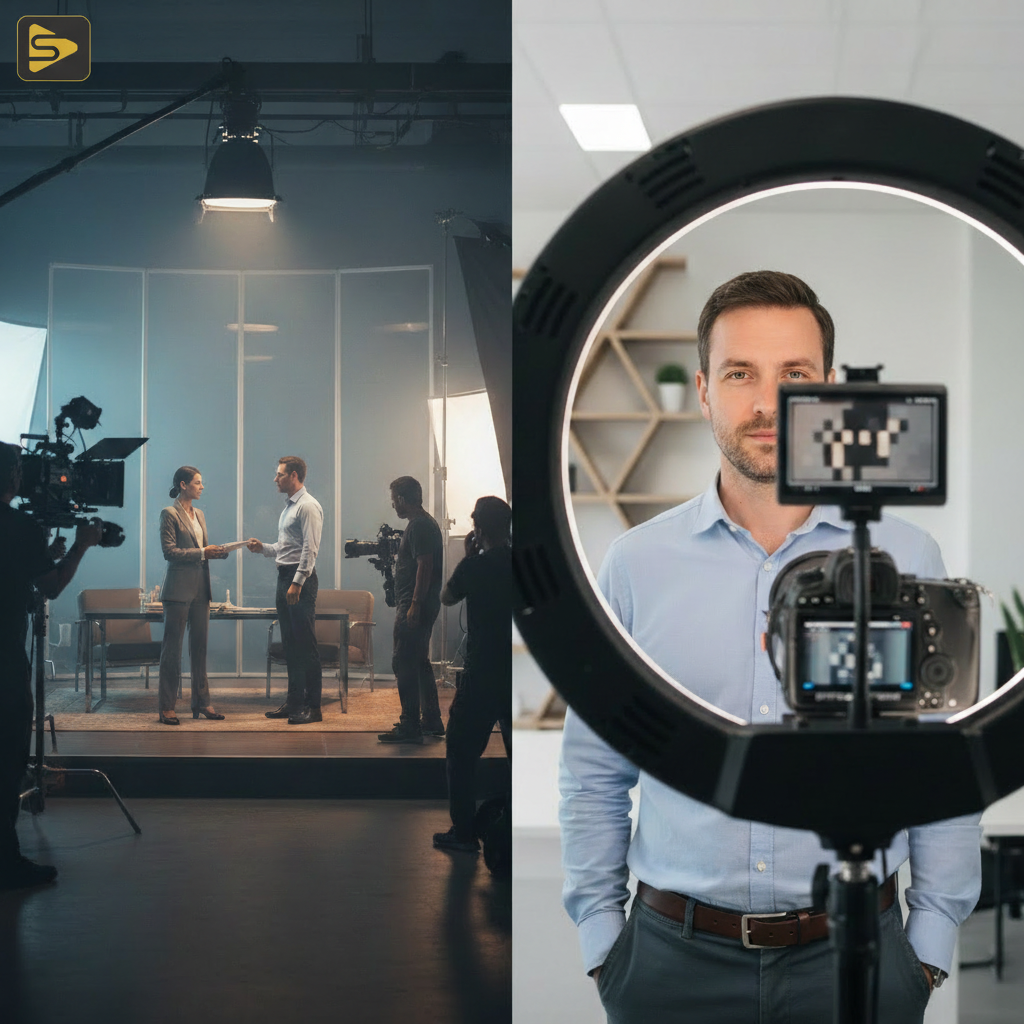
Narrative films invite viewers to be observers of a story, while direct-to-camera content forces them to be participants in a conversation.
- Eye Contact vs. Voyeurism: Direct-to-camera (DTC) leverages the ‘eye contact’ effect, which studies suggest increases neuro-synchrony between the speaker and the listener.
- The Authenticity Paradox: In an era of AI-generated content, high-production narrative films can sometimes trigger a ‘marketing defense’ in viewers.
- Pattern Interruption: A raw, founder-led video in a sea of polished ads often achieves a higher hook-rate metric because it feels like a native post, not a commercial.
When Narrative Storytelling Wins
Narrative brand films are best for top-of-funnel awareness where the goal is to build brand equity and emotional resonance. If you are a Series C startup preparing for an exit or a major product launch, a cinematic narrative communicates scale and stability. It moves the viewer from ‘I don’t know this company’ to ‘I believe in this company’s mission.’
When Direct-to-Camera Dominates
Direct-to-camera excels in Direct Response Video (DRV) and bottom-of-funnel conversion. For a CMO looking to lower CPL on LinkedIn or Meta, a founder speaking directly to a specific pain point often outperforms a $50k commercial. It’s about the authenticity paradox: the more human the delivery, the higher the trust.
Evaluating the Budget-to-Performance Ratio
High-production doesn’t always mean high-performance, but ‘cheap’ production almost always means poor brand perception. In the Bay Area, corporate video production typically ranges from $2,500 to $15,000, while premium brand films can reach $50,000 per finished minute.
What most people miss is that DTC content can be scaled through systems. For example, our internal AI content engine, Ingest.blog, helps clients turn video transcripts into high-velocity SEO content. This ensures the ROI of a single shoot is multiplied across platforms.
| Feature | Narrative Brand Film | Direct-to-Camera (DTC) |
|---|---|---|
| Primary Goal | Brand Equity & Awareness | Conversion & Trust | Typical Cost | $8k – $50k+ | $2.5k – $10k | Platform Fit | YouTube, TV, Website Hero | LinkedIn, Meta, Email, VSL | Production Level | Cinematic / Scripted | Authentic / Expert-led |
Need help deciding which format fits your current growth stage? Schedule a free consultation with our strategy team to map out your content roadmap.
The Strategic Framework for Founder Video Strategy
A successful founder video strategy balances the ‘Visionary’ (Narrative) with the ‘Expert’ (Direct-to-Camera). Most companies we work with fail because they only do one or the other.
- Identify the Funnel Stage: Use narrative for ‘Why we exist’ and DTC for ‘How we solve your problem.’
- Audit Your Social Proofing: If your brand lacks trust, direct-to-camera testimonials and founder explainers are your fastest path to credibility.
- Measure Attention Retention Rate: Narrative films often have a slow build; DTC needs a hook in the first 3 seconds.
The ‘Boring’ Advantage
Here’s a contrarian insight: sometimes ‘boring’ is better. In high-stakes industries like medical practices or fintech, overly creative narrative films can feel evasive. A straightforward, direct-to-camera explanation of a complex procedure or a financial product feels like a consultation, not an ad. This is why video sales letters (VSLs) remain the gold standard for high-ticket conversions.
Platform-Specific Selection: LinkedIn vs. TikTok
The algorithm dictates the format. On LinkedIn, professional direct-to-camera vs. narrative brand films comparisons often show that raw, educational content from a C-suite executive gets 3x the organic reach of a shared corporate commercial.
Conversely, on platforms like YouTube, a cinematic brand film can serve as a long-term ‘anchor’ asset that builds authority over years. According to Forbes, video length and format should be dictated by the user’s intent on that specific platform. For the Bay Area market, where competition for attention is fierce, mixing these formats is non-negotiable.
Ready to move beyond cheap explainer videos? Explore our video production services to see how we blend cinematic quality with performance marketing logic.
Hybrid Structures: The Best of Both Worlds
The most effective modern campaigns use a ‘Hybrid’ approach. This involves a narrative opening to grab attention (the hook), followed by a direct-to-camera middle section (the value), and a narrative close (the brand promise).
- The Hook: A cinematic 5-second sequence showing the problem.
- The Meat: The founder or expert explaining the solution directly to the lens.
- The Proof: Short narrative snippets of customer success.
This structure addresses visual storytelling needs while maintaining the high-trust feel of a personal recommendation. It’s a far cry from a generic marketing agency approach that just wants to ‘make a cool video.’
Execution: Moving Beyond the One-Off Video Shoot
The biggest mistake we see in the SF Bay Area is the ‘campaign-in-a-vacuum’ mentality. You don’t need a video; you need a distribution system. Whether you choose direct-to-camera vs. narrative brand films, that asset must be supported by SEO-optimized content, paid media, and automated follow-ups.
In our experience with mid-market clients, the companies that win are those that treat video as data. They test a narrative version against a DTC version and let the Conversion Rate Optimization (CRO) metrics decide the winner.
Your Action Plan for Monday Morning:
Look at your highest-traffic landing page. If it doesn’t have a direct-to-camera video from a leader in your company explaining exactly how you solve the visitor’s pain point, you are leaving trust—and revenue—on the table. Stop searching for a freelance videographer and start looking for a growth partner.
Ready to scale your content without scaling your stress? Click here to book your free strategy session and let’s build a video engine that actually performs.
Frequently Asked Questions
Which format has a better ROI: narrative or direct-to-camera?
Generally, direct-to-camera (DTC) offers a faster ROI for lead generation and sales due to lower production costs and higher trust-building speed. Narrative films offer a better long-term ROI for brand equity and premium positioning, making them essential for companies looking to establish market leadership or prepare for an acquisition.
How long should a direct-to-camera founder video be?
For social media ads, aim for 60-90 seconds. For a website ‘About Us’ or a Video Sales Letter (VSL), you can extend to 2-3 minutes, provided you maintain a high attention retention rate by using b-roll and text overlays to emphasize key points.
Can we use direct-to-camera videos for Google Ads?
Absolutely. In fact, ‘Expert-led’ DTC videos often have higher click-through rates on YouTube discovery ads compared to generic commercials. They feel like educational content, which aligns better with user intent when they are searching for solutions to specific problems.
Do I need a professional studio for direct-to-camera content?
While ‘lo-fi’ is trending, there is a floor for quality. Poor audio and lighting can damage brand authority. We recommend a professional studio session or an on-site professional crew to ensure your ‘authentic’ video still looks like it came from a market leader.