📋 Table of Contents
According to Wyzowl’s 2024 State of Video Marketing report, 88% of marketers say video provides a positive ROI, yet many Bay Area teams struggle to decide when to hire a freelance videographer for a quick clip versus investing in a full-scale brand film. The content matrix framework is the strategic answer to this resource allocation dilemma, ensuring your production budget matches your buyer’s intent.
Why Your Funnel Needs a Content Matrix Framework
The real kicker in modern marketing is that high production value does not always equal high conversion rates; relevance and intent signal are the true north stars of performance. In a landscape saturated with generic AI noise, the content matrix framework allows CMOs and founders to categorize assets by two axes: Production Effort and Funnel Depth.
- Effort vs. Impact: Not every social post needs a 4K cinema camera.
- Intent Alignment: High-intent searchers need technical depth, while awareness-level audiences need emotional resonance.
- Resource Efficiency: Stop over-investing in top-of-funnel (TOFU) fluff and start funding high-conversion bottom-of-funnel (BOFU) assets.
In our experience with Series B SaaS founders, the most common mistake is treating every video as a one-off video shoot rather than a piece of a larger content strategy. By adopting a matrix, you shift from reactive production to proactive Content Operations (ContentOps).
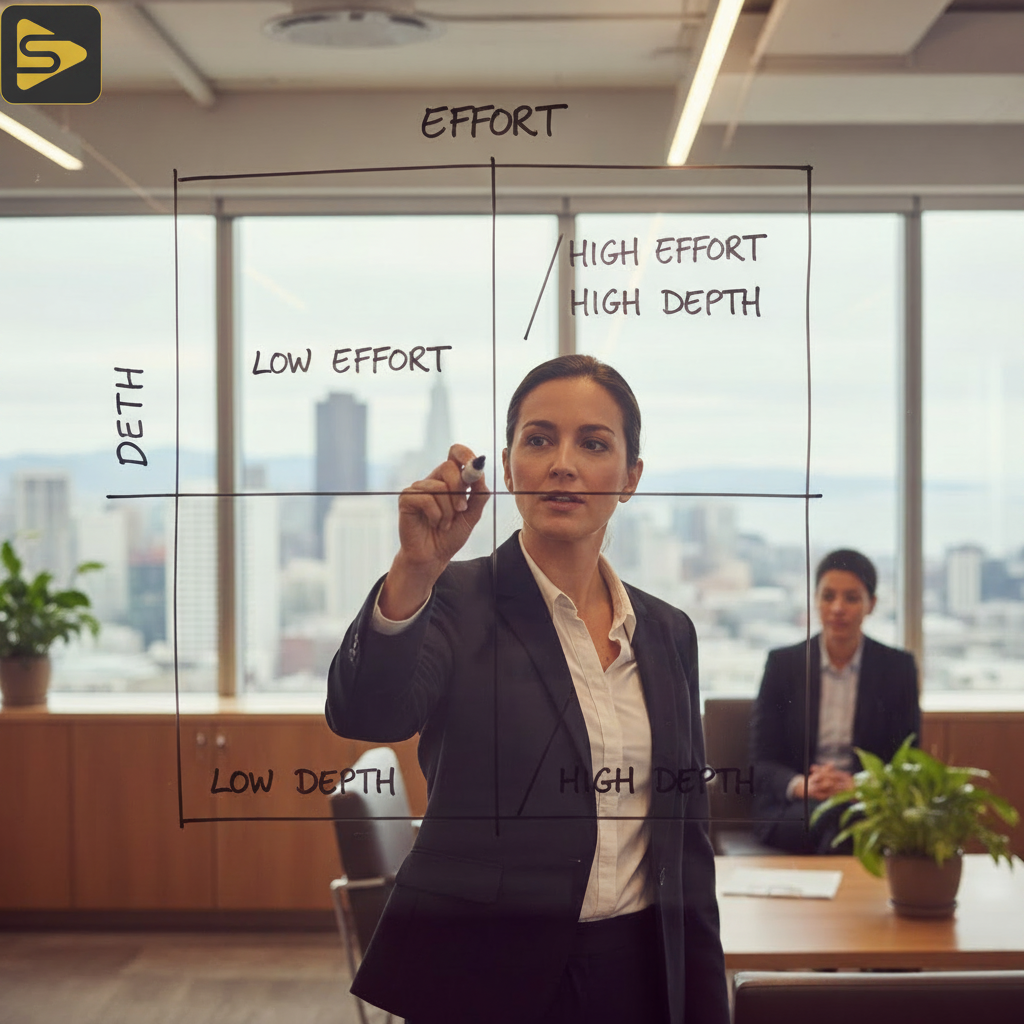
Quadrant 1: High Effort, Top of Funnel (The Authority Builders)
Reserve your highest production energy for assets that deliver “Information Gain”—original insights that AI cannot replicate. This quadrant is where your brand films and flagship video production projects live.
For a typical Bay Area mid-market client, this might look like a mini-documentary featuring their founding story or a high-fidelity commercial that establishes market category leadership. Because these assets are meant to live for 12-24 months, the investment in professional lighting, sound, and narrative structure is non-negotiable.
- Primary Goal: Brand equity and emotional resonance.
- Asset Types: Brand films, original research videos, high-end 3D animations.
- Production Level: Full crew, cinema-grade equipment, extensive post-production.
The Shift to Zero-Click Content
As platforms like LinkedIn and X prioritize native consumption, these high-effort assets must be designed for “zero-click” engagement. Instead of just a link to a YouTube video, use your funnel production strategy to create high-impact native snippets that provide value directly in the feed. This combats Content Decay by keeping your brand top-of-mind without forcing a platform exit.
Need to map your next campaign? Schedule a free consultation to see how we align production with your specific growth goals.
Quadrant 2: Low Effort, Top of Funnel (The Volume Engine)
The goal here is Production Velocity—staying visible in the “Dark Social” journey where prospects are researching you before they ever hit your CRM. This is where agile capture and AI-augmented workflows shine.
Instead of a one-off video shoot, think about recurring series like vlogs, quick tips, or reaction videos to industry news. We often recommend using Ingest.blog, our internal AI content engine, to help select clients transform these quick video insights into SEO-optimized long-form articles, maintaining high content velocity without scaling headcount.
- Primary Goal: Frequency, top-of-mind awareness, and community building.
- Asset Types: Smartphone-captured tips, podcast clips, social polls.
- Production Level: Agile, single-person crew or self-recorded with professional templates.
| Asset Type | Funnel Stage | Typical Bay Area Pricing | Primary Metric |
|---|---|---|---|
| Brand Film | Awareness | $8,000–$50,000 | Sentiment / Reach |
| Product Demo | Consideration | $2,500–$10,000 | View-through Rate |
| Testimonial | Conversion | $1,500–$5,000 | Sales Velocity |
Quadrant 3: High Effort, Bottom of Funnel (The Deal Closers)
Low reach does not mean low value; in fact, the ROI of “unscalable” content in B2B is often higher than viral hits. This quadrant is about marketing asset mapping for high-intent leads who are comparing you against a competitor.
What most people miss is that a lead at the bottom of the funnel is looking for a reason to say “no.” High-fidelity technical demos, customer success stories, and personalized video proposals remove friction. According to HubSpot’s 2024 data, personalized video content has a significantly higher conversion rate than generic sales collateral.
- The “Messy Middle” Factor: Use this quadrant to provide Information Gain—specific data points or case studies that prove your solution works in the prospect’s specific niche (e.g., biotech or fintech).
- Asset Types: Deep-dive product walkthroughs, multi-camera customer testimonials, interactive ROI calculators.
- Focus: Accuracy, credibility, and security compliance (especially for our medical and corporate clients).

Quadrant 4: Low Effort, Bottom of Funnel (The Nurture Layer)
Once a lead is in your marketing automation platform, the goal is to keep them moving through the pipeline with minimal friction. This is the realm of Full-Funnel Attribution and automated lead nurture.
Here’s the thing: you don’t need a freelance videographer for a nurture email. You need a system. Use low-effort, high-authenticity video snippets—like a quick screen share from an account executive—to answer common objections. This builds trust faster than a polished PDF ever could.
- Primary Goal: Reducing sales cycle length and increasing lead-to-close ratios.
- Asset Types: FAQ videos, “Thank You” clips, automated onboarding walkthroughs.
- Integration: These should be triggered automatically within your CRM based on lead stage changes.
Pro Tip: Use the content matrix framework to audit your current library. If 90% of your content is in the “Low Effort/Top of Funnel” quadrant, you’re likely suffering from high traffic but low conversions. Redirect that energy into Quadrant 3.
Optimizing Resource Allocation: Agency vs. In-House
The choice between a one-off video shoot and a partner like iStudios Media comes down to scaling. While a freelance videographer is great for a single asset, a growth partner manages the entire Content Lifecycle Management.
- Strategic Planning: We don’t just film; we map assets to your Google Ads and SEO strategy to ensure every frame supports a KPI.
- Scalability: We provide the infrastructure to produce high-fidelity brand films and high-volume social content simultaneously.
- Technical Integration: We ensure your video assets are properly embedded for SEO and tracked within your marketing automation platform.
For event producers and HR leads, this means having a reliable team that understands the nuances of event live streaming and corporate compliance, rather than managing a fragmented list of vendors.
The Content Sunset: When to Stop Producing
An honest, contrarian insight: Most companies are producing too much content that doesn’t matter. If an asset falls into a “Low Effort/Low Impact” category and doesn’t serve a specific stage of the funnel production strategy, it’s time to sunset it.
Use the matrix to identify “Content Decay.” If an old high-effort asset is no longer generating Information Gain, don’t just leave it. Repurpose it. Turn that 20-minute webinar into ten 60-second “Low Effort” clips for your social publishing tool. This is the Efficiency Frontier of modern marketing—using AI and smart editing to move high-value insights across quadrants.
Your Action Plan for This Week
Don’t try to overhaul your entire strategy at once. Start by auditing your last three months of production against the content matrix framework. Identify one high-intent “bottom of funnel” gap and fill it with a high-fidelity asset. Then, take that asset and slice it into five “low effort” distribution pieces. You’ll see more movement in your pipeline than a dozen random blog posts could ever deliver.
Ready to stop guessing and start growing? Contact iStudios Media today for a strategic production audit. Let’s build a content engine that actually converts.
Frequently Asked Questions
How do I choose between a freelance videographer and an agency?
A freelance videographer is ideal for simple, single-camera tasks where the strategy is already defined. However, if you need a content matrix framework that integrates video with SEO, Google Ads, and CRM automation to drive measurable ROI, a full-stack agency like iStudios Media provides the strategic oversight and multi-disciplinary expertise required for scaling.
What is the typical ROI on high-effort brand films?
While brand films have a higher upfront cost ($8,000–$50,000), they serve as cornerstone assets that anchor your entire funnel production strategy. They improve conversion rates across all paid channels by building immediate trust. In the Bay Area, where the cost of customer acquisition is high, these assets often pay for themselves by increasing lead quality and brand recall.
Can AI replace high-effort content production?
AI is excellent for moving assets from the high-effort to low-effort quadrants through automation and repurposing. However, for marketing asset mapping that requires original research, emotional storytelling, and deep technical expertise (Information Gain), human-led high-fidelity production remains the only way to differentiate your brand from the sea of AI-generated commodity content.
How often should we update our content matrix?
We recommend a quarterly review of your content matrix framework. This allows you to account for Content Decay, adjust for shifts in buyer behavior (like the rise of Dark Social), and reallocate budget based on which quadrants are delivering the highest Full-Funnel Attribution. Regular audits ensure your Content Operations remain lean and effective.