
📋 Table of Contents
According to a 2024 study by LeadConnect, 78% of customers buy from the company that responds to their inquiry first. For a CRM-integrated lead flow in the high-stakes San Francisco medical market, this isn’t just a metric—it’s the difference between a thriving practice and a stagnant waiting room.
- The ‘Speed to Lead’ window for SF medical practices is now under five minutes.
- HIPAA compliance must be baked into the automation layer, not added as an afterthought.
- Omni-channel nurturing (SMS + Email) reduces no-show rates by up to 30% in urban centers.
- Bidirectional sync between your CRM and EHR is the gold standard for ROI tracking.
Why a CRM-Integrated Lead Flow is Essential for SF Clinics
In the Bay Area, patients behave like SaaS power-users; they expect frictionless, digital-first interactions from their healthcare providers. If your lead management relies on a front-desk staff member manually checking an email inbox, you are bleeding high-value elective procedure revenue to more agile competitors.
Most practices we see are stuck in a cycle of ‘random acts of marketing.’ They hire a freelance videographer for a one-off video shoot but have no system to capture the traffic that content generates. A true CRM-integrated lead flow bridges the gap between creative storytelling and hard-line patient acquisition.
- Centralized Data: No more lost sticky notes or forgotten voicemails.
- Automated Attribution: Know exactly which Google Ad keyword resulted in a surgery.
- Scalable Nurturing: Educate patients on complex procedures while your staff focuses on in-person care.
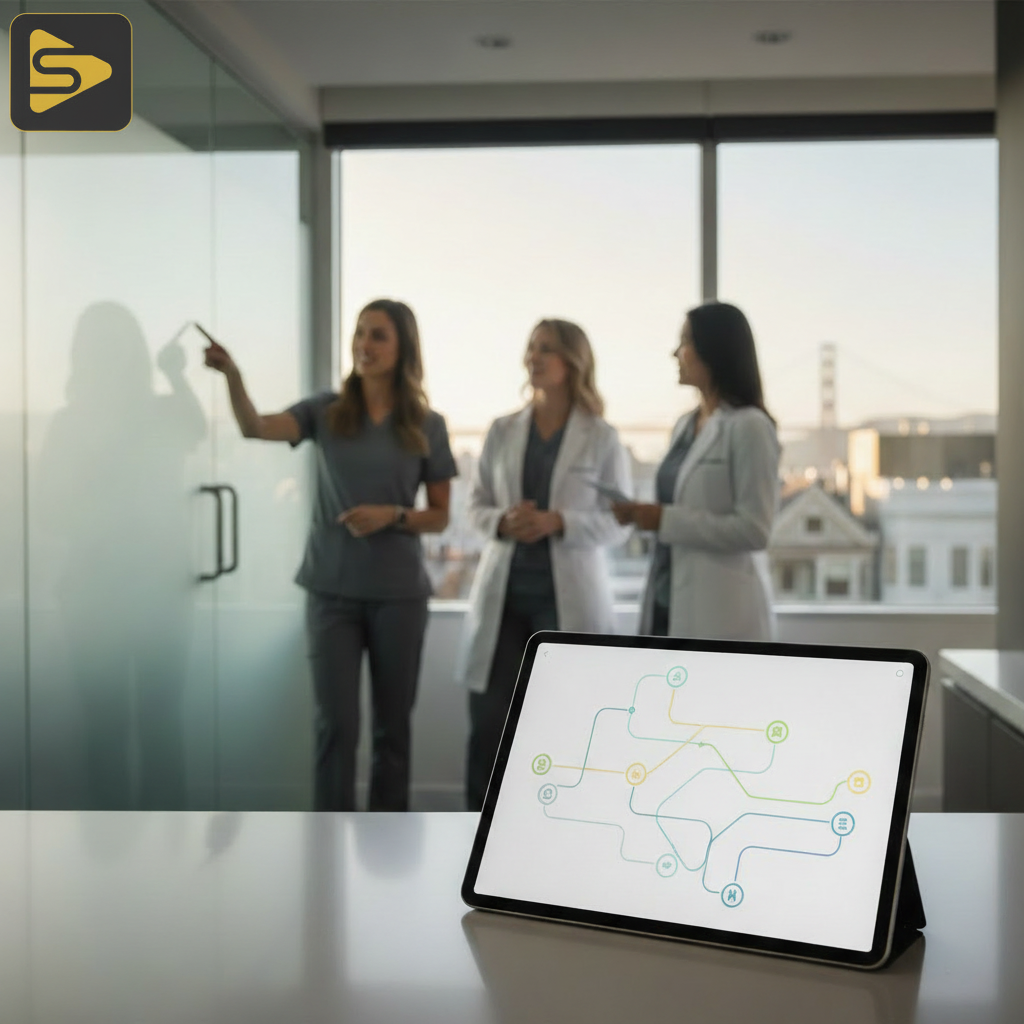
The Architecture of Healthcare Lead Generation in the Bay Area
The real kicker is that most agencies build flows that break the moment a patient asks for a consultation. Effective healthcare lead generation requires a ‘Tech Stack’ approach that balances user experience with federal privacy mandates.
For a typical Bay Area mid-market medical group, we recommend a stack that includes a robust marketing automation platform paired with a HIPAA-compliant wrapper like NexHealth or Spruce. This ensures that when a lead clicks an ad, their data is encrypted from the first touchpoint. Unlike a generic marketing agency, we focus on the technical plumbing that makes medical practice marketing actually profitable.
Consider the ‘Frictionless Patient Journey’ framework:
- The Hook: A high-intent Google Search (e.g., “Fertility clinic San Francisco”).
- The Capture: A mobile-optimized landing page with an interactive intake form.
- The Sync: Immediate push to the CRM with automated lead scoring.
- The Response: An automated SMS sent within 60 seconds to book the discovery call.
Need to see how your current stack compares? Schedule a free strategy consultation to audit your lead flow.
Solving the HIPAA Compliance Puzzle in Automation
Compliance is often used as an excuse for poor marketing technology, but in 2025, privacy-first marketing is a competitive advantage. You cannot simply plug a standard web form into a basic CRM without violating HIPAA or the California Consumer Privacy Act (CCPA).
The best way to handle this is through ‘Zero-party data’ collection—where patients voluntarily provide information through secure, interactive forms. This data should live in a HIPAA-compliant CRM integration that uses BAA (Business Associate Agreements) for all third-party processors. According to HHS.gov, failing to secure protected health information (PHI) in your marketing stack can lead to significant civil penalties.
Comparison: Standard vs. HIPAA-Compliant Lead Flows
| Feature | Standard Flow (Risky) | Integrated Secure Flow |
|---|---|---|
| Data Storage | Unencrypted Email/Sheets | Encrypted CRM Database |
| Lead Response | Manual (Hours/Days) | Automated SMS (Seconds) |
| Attribution | None/Guessed | Full UTM Tracking |
Optimizing Patient Acquisition Cost (PAC) in SF
In San Francisco, the cost-per-click for medical keywords can be astronomical, making Patient Acquisition Cost (PAC) optimization survival-critical. If you are paying $40 per click for ‘LASIK San Francisco,’ you cannot afford a leaky bucket in your follow-up process.
What most people miss is that high PAC isn’t just about the ad spend; it’s about the ‘Cost of Delay.’ Every hour a lead sits untouched, the probability of conversion drops by 10x. By utilizing a CRM-integrated lead flow, you can implement ‘AI-driven patient sentiment analysis’ to prioritize leads who demonstrate high urgency in their form responses.
We’ve found that for our paid advertising clients, integrating the CRM directly with Google Ads’ Enhanced Conversions allows the algorithm to find more patients who look like your highest-value cases. This is how Series B medical startups scale without doubling their marketing budget every year.

Beyond the Form: Using SMS to Combat No-Show Rates
The ‘Frictionless Patient Journey’ doesn’t end when the appointment is booked. In a city as busy as SF, no-show rates can hover around 20-30% for specialist practices. This is where medical lead management automation proves its ROI.
Instead of relying on a staff member to make reminder calls, your CRM-integrated lead flow should trigger a multi-channel sequence:
- T-Minus 48 Hours: Interactive SMS asking for confirmation.
- T-Minus 24 Hours: Email with parking instructions and digital intake forms.
- T-Minus 2 Hours: Final text reminder with a ‘click to call’ for rescheduling.
This level of automation creates a ‘Hybrid Care Model’ where the digital experience feels as professional as the clinical one. If you’re looking to scale your content alongside these systems, Ingest.blog is our internal AI content engine that we use to maintain high SEO velocity for select healthcare clients.
Implementing a Bidirectional EHR-CRM Sync
The holy grail of San Francisco healthcare marketing is the bidirectional sync. This means your marketing CRM talks to your Electronic Health Record (EHR) system like Epic, AthenaHealth, or ModMed. When a lead becomes a patient and completes a $15,000 procedure, that data flows back to the CRM.
The real reasoning here is simple: without this sync, you are optimizing for leads, not revenue. An honest, contrarian insight we hold is that more leads is often a bad thing if they are low-quality. A bidirectional sync allows you to tell Google Ads to stop bidding on keywords that generate ‘tire-kickers’ and double down on those that produce surgical candidates.
Ready to automate your patient pipeline? Connect with our execution-focused growth partners for a custom audit of your medical practice’s digital infrastructure.
Frequently Asked Questions
How do we ensure our CRM-integrated lead flow is HIPAA compliant?
Compliance requires a multi-layered approach: selecting a CRM that offers a Business Associate Agreement (BAA), ensuring all data is encrypted at rest and in transit, and using secure API connections rather than standard webhooks. It’s also vital to audit user access levels within your marketing team to ensure only necessary personnel see PHI.
What is the typical ROI on medical lead management automation?
While results vary, most Bay Area practices see a 15-25% increase in lead-to-appointment conversion rates within the first 90 days. By reducing the manual labor required for follow-up and decreasing no-show rates through automated SMS, the system often pays for itself by capturing just two or three additional high-value procedures per month.
Can we integrate Google Ads with our existing EHR?
Direct integration with legacy EHRs is often difficult due to security silos. However, using a ‘middle-ware’ CRM or a HIPAA-compliant marketing automation platform allows you to bridge the gap. You can track the lead from the ad click to the CRM, and then manually or via secure upload, sync the final conversion data back for attribution.
Is SMS automation legal for medical practices in California?
Yes, provided you adhere to both HIPAA and TCPA (Telephone Consumer Protection Act) guidelines. This includes obtaining explicit opt-in consent from the patient to receive text messages and providing a clear way to opt-out. In SF, patients generally prefer SMS for its convenience, provided the content remains professional and secure.
How does this differ from hiring a freelance videographer?
A freelancer provides a creative asset; we provide a growth engine. While high-quality video production is a core part of the ‘Hook,’ it requires a CRM-integrated lead flow to turn those views into actual patients. We combine production with performance marketing and technical automation to ensure your creative investment drives measurable ROI.