📋 Table of Contents
According to recent data from Crunchbase, Series C rounds in 2024 have seen a significant shift toward ‘flight to quality,’ where investors prioritize sustainable unit economics over raw user growth. For founders, this means your Series C investor video can no longer rely on the ‘visionary’ tropes of early seed rounds; it must now function as a high-stakes evidence locker for your path to profitability.
Moving from Series B to Series C represents a fundamental change in the corporate communication strategy. At this stage, your audience isn’t just looking for a proof of concept—they are looking for a predictable machine. The real kicker? Most companies treat these updates like an afterthought, relying on a one-off video shoot or a freelance videographer who lacks the context of your LTV/CAC ratios or the ‘Rule of 40’ narrative. To maintain investor confidence across global offices, you need a structured production sprint that mirrors a product launch.
Stage 1: Narrative Architecture and Data Hygiene
Before a single camera rolls, your Series C investor video must be anchored in a narrative that synchronizes marketing attribution with financial audits. Here’s the thing: investors at this level are hyper-focused on Series C Unit Economics. If your video highlights a 20% growth in leads but fails to mention the ‘burn-to-scale’ ratio, you’ve already lost the room.
- The CMO-CFO Alliance: Ensure your marketing spend is perfectly aligned with the CFO’s financial reporting to avoid discrepancies during the Q&A loop.
- Defining the ‘Rule of 40’: Use this as your primary narrative anchor—balancing your growth rate and profit margin to show a healthy, scalable business.
- Data Visualization: Move beyond static slides by planning for animation/graphics that turn complex ERP data into digestible, high-impact visuals.
In our experience with Bay Area Series C SaaS teams, the most successful updates are those that treat the report like a high-end marketing asset. This involves ‘productizing’ the update—creating a repeatable framework that delivers consistent visual quality regardless of which global office the executive is filming from. For high-velocity teams, using our internal AI content engine, Ingest.blog, can help distribute these narratives across internal channels to keep the entire organization aligned with the investor message.
Stage 2: Executive Video Production Planning
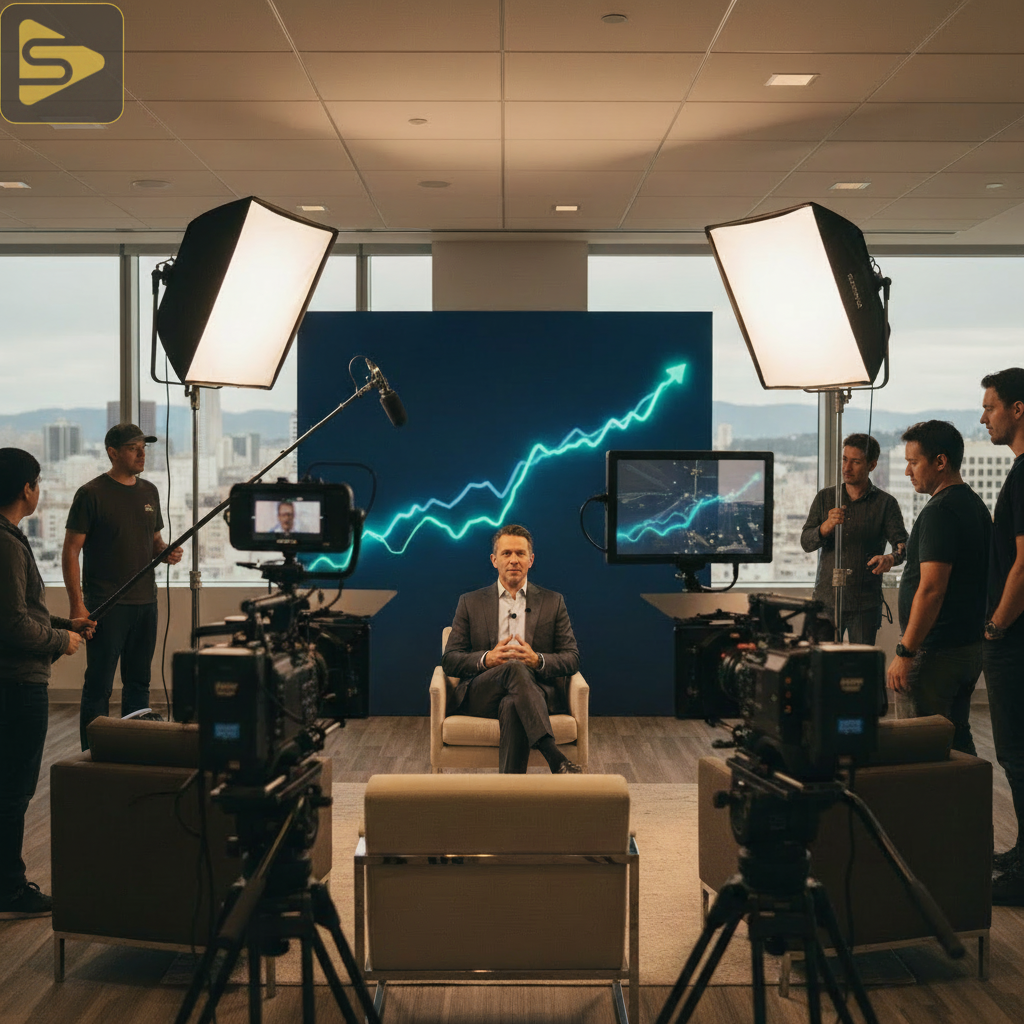
High-stakes updates require executive video production that reflects the maturity of a late-stage company. What most people miss is that visual consistency is a proxy for operational stability. If your CEO looks like they are filming in a basement while your VP of Sales is in a professional studio, it signals a lack of internal alignment.
- Global Consistency: Implement a ‘Production Bible’ that specifies lighting, framing, and audio standards for all remote executives.
- Scenario Mapping: Don’t just present the ‘Bull’ case. Use the roadmap to address ‘Bear’ and ‘Base’ growth scenarios, demonstrating that leadership has a plan for market volatility.
- Equipment Standardization: Instead of hiring a freelance videographer in every city, partner with a full-stack agency that can manage local crews or ship standardized ‘Studio-in-a-Box’ kits.
A typical Bay Area mid-market client often struggles with vendor fragmentation at this stage. Managing four different videographers leads to four different brand ‘feels.’ By centralizing your video production with a single partner, you ensure that the visual fidelity matches the professional rigor of your Series C status.
Stage 3: The Production Sprint and Technical Execution
The actual filming of a Series C investor video should be the shortest part of the process if your pre-production is sound. This is where Data-Driven Storytelling meets cinematic execution. The goal is to make the data feel inevitable, not just coincidental.
| Feature | One-Off Video Shoot | Strategic Production Partner |
|---|---|---|
| Narrative Alignment | Surface-level scripts | Deep integration with unit economics |
| Visual Quality | Inconsistent lighting/audio | Enterprise-grade, multi-cam setups |
| ROI Visibility | None (cost center) | High (investor retention & confidence) |
But wait—don’t forget the importance of audio. In investor relations, poor audio is a credibility killer. According to research from Harvard Business Review, the clarity of a speaker’s voice significantly impacts the perceived trustworthiness of their message. This is why we prioritize high-end audio capture even in remote ‘vlog-style’ updates.
Need help structuring your next update? Schedule a free consultation to see how we can streamline your executive communications.
Stage 4: Post-Production and the Q&A Loop
The final stage is where you refine the message to reduce follow-up friction with VCs. At Series C, the ‘Post-Production’ phase isn’t just about editing; it’s about managing the distribution and feedback loop. Modern Investor Relations (IR) for Startups involves more than just a video link—it’s an interactive experience.
- Interactive Dashboards: Embed your video alongside live data dashboards in your marketing automation platform to provide real-time transparency.
- Chapter Markers: Use tools like Wistia or Vimeo to add chapter markers, allowing investors to jump directly to ‘LTV/CAC Ratio Optimization’ or ‘Product Roadmap.’
- The Q&A Buffer: Produce short ‘FAQ’ video snippets based on historical investor questions to proactively address concerns before they are even asked.
- Content Distribution: Use your content marketing strategy to repurpose key insights for LinkedIn to build secondary brand authority with potential future hires and partners.

The real kicker? Most founders stop once the video is sent. But the best ones use the engagement metrics—who watched what, and for how long—to prepare for the inevitable follow-up calls. This level of Marketing ROI Attribution is what separates a scaling startup from a struggling one.
Common Pitfalls in Series C Communication
In our work with Series B and C founders, we see one recurring mistake: over-polishing the wrong things. While high production value is essential, it should never mask a lack of substance. Investors can spot ‘marketing fluff’ a mile away. An honest, contrarian insight we often share: sometimes a raw, ‘authentic’ update from the warehouse floor is more effective than a sterile studio shoot—if the data supports it.
- Ignoring the ‘Burn-to-Scale’ Ratio: Being too optimistic without acknowledging market volatility.
- Vendor Fragmentation: Using a local freelance videographer who doesn’t understand your cap table or long-term vision.
- Lack of Accessibility: Failing to provide transcripts or captions for global investors who may be watching on mute.
If you are looking to scale your content without scaling your internal headcount, you need a partner that understands the intersection of production and performance. Our team at iStudios Media provides everything from event live streaming to complex executive video production, ensuring your message lands with precision.
Actionable Takeaway: Start Your Sprint Today
Don’t wait until the week before your board meeting to think about your Series C investor video. This week, sit down with your CFO and identify the three most critical KPIs for the upcoming quarter. Map those to a narrative that explains not just what happened, but why it matters for the long-term valuation. By treating your investor updates as a strategic 4-stage roadmap, you transform a required task into a powerful tool for capital retention.
Ready to elevate your investor relations? Book your free strategy session with iStudios Media today and let’s build your 4-stage roadmap together.
Frequently Asked Questions
How much does a professional Series C investor video typically cost?
In the Bay Area, professional executive video production for investor updates typically ranges from $2,500 to $15,000 per project. This varies based on the number of filming locations, the complexity of data visualization/graphics, and whether the project requires multi-camera setups or global coordination across different offices.
Why shouldn’t I just use a freelance videographer for these updates?
While a freelance videographer is great for a one-off video shoot, they often lack the strategic depth required for Series C reporting. A strategic partner understands unit economics, corporate communication strategy, and how to align visual narratives with complex financial data, ensuring consistency across the entire brand ecosystem.
How do I maintain visual consistency with executives in different cities?
We recommend a ‘hub-and-spoke’ production model. This involves a central agency managing the creative direction and ‘Production Bible,’ while utilizing standardized equipment kits or vetted local crews. This ensures that lighting, audio quality, and brand aesthetics remain uniform regardless of where the executive is located.
Can I use AI to help with my investor video production?
Yes, AI is highly effective for predictive modeling visuals and streamlining the scripting phase. We use AI-powered tools for noise reduction, automated transcription, and even content distribution via our internal AI content engine, Ingest.blog, to ensure your message reaches all stakeholders efficiently without losing the human touch of leadership.