
📋 Table of Contents
According to a 2024 study by Wyzowl, 87% of marketers say video has directly increased sales, yet the debate between high-fidelity production and raw authenticity has never been more polarized. For a growth-minded SF video agency, the question isn’t which format is better, but which one solves the specific friction point in your customer’s journey right now.
Key Takeaways for Marketing Leaders
- Studio-Grade: Essential for building long-term brand equity and trust in high-stakes B2B or medical environments.
- UGC-Style: High-performing for social ads where ‘creative fatigue’ and ad-blindness are primary conversion killers.
- The Hybrid Middle: The most effective Bay Area campaigns currently blend professional lighting with smartphone-style framing.
The Trust Deficit: Why SF Video Agency Standards are Shifting
In the Bay Area’s hyper-competitive tech and medical landscapes, your production value serves as a silent proxy for your product’s reliability. Most marketing directors face a ‘trust deficit’ when launching new products, where over-polished content can sometimes feel like a corporate mask rather than a genuine solution.
The real kicker? While a one-off video shoot might check a box, it rarely moves the needle on long-term brand authority unless it’s part of a broader performance strategy. We see many Series B SaaS founders struggle because they invest $20k in a brand film but ignore the high-velocity social content needed to feed their paid media funnels.
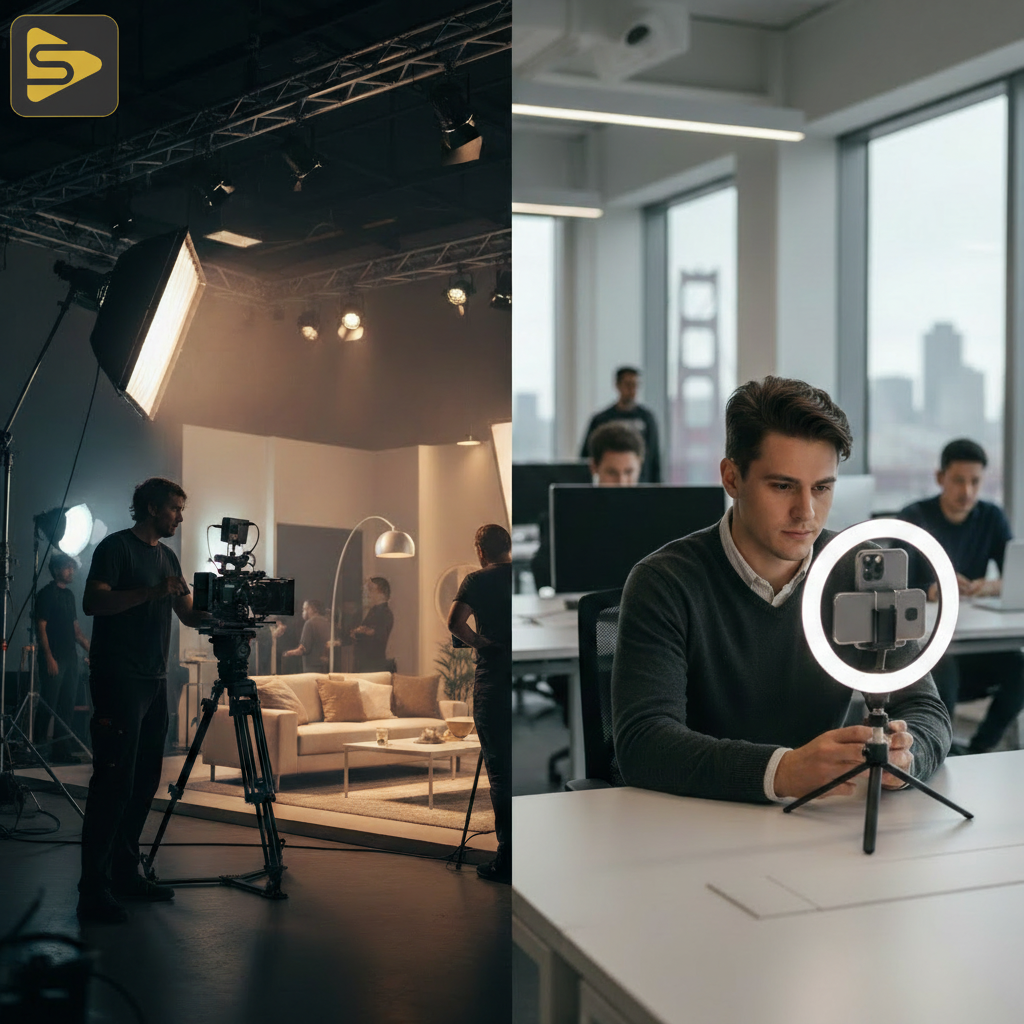
Here’s the thing about content quality standards: they are platform-dependent. A LinkedIn audience expects the polish of corporate video production versus UGC, while a TikTok user will scroll past a cinematic masterpiece in milliseconds because it looks like an ad. Understanding this ‘Platform-to-Funnel’ mapping is the difference between a high ROAS and a wasted budget.
Ready to see how integrated production drives ROI? Schedule a free strategy consultation with our team to map your content needs.
Comparing Corporate Video Production versus UGC Metrics
Choosing between high-end production and user-generated content (UGC) should be a mathematical decision, not an aesthetic one. In our experience with mid-market clients, the cost-per-conversion often drops when studio-grade assets are used for retargeting, while UGC wins at the top-of-funnel discovery phase.
| Metric | Studio-Grade Production | User-Generated Content (UGC) |
|---|---|---|
| Primary Goal | Brand Authority & Trust | Engagement & Social Proof |
| Platform Fit | Website, LinkedIn, YouTube, TV | TikTok, Reels, Meta Ads |
| Typical Cost (SF) | $5,000 – $50,000+ | $500 – $2,500 per asset |
| Longevity | 12–24 Months | 2–4 Weeks (High Fatigue) |
But wait—there is a contrarian reality that most agencies won’t tell you. Sometimes, a high-end SF video agency is actually too good for social media. When content looks too professional, it triggers a psychological defense mechanism in Gen Z and Millennial consumers known as ‘ad blindness.’ According to Forbes, authenticity is now a top driver for brand loyalty among younger demographics.
When to Hire a Freelance Videographer vs. a Full-Stack Agency
- Freelance Videographer: Best for simple, single-camera event coverage or basic interviews where strategic ROI isn’t the primary goal.
- Full-Stack SF Video Agency: Necessary when you need to integrate SEO strategy, paid media management, and CRM automation into your video rollout.
- The Risk: Relying on a one-off video shoot often results in ‘orphaned content’—videos that look great but have no distribution plan or lead-capture system behind them.
The ‘Lo-Fi’ Luxury Paradox in Bay Area Marketing
What most people miss is that ‘authentic’ content doesn’t have to mean ‘low quality.’ We are seeing a massive trend in ‘Lo-Fi Luxury,’ where high-end brands use professional crews to mimic the look of a smartphone to capture that raw, high-conversion energy without the poor audio or lighting of true UGC.
For a typical Bay Area medical practice, this might look like a professionally lit ‘Day in the Life’ series that feels like a FaceTime call but maintains the HIPAA-compliant, professional standards of a clinical environment. This hybrid approach allows for production scalability without sacrificing the human element that drives patient acquisition.

To keep up with the demand for this high-velocity content, we often utilize Ingest.blog (https://ingest.blog), our internal AI content engine, to help select clients turn their video transcripts into SEO-optimized articles and social posts instantly. This ensures that a single one-off video shoot provides weeks of cross-platform value.
A Decision Framework for SF Marketing Directors
To justify your spend to the C-suite, you need a framework that connects production grade to business outcomes. Start by auditing your current funnel: is the problem a lack of awareness (need UGC) or a lack of trust at the closing stage (need Studio-Grade)?
- Identify the Platform: If it’s for a LinkedIn Lead Gen form, prioritize studio-grade corporate video production versus UGC to establish executive presence.
- Evaluate the Content Lifecycle: Is this a cornerstone asset for your homepage (Studio) or a 48-hour Instagram Story (UGC)?
- Check the Trust Level: Are you a new Series A startup? You need the ‘Studio’ polish to look bigger than you are. Are you an established enterprise? You might need ‘UGC’ to look more approachable.
- Analyze the ROAS Benchmarking: Run a split test. Compare a $1,500 UGC ad against a $5,000 studio-cut ad on Meta. The winner dictates your next quarter’s budget.
Looking to scale your content without scaling your internal headcount? Contact iStudios Media today for a custom production and performance roadmap.
Common Pitfalls in SF Video Production
Many marketing directors fall into the trap of ‘over-producing’ for the wrong reasons. They spend $15k on a video because the CEO wants to look like a movie star, rather than spending $15k on a series of 10 high-impact performance creatives that actually drive sales via Google Ads or Meta.
- The ‘Franken-video’ Trap: Trying to make one video work for the website, TikTok, and a trade show booth. (Spoiler: It fails at all three).
- Ignoring the ‘Sound-Off’ Rule: 80% of social video is watched without sound, yet many directors spend more on audio engineering than on on-screen captions.
- Poor Lead Nurture: Driving 10,000 views to a video but having no CRM automation to capture the intent.
The Mathematical Model for Justifying Studio Spend
In the world of Bay Area marketing trends, data is the only language that matters in the boardroom. If your studio-grade brand film increases your website conversion rate from 1% to 1.5%, and your average deal size is $50k, that single video is worth hundreds of thousands in annual recurring revenue (ARR).
Conversely, if your goal is social proof, 20 pieces of creator-led UGC will almost always outperform one high-end commercial in terms of engagement and shareability. The goal for any SF video agency should be to build a balanced portfolio that mitigates creative fatigue while maintaining a high-fidelity brand image.
Actionable Step for This Week
Audit your top-performing social post from the last 90 days. If it was a raw, behind-the-scenes photo or video, it’s time to lean into ‘Professional Raw’ content. If your highest-converting asset is your professional demo reel, double down on high-fidelity case study videos. Don’t guess; let the data from your Google Analytics and ad managers guide your production level.
Frequently Asked Questions
What is the typical cost for an SF video agency project?
Industry-reported ranges for corporate video production in the Bay Area typically fall between $2,500 and $15,000 per project. Premium brand films or commercials can range from $8,000 to $50,000 per finished minute, depending on the complexity of the crew, talent, and post-production requirements.
When should I choose corporate video production versus UGC?
Choose corporate video production for high-stakes environments like investor pitches, homepage hero videos, and medical patient testimonials where trust is paramount. Opt for UGC-style content for high-volume social media advertising, ‘top-of-funnel’ brand awareness, and platforms like TikTok or Instagram where raw authenticity drives higher engagement.
Can I use a freelance videographer for my brand launch?
While a freelance videographer is excellent for capturing raw footage or specific events, a brand launch usually requires a strategic partner. An agency provides the creative direction, marketing automation integration, and distribution strategy that a solo freelancer typically cannot offer, ensuring your video actually reaches your target audience.
How do content quality standards affect my SEO?
Google prioritizes user experience, and high-quality video is a major ‘stickiness’ factor. Studio-grade video often leads to longer ‘time on page,’ which signals to search engines that your content is valuable. However, if the video file is too large and slows down your site, it can hurt your mobile SEO rankings.
Is a one-off video shoot enough for a quarterly campaign?
Rarely. In today’s landscape of creative fatigue, a one-off video shoot should be viewed as a ‘content capture’ session. The goal should be to gather enough ‘B-roll’ and interview footage to create multiple versions, including 15-second social cuts, 60-second explainers, and long-form website assets for maximum ROI.