
📋 Table of Contents
According to Wyzowl’s 2024 State of Video Marketing report, 88% of marketers say video is a vital part of their strategy, yet the biggest bottleneck remains the sheer time and cost of creation. For many Bay Area CMOs, the pressure to produce high-frequency content leads to a choice between hiring an expensive internal team or getting stuck in a cycle of the scaling video production trap where quality drops as volume rises.
The traditional model of hiring a freelance videographer for a one-off video shoot is fundamentally broken for businesses that need to move at the speed of social algorithms. To achieve a 10x increase in output without a 10x increase in headcount, you need to stop thinking about “making videos” and start building a video content supply chain. This requires a shift from manual execution to a structured, 4-quadrant framework designed for content operations efficiency.
The 4-Quadrant Framework for Content Operations
True efficiency in scaling video production comes from decoupling the act of filming from the final deliverable through modular design and production automation.
- Quadrant 1: Modular Acquisition – Filming for the edit, not the story.
- Quadrant 2: Content Atomization – Breaking one long-form asset into 30+ micro-assets.
- Quadrant 3: Algorithmic Assembly – Using AI-augmented workflows to handle the heavy lifting of post-production.
- Quadrant 4: Performance Distribution – Integrating video into SEO, paid media, and CRM automation.
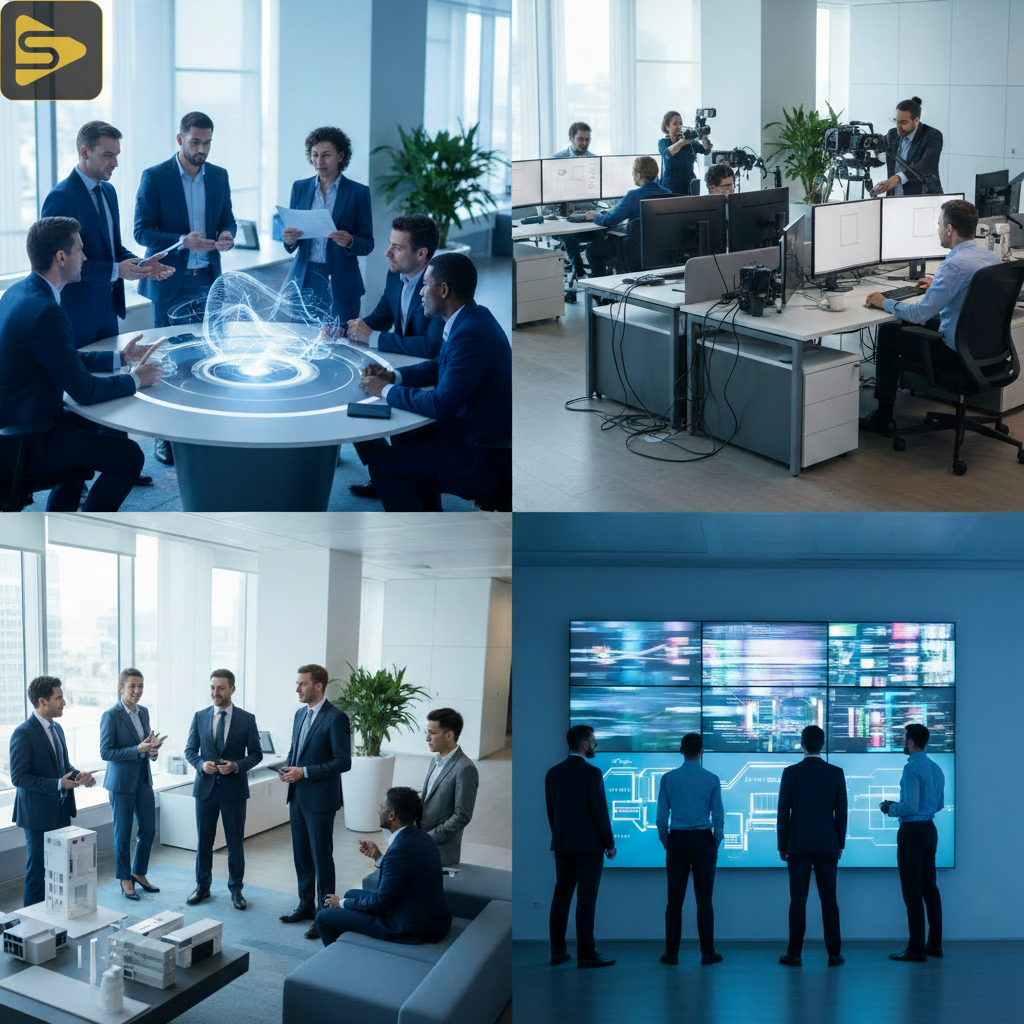
Quadrant 1: Modular Acquisition (Filming for the Edit)
In our experience with Series B SaaS founders, the most expensive mistake is filming a single video with a single purpose. Instead, we advocate for “Batching & Atomic Design.” By planning a shoot around modular components—hooks, value pillars, and CTAs—you can create a library of raw footage that serves multiple campaigns.
Think of it like LEGO bricks. If you film a 10-minute interview correctly, you aren’t just getting one testimonial; you are getting 15 social clips, three product demos, and a dozen ad creatives. This is the foundation of a sophisticated enterprise video strategy.
Quadrant 2: Content Atomization and Repurposing
The real kicker? Most companies leave 90% of their production value on the cutting room floor. Content atomization is the process of taking a high-value asset, like a corporate event or a podcast episode, and slicing it into high-intent snippets for LinkedIn, Instagram, and YouTube Shorts.
For example, a typical Bay Area mid-market client might record a single 45-minute webinar. Through a structured repurposing workflow, that one session becomes:
- 5 “How-to” LinkedIn videos
- 3 High-energy Instagram Reels
- 1 Long-form SEO-optimized YouTube video
- 10 Quote cards for social publishing
Need help building your engine? Schedule a free consultation with our production leads to audit your current workflow.
Leveraging AI in the Video Content Supply Chain
The industry is moving away from manual editing toward algorithmic assembly, where AI tools handle the technical debt of video production.
Here’s the thing: AI isn’t going to replace your creative director, but it will replace your junior editor’s most tedious tasks. Tools like Descript for text-based editing or Munch for automated social clipping can reduce post-production time by 60-70%. At iStudios Media, we use Ingest.blog (https://ingest.blog), our internal AI content engine, to ensure our video scripts are perfectly aligned with SEO data before the cameras even roll.
| Task | Traditional Method | AI-Augmented Workflow |
|---|---|---|
| Transcription | Manual (2-4 hours) | Instant (AI-Powered) |
| Social Clipping | Manual Selection | Algorithmic Virality Scoring |
| Captioning | Frame-by-Frame | Automated & Localized |

Quadrant 3: Algorithmic Assembly and Post-Production
What most people miss is that scaling video production is a logistics problem, not a creative one. By standardizing your “A-Roll” and “B-Roll” tagging, you allow automated systems to pull relevant footage instantly. This is how Forbes reports top agencies are keeping up with the demand for 24/7 content cycles.
But wait—don’t over-automate. An honest, contrarian insight we live by is that while AI can assemble, it cannot empathize. Your brand’s unique “voice” still requires human oversight to ensure your corporate video production doesn’t feel like a generic template.
Integrating Video into Your Performance Marketing
A video that doesn’t drive a conversion is just a vanity metric; it must be mapped to your CRM and paid media strategy.
For medical practice owners or professional service firms, video is the ultimate trust-builder. When integrated into a marketing automation platform, a video can trigger based on a lead’s behavior. If a prospect watches 75% of your product demo, your CRM should automatically move them to a “High Intent” pipeline and trigger a personalized follow-up.
Quadrant 4: Performance Distribution
Distribution is where scaling video production meets ROI. Instead of posting and praying, use data from Google Analytics and LinkedIn Ads to see which modular hooks are performing best. Then, double down on those specific styles in your next batch shoot.
- Map videos to specific stages of the buyer journey (Awareness vs. Decision).
- Use A/B testing for video thumbnails and first 3-second hooks.
- Embed videos on high-traffic SEO pages to increase dwell time—a key ranking factor according to Moz.
Ready to move beyond one-off shoots? Contact iStudios Media today to discuss a scalable production retainer that fits your growth goals.
The ROI of a Scalable Video Engine
The real value of this framework isn’t just saving money—it’s the ability to pivot. When a Bay Area startup needs to change their messaging for a Series C round, a modular system allows them to swap out the “Hook” and “CTA” of 50 videos in a week, rather than reshooting everything.
Typical Bay Area pricing for this level of enterprise video strategy ranges from $5,000 to $20,000 per month for managed content operations, which is often less than the cost of a single senior creative hire when you factor in benefits and overhead. By partnering with a full-stack agency, you gain access to studio photography, event live streaming, and paid advertising expertise all under one roof.
Summary: Your Action Plan for Monday Morning
Don’t try to overhaul your entire department at once. Start by auditing your next shoot: can you record three extra “hooks” for social media while the lights are already set up? That small step is the beginning of your video content supply chain. Focus on batching, embrace AI for the boring parts, and always film with the next 10 assets in mind.
Frequently Asked Questions
How do I start scaling video production without a dedicated studio?
You don’t need a permanent studio to scale. Many of our clients utilize our professional studio sessions in San Leandro or on-site corporate photography setups. The key is “batching”—booking one full day of production to capture 2-3 months of content, which keeps your internal team focused on strategy rather than logistics.
What is the difference between a freelance videographer and a production partner?
A freelance videographer typically handles a one-off video shoot and delivers a finished file. A production partner, like iStudios Media, integrates with your content operations, providing strategy, CRM automation, and performance tracking to ensure the video actually generates a return on investment.
Can AI really replace a video editor?
Not entirely. AI is excellent for “mechanical” editing—transcription, basic cuts, and captioning. However, professional video production still requires a human eye for storytelling, brand alignment, and emotional pacing. We recommend an AI-augmented workflow where technology handles 70% of the volume, and humans provide the 30% of creative polish.
How much should a mid-market company budget for video scaling?
While costs vary, industry-reported ranges for professional corporate video production retainers in the Bay Area typically fall between $3,000 and $10,000 per month. This usually covers a mix of strategy, filming, and high-volume post-production, providing a much higher ROI than fragmented, per-project spending.