
📋 Table of Contents
According to Wyzowl’s 2024 State of Video Marketing report, 88% of marketers say video is a vital part of their strategy, yet most companies still treat it as a creative afterthought rather than a data-driven acquisition channel. If you are still hiring a freelance videographer for a one-off video shoot without looking at your Google Search Console first, you are essentially gambling with your production budget.
Building a video-first content calendar requires shifting from “what looks cool” to “what are people actually asking?” For Bay Area founders and marketing directors, this means mapping every frame of your production to specific search intent data. When you align your video production with the terms your customers use in Google and TikTok search, you stop being a vendor and start being a resource.
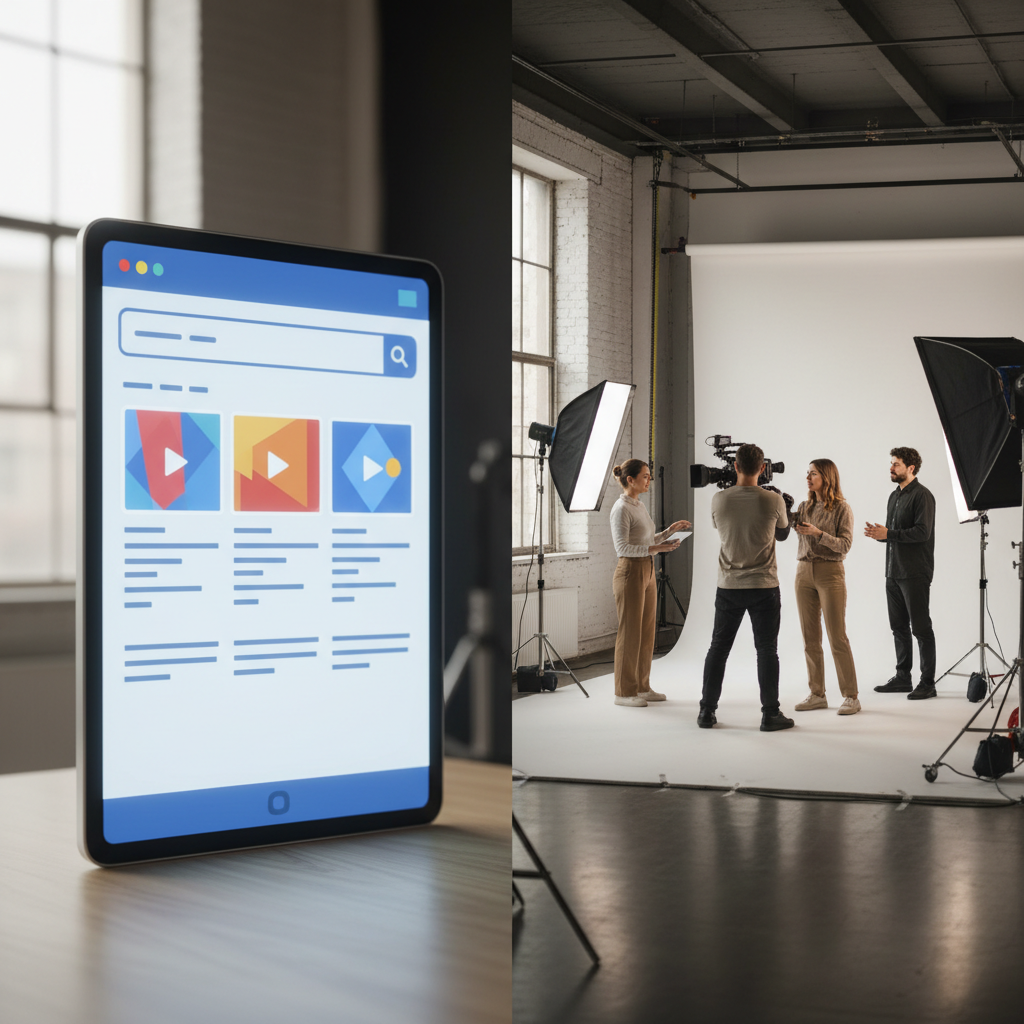
Why Search Intent Marketing Dictates Video Success
The most expensive video you can produce is the one nobody is searching for. In our work with Series B SaaS founders, we often see teams spend $20,000 on a brand film that answers zero customer questions, while a simple, search-optimized demo video generates 10x the pipeline.
- Information Retrieval Intent: Users looking for “how-to” or “what is” solutions. These fuel your educational YouTube strategy.
- Commercial Intent: Users comparing solutions, like “best marketing automation platform.” This is where case study videos shine.
- Transactional Intent: Users ready to buy. High-production product videos and limited-time offers fit here.
- Navigational Intent: Users looking for your specific brand. Culture and team videos help build trust here.
Transitioning to a data-driven content strategy means you stop guessing. By analyzing Social SEO trends on platforms like TikTok and YouTube, you can identify “Zero-Click” opportunities—videos that provide so much value in the first 30 seconds that the user trusts your brand before they even reach your site.
Mapping Keywords to a Video-First Content Calendar
The secret to a scalable video-first marketing strategy is clustering keywords by intent before you ever pick up a camera. Instead of a generic marketing agency approach that creates content for the sake of content, we recommend a “Reverse Funnel” workflow.
- Extract High-Volume Queries: Use tools like SEMrush or Google Keyword Planner to find questions relevant to your niche.
- Categorize by Format: Assign an “Explainer” format to informational keywords and a “Comparison” format to commercial keywords.
- Identify Seasonal Spikes: Use Google Trends to see when specific Bay Area industries (like Fintech or Biotech) search for solutions.
- Build the 90-Day Roadmap: Plot these videos onto your calendar 30 days before the search volume peaks.
Need a partner who understands the data as well as the lens? Schedule a free consultation with our team to audit your current content roadmap.
The Shift from Traditional SEO to Social Search
Search is no longer confined to a white box on Google; for younger demographics and B2B buyers alike, TikTok and YouTube are the primary discovery engines. This shift requires Search Intent Mapping that accounts for SERP Video Carousels—those video blocks you see appearing at the top of Google search results.
Here’s the thing: Google is increasingly prioritizing video content that answers a query directly. To win, your scripts should be Data-Backed. Use the “People Also Ask” section of Google to write the first 3 seconds of your video hook. If the search query is “How to scale a medical practice,” your video should start with that exact phrase.

Content Calendar Automation and Production Velocity
Scaling content without scaling headcount is the primary challenge for mid-market CMOs. This is where content calendar automation becomes a competitive advantage. By using internal tools—like Ingest.blog, our internal AI content engine that we also offer to select clients—you can turn one filmed interview into a month’s worth of search-optimized blog posts and social clips.
What most people miss is that a video-first content calendar doesn’t just produce video; it produces the transcript for your SEO, the copy for your email nurture sequences, and the scripts for your paid advertising campaigns. In our experience with mid-market clients, this integrated approach reduces the “vendor fragmentation” that kills marketing ROI.
Typical Bay Area Production Costs vs. Value
| Service Type | Industry Price Range (Bay Area) | Primary Search Intent |
|---|---|---|
| Corporate Brand Film | $8,000 – $50,000 | Navigational / Trust |
| Educational “How-To” Series | $2,500 – $10,000 | Informational |
| Event Live Streaming | $1,500 – $8,000 | Community / Awareness |
| Podcast Production (Per Ep) | $300 – $1,500 | Thought Leadership |
Search-Led Storytelling: Turning Data into Narrative
Data tells you what to film, but storytelling tells you how to film it. A dry “How-to” video based on search data is boring. Search-Led Storytelling involves taking a high-volume query and wrapping it in a cinematic narrative.
For example, if you are a medical practice owner in San Francisco, don’t just film a video titled “What is Invisalign?” Instead, film a “Day in the Life” or a patient transformation story that naturally answers the search query within the first 60 seconds. This satisfies the algorithm’s need for information while satisfying the human need for connection.
Ready to move beyond the one-off video shoot? Explore our integrated digital marketing services to see how we combine production with performance.
Predictive Video Planning for Seasonal ROI
The real kicker in a video-first content calendar is the ability to predict demand. If you’re in the hospitality or event space, your search volume for “holiday party venues” peaks in October, but the intent begins in August. Predictive planning involves filming your content in July so it is indexed and ranking by the time the search spike hits.
- Q1: Focus on “New Year, New Strategy” and “How-to” informational content.
- Q2: Shift to product demos and case studies for end-of-fiscal-year budget spend.
- Q3: Build awareness for major industry conferences through event live streaming.
- Q4: Focus on transactional offers and “Year in Review” brand films.
Conclusion: Take Action This Week
Don’t let your video strategy be a guessing game. This week, log into your Google Search Console, find the top 5 questions people are asking to find your site, and script five 60-second videos answering those questions. This is the foundation of a video-first content calendar that actually pays for itself. If you need a partner to handle the strategy, production, and CRM & marketing automation to track the leads those videos generate, we are here to help.
Ready to dominate the search results? Contact iStudios Media today for a tailored video-first strategy session.
Frequently Asked Questions
How do I find search intent data for video specifically?
Start by using the YouTube search bar’s auto-complete feature and Google’s “Video” tab in search results. Tools like AnswerThePublic are also excellent for identifying the exact questions your audience is asking. Use these queries as the primary titles for your video content to align with user intent.
What is the difference between Social SEO and traditional SEO?
Traditional SEO focuses on ranking web pages in Google’s search engine. Social SEO refers to optimizing your video content on platforms like TikTok, Instagram, and YouTube so they appear in those platforms’ internal search results. Both require keyword-rich captions, relevant hashtags, and high engagement rates to succeed.
Can I use the same video-first content calendar for all platforms?
While the core data and topics should remain consistent, the delivery must be platform-specific. A 10-minute deep dive is perfect for a video-first content calendar on YouTube, but that same data should be chopped into 30-second high-impact hooks for TikTok and LinkedIn to maximize reach and engagement across different audiences.
How much should a Bay Area business budget for a video-first strategy?
A comprehensive strategy typically ranges from $2,500 to $15,000 per month depending on production frequency and complexity. This often includes a mix of studio sessions, on-site filming, and post-production. Investing in a retainer-based model usually yields a higher ROI than one-off projects due to consistent data optimization and brand alignment.