📋 Table of Contents
According to a recent report by HubSpot, 27% of marketers cite ‘lack of clear strategy’ as their biggest hurdle when working with external partners. In the high-stakes Bay Area market, a vague 20-minute creative brief is often the only thing standing between a successful launch and a budget-draining revision cycle.
Most Marketing Directors and startup founders treat the initial briefing as a formality. They assume the production team—whether it’s a freelance videographer or a full-service agency—can read between the lines of a three-sentence email. Here is the reality: misalignment at the start doesn’t just slow you down; it creates a ‘technical debt’ in your creative assets that is nearly impossible to fix in post-production. At iStudios Media, we’ve found that front-loading 20 minutes of strategic clarity saves roughly 20 hours of back-and-forth later.
The High Cost of the ‘One-Off Video Shoot’ Mentality
Treating your content as a series of disconnected tasks is the fastest way to blow your marketing budget without seeing a return.
When you hire a freelance videographer for a one-off video shoot, you are often paying for a pair of hands, not a strategic partner. Without a structured 20-minute creative brief, you risk receiving a polished video that looks great but fails to convert because it wasn’t optimized for your specific distribution channels.
- Scope Creep: Without a ‘Definition of Done,’ projects swell as stakeholders add ‘just one more thing.’
- Inconsistent Quality: Fragmented vendors lead to a brand voice that feels like a patchwork quilt.
- Wasted Ad Spend: Production teams often ignore platform-specific nuances (like safe zones for TikTok) unless explicitly briefed.
For a typical Bay Area mid-market client, these inefficiencies can represent thousands of dollars in wasted overhead. True marketing agency alignment requires shifting from an ‘order-taker’ dynamic to a ‘growth partner’ dynamic from the very first call.

Why Synchronous Alignment Beats the Email Chain
The real kicker? Email is where creative nuance goes to die. We advocate for a ‘Live Doc’ session where the 20-minute creative brief is co-authored in real-time. This eliminates the ‘feedback loop’ before it even begins by forcing stakeholders to agree on the ‘Minimum Viable Brief’ (MVB) before a single camera is packed.
If you’re managing high-velocity content, you might even consider tools like Ingest.blog, our internal AI content engine, to help distribute that core message across multiple platforms once production is complete. However, even the best AI cannot fix a fundamentally flawed creative strategy.
The Anatomy of a Video Production Brief Template That Works
A functional brief isn’t a 10-page manifesto; it’s a modular framework that prioritizes constraints over fluff.
The best video production brief template focuses on three pillars: The Hook, The Constraint, and The Definition of Done. If you can’t articulate these in under 20 minutes, you aren’t ready to hit record. In our work with Series B SaaS founders, we’ve seen that the most successful projects are those where the technical deliverables are mapped directly to business outcomes.
| Brief Element | Traditional Approach | The 20-Minute Sprint Approach |
|---|---|---|
| Objective | “Make a cool brand video” | “Drive 20% more demo signups via LinkedIn Ads” |
| Audience | “Everyone in tech” | “VPs of Engineering at Series C startups” |
| Deliverables | “One long video” | “1x 90s Brand Film, 3x 15s Vertical Cutdowns” |
Need a partner who understands this level of precision? Schedule a free consultation with our production leads to see how we build scalable creative systems.
How to Prevent Scope Creep in Your Production Workflow
Clear boundaries are the only way to ensure that a $5,000 project doesn’t accidentally become a $15,000 headache.
In a standard production workflow, scope creep happens because the ‘Definition of Done’ is subjective. To fix this, your 20-minute creative brief must include a technical checklist that leaves no room for interpretation. This is especially critical for corporate video production where multiple stakeholders—from Legal to HR—might try to weigh in after the fact.
- Identify the Final Decision Maker: One person, not a committee, must have the final ‘green light’ authority.
- Lock the Aspect Ratios: Are you filming for 16:9 (YouTube), 9:16 (Reels), or 4:5 (Instagram)? Changing this later doubles editing time.
- Set Revision Caps: Standard industry practice is two rounds of revisions. Anything more should be billed as an add-on.
- Pre-Approve the Talent/Location: Don’t wait until the day of the shoot to realize the office background is too cluttered.
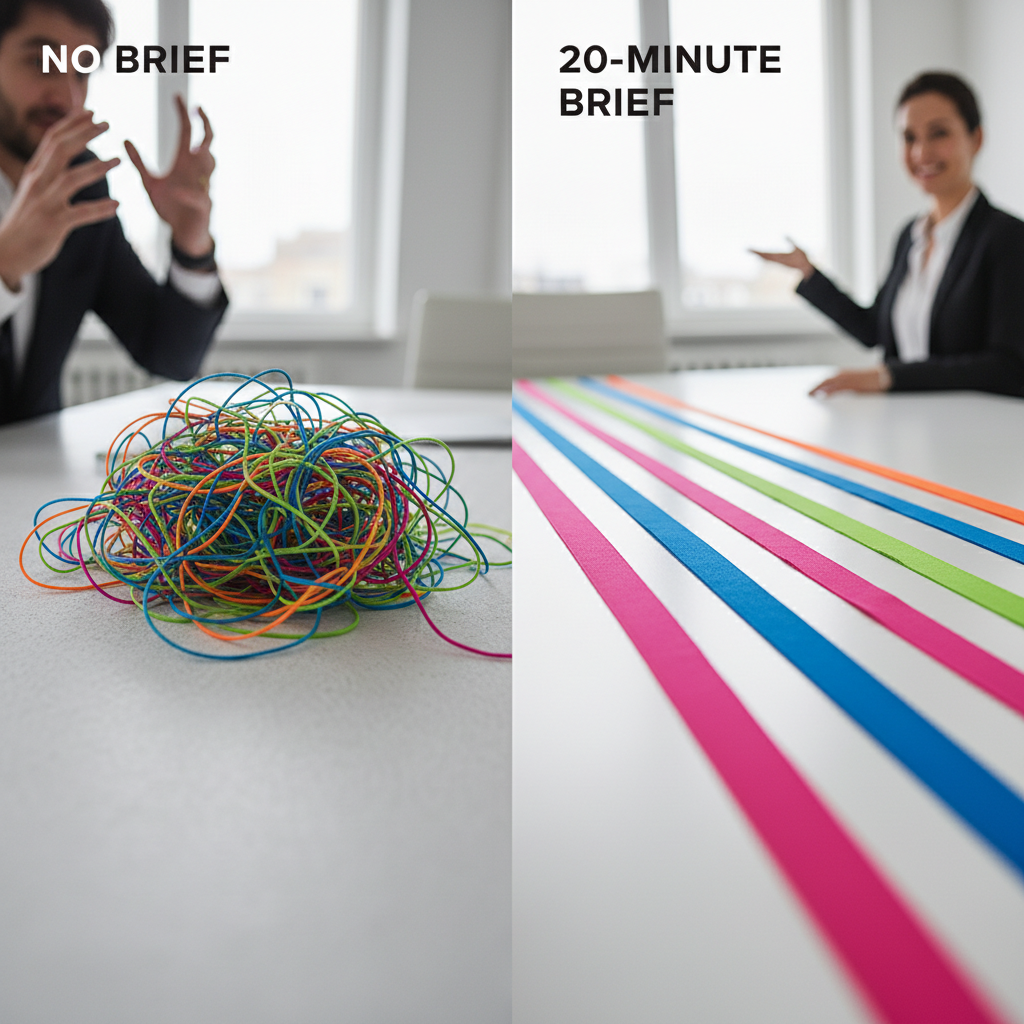
The Neuroscience of the Brief: Why the First 20 Minutes Matter
The first 20 minutes of a creative partnership dictate 80% of the final output quality because of ‘priming.’
When you provide a structured 20-minute creative brief, you are effectively programming the creative team’s subconscious to look for specific visual cues and emotional beats during the shoot. This is why we tell our clients: “Don’t tell us what you want it to look like; tell us how you want the viewer to feel.” According to Forbes, emotional connection is the leading driver of brand loyalty, yet it’s the first thing sacrificed in a rushed briefing.
What most people miss is that a brief is a risk-mitigation tool. By being explicit about what you don’t want, you narrow the field of possibility to only the most effective creative directions. This ‘Creative Alignment’ is what separates high-performance agencies from generic vendors.
Briefing for the Algorithm: Platform-Specific Nuances
A video that works on a conference stage will almost certainly fail as a Meta ad if it isn’t briefed correctly.
Modern marketing agency alignment requires understanding that the ‘Hook’ must happen within the first 1.7 seconds for social platforms. If your production workflow doesn’t account for ‘sound-off’ viewing by including captions in the brief, you are essentially throwing away 70% of your potential reach.
- LinkedIn: Focus on authority and thought leadership; keep it professional but human.
- Instagram/TikTok: High energy, fast cuts, and native-feeling text overlays.
- YouTube: Longer-form storytelling with a focus on SEO-friendly titles and thumbnails.
Ready to upgrade your content strategy? Get a free quote for your next project and experience a production partner that speaks the language of ROI.
The ‘No-Brief’ Fallacy: Why Speed-to-Market is Killing Quality
The biggest lie in modern marketing is that ‘moving fast and breaking things’ applies to high-end video production.
While agile workflows are great for software, a one-off video shoot without a plan leads to ‘Franken-videos’ that serve no one. We’ve seen many Bay Area medical practice owners try to skip the briefing process to save time, only to end up with content that violates HIPAA constraints or fails to resonate with patients. A 20-minute creative brief isn’t a bottleneck; it’s an accelerant. It allows the production crew to move with confidence, knowing exactly what ‘success’ looks like.
By using a standardized video production brief template, you create a repeatable system. This allows you to scale your content output without scaling your headcount—the ultimate goal for any CMO or VP of Marketing.
Actionable Takeaway for This Week
Before your next creative meeting, spend 10 minutes filling out a ‘Constraint Map.’ List the three things the video must do and the three things it absolutely cannot do. Present this at the start of your next call. You’ll find that the conversation shifts immediately from ‘what’s possible’ to ‘what’s effective.’
Frequently Asked Questions
What should be included in a video production brief template?
A comprehensive brief should include the primary objective (KPIs), target audience personas, core message or “the hook,” technical specifications (ratios, length), distribution channels, and a clear budget range. Including examples of existing content you admire can also help align visual expectations quickly without lengthy descriptions.
How can I prevent scope creep with a freelance videographer?
The best way to prevent scope creep is to define the “Definition of Done” in your initial 20-minute creative brief. Explicitly list the number of revision rounds included, the final file formats required, and the specific stakeholders who need to provide approval at each stage to avoid late-stage changes.
Why is marketing agency alignment important for ROI?
Alignment ensures that every dollar spent on production is directly contributing to your business goals. When your agency understands your CRM automation and lead nurture sequences, they can produce content that fits perfectly into your sales funnel, rather than just creating “pretty” videos that don’t convert.
Can I use AI to help write my creative brief?
Yes, AI can be a powerful tool for drafting the initial structure of a brief. You can use prompts to generate audience personas or brainstorm hooks. However, human oversight is required to ensure the brief reflects your unique brand voice and the specific constraints of your Bay Area market.
Stop settling for inconsistent results. Contact iStudios Media today to partner with a team that values strategy as much as cinematography.