📋 Table of Contents
According to research by Bizzabo, 80% of marketers believe live events are their company’s most important marketing channel, yet most leave 90% of the potential ROI on the cutting room floor after the closing keynote. If you are treating your SF conference video as a one-off archive project, you aren’t just missing out on views—you are burning your annual content budget on a single weekend.
At iStudios Media, we see a recurring pattern among Series B SaaS founders and enterprise CMOs in the Bay Area: they spend $50,000 on event production but end up with a three-minute highlight reel that dies on LinkedIn within 48 hours. The shift from a ‘coverage’ mindset to a ‘distribution’ mindset requires a total overhaul of your production workflow. This guide breaks down the “Content Waterfall” framework we use to turn a three-day Moscone Center event into a 12-month asset library.
The Modular Capture Strategy: Filming for the Edit
The secret to long-tail distribution is moving away from the traditional one-off video shoot and embracing a modular capture strategy that prioritizes the post-event timeline.
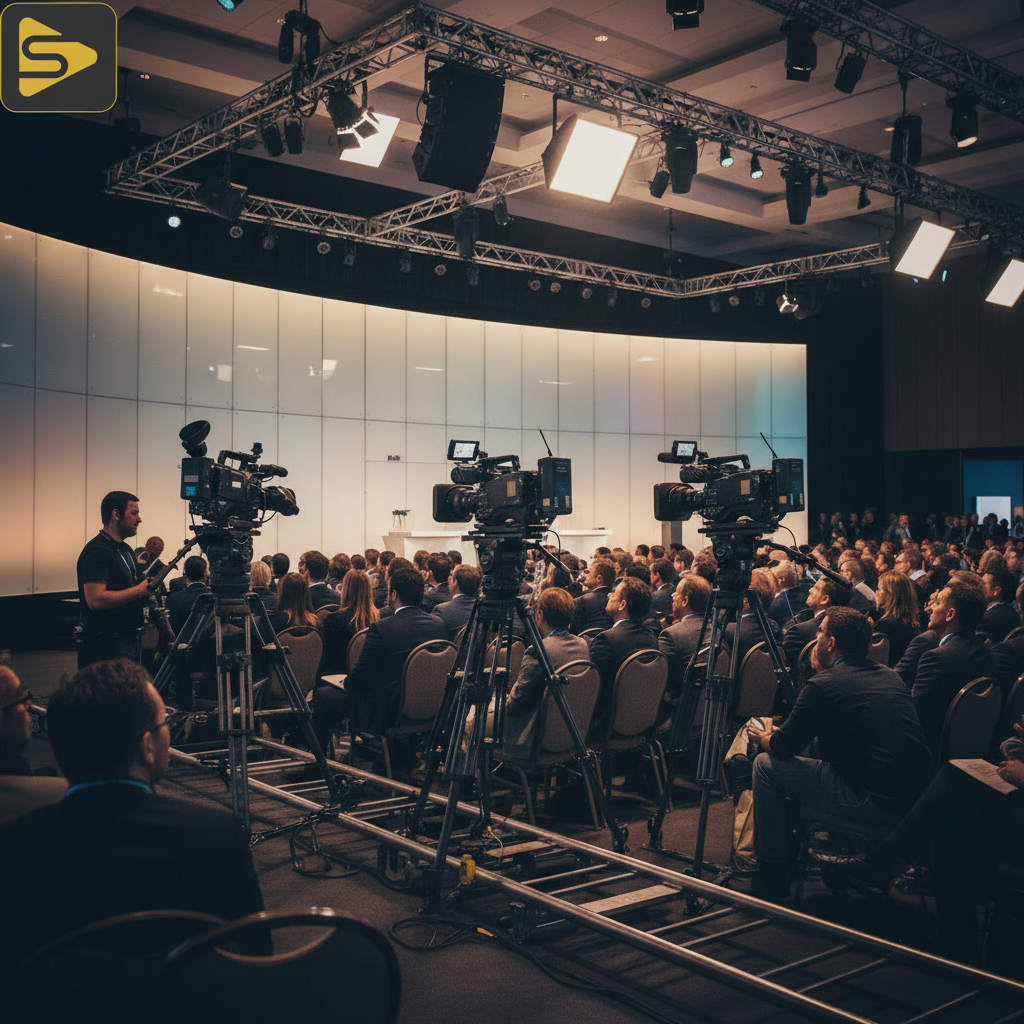
What most people miss is that a freelance videographer hired for ‘coverage’ will focus on the stage, but a strategic partner focuses on the isolate (ISO) feeds. To fuel a year of content, you need clean, multi-camera angles designed specifically for vertical cropping. This means your SF conference video crew needs to frame shots with ‘safe zones’ for 9:16 social formats while simultaneously capturing 16:9 for YouTube and your website.
- ISO Feeds are Mandatory: Never settle for just a switched program feed; you need the raw footage from every camera to catch those micro-expressions and audience reactions.
- Dedicated Content Director: You need a lead who sits between the AV team and the social team to ensure technical specs like clean audio stems are preserved.
- The 9:16 Safety Net: Mark your monitors. If the speaker’s head is cut off when cropped for TikTok, that $5,000 keynote just became useless for social growth.
In our experience with mid-market clients, the difference between a successful capture and a wasted one is the ‘Hallway Track.’ While the main stage holds the prestige, the hallway interviews provide the raw, ‘zero-click’ content that platforms like LinkedIn prioritize today.
Key Takeaways for Executive Teams
- Shift from ‘Hype Recaps’ to ‘Educational Pillar Content’ to establish authority.
- Prioritize high-fidelity audio; viewers will forgive a shaky camera, but they will mute bad audio instantly.
- Plan your ‘Content Buckets’ (Social Proof, Educational, Culture) before the first camera turns on.
Building the Content Waterfall: From Keynote to 50+ Assets
A single 45-minute keynote should never be just one video; it is the source material for an entire ecosystem of video content repurposing.
The ‘Content Waterfall’ starts at the top with the full-length session and cascades down into smaller, high-impact units. For a typical Bay Area tech conference, we structure the capture to support this specific hierarchy:
- The Pillar (Long-form): Full sessions uploaded to Wistia or YouTube for SEO and gated lead gen.
- The Nuggets (1-3 mins): Specific answers to industry pain points, perfect for LinkedIn and email newsletters.
- The Micro-Clips (15-60 secs): High-energy, vertical-first clips for Reels, Shorts, and TikTok.
- The Social Proof: 30-second attendee testimonials captured on the floor.
Here’s the thing: most agencies treat this as an afterthought. We recommend using integrated video production teams who understand how to tag footage in real-time. This allows for a much faster turnaround, often getting ‘daily highlight’ clips out while the event is still happening.
Need a partner who can manage this complexity? Schedule a free consultation with our SF-based production team to map out your event strategy.
The ‘Podcast Pod’ and On-Site Executive Interviews
The most efficient way to scale content without scaling headcount is to treat your conference as a high-volume recording studio.
Instead of chasing executives through a crowded lobby, set up a dedicated ‘Podcast Pod’ or a mobile studio on the expo floor. This controlled environment allows for professional podcast production that produces months of thought leadership content in a single afternoon. By inviting your guest speakers for a 15-minute ‘deep dive’ after they leave the stage, you leverage their influence and provide them with high-quality assets they’ll want to share with their own followers.
| Asset Type | Production Effort | Typical ROI |
|---|---|---|
| Keynote Recap | Low | Short-term Hype |
| Educational Nuggets | Medium | High (Year-long SEO) |
| Podcast Interviews | High | Very High (Authority) |
Structuring Your SF Conference Video for SEO and Search
Your event content shouldn’t just live on social media; it needs to fuel your event content strategy for search engines like Google and YouTube.
According to HubSpot’s State of Marketing report, video is the top media format for the fourth year in a row. To capitalize on this, each session should be transcribed and turned into a long-form blog post. This is where we often leverage Ingest.blog, our internal AI content engine that we offer to select clients, to rapidly transform video transcripts into SEO-optimized articles that maintain your brand’s unique voice.
The real kicker? By embedding these videos into your site, you improve dwell time, which is a critical ranking factor for digital marketing and local SEO. A typical Bay Area medical practice or professional services firm can see significant gains by repurposing conference insights into patient-facing or client-facing educational content.
Avoiding the ‘Content Waste’ Trap
What most people miss is that ‘content waste’ happens when there is no bridge between the production crew and the social media manager. You can have the most beautiful 4K footage in the world, but if it’s trapped in a 2TB hard drive and not organized by ‘thematic buckets,’ it will never be used.
To avoid this, your SF conference video partner should provide a searchable, tagged library. We recommend categorizing assets into:
- Thematic Buckets: Grouping clips by topic (e.g., “AI in Fintech,” “Scaling Culture”) rather than by speaker.
- B-Roll Libraries: High-quality shots of the Bay Area, the venue, and networking that can be used for future recruitment or promo videos.
- Raw Audio Stems: For use in future voiceover or podcast ad spots.
But wait—don’t forget the power of paid advertising. Those 15-second high-impact clips are perfect for LinkedIn Ads targeting the same people who couldn’t make it to the event. This turns your conference into a lead-generation machine that operates long after the booths are packed away.
Operationalizing the Post-Event Workflow
The first 72 hours after an event are critical. This is when the energy is highest and your social media marketing should be at its peak. However, the long-tail distribution happens in the months that follow.
For our Series A-C startup founders, we recommend a 30-60-90 day distribution plan. Month one is about the ‘Big Reveal’ and session replays. Month two shifts to ‘Educational Nuggets’ that solve specific problems. Month three leverages ‘Social Proof’ to drive early-bird registrations for the following year. This integrated approach is why working with a full-stack agency is superior to hiring a one-off video shoot from a freelancer who disappears once the invoice is paid.
Ready to turn your next event into a content powerhouse? Contact us today for a strategic production plan.
FAQs: SF Conference Video Distribution
How many social assets can I realistically expect from a 3-day conference?
By following a modular SF conference video strategy, a typical 3-day event can yield 50 to 100+ unique assets. This includes full session replays, 15-20 educational nuggets, dozens of micro-clips for social stories, and multiple testimonial reels. The key is planning the ‘capture for the edit’ before the event begins.
What is the difference between a highlight reel and a pillar content strategy?
A highlight reel is a 2-3 minute ‘vibe’ video meant for hype. A pillar content strategy treats the event as a source for video content repurposing, focusing on extracting specific insights and educational value that can be distributed over 12 months. Highlights are for vanity; pillar content is for authority and SEO.
Do I need a separate crew for social media video capture?
While one crew can handle both, it requires a dedicated Content Director. This person ensures that cameras are framing for both 16:9 and 9:16 and that the audio is captured in a way that allows for clean social clips. Without this role, you risk having high-quality footage that is unusable for vertical social platforms.
How soon after the conference should we start distributing content?
You should have ‘Real-Time’ social coverage (photos and raw clips) during the event. High-quality ‘Daily Highlights’ should drop within 24 hours. However, the structured ‘Content Waterfall’ of educational nuggets and long-form pillar content usually begins 7-14 days post-event and continues for the rest of the year.
What are the technical requirements for high-quality video repurposing?
You need at least 4K resolution to allow for cropping into vertical formats without losing quality. Additionally, you must have ‘ISO’ (isolated) audio tracks for every speaker. This allows you to remove background noise or overlapping talk, which is essential for creating professional-grade social media clips and podcast production.