📋 Table of Contents
In the current advertising landscape, maximizing your integrated production ROI has shifted from a competitive advantage to a baseline requirement for survival. As algorithmic bidding on platforms like Meta and Google Ads becomes more automated, the primary lever for reducing Customer Acquisition Cost (CAC) is no longer the media buy—it is the creative asset itself.
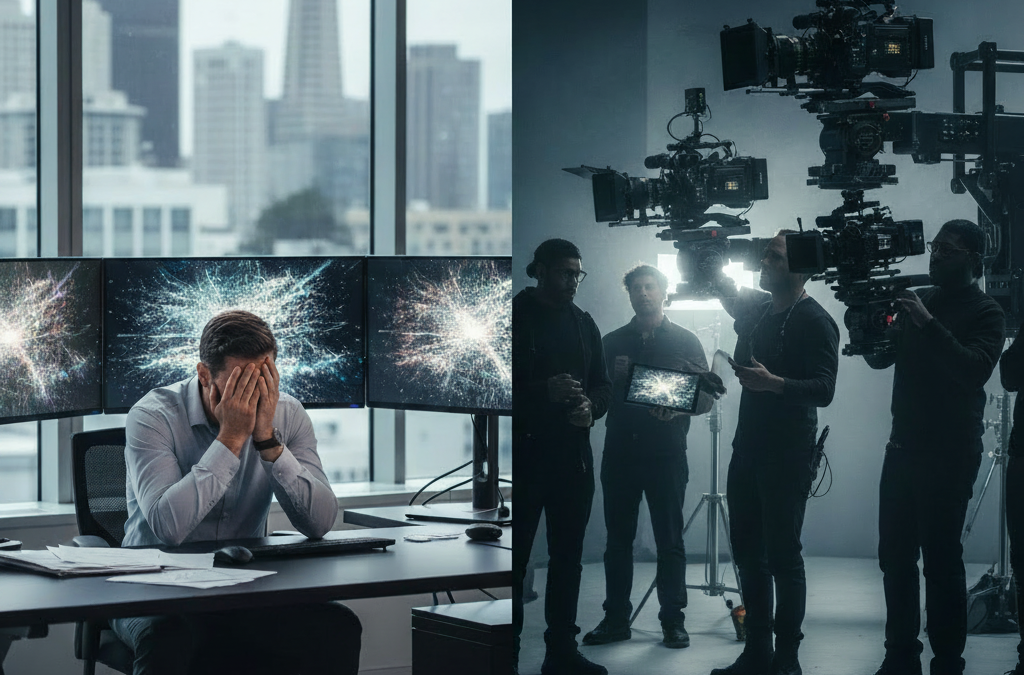
Consequently, many growth-stage companies in the SF Bay Area find themselves trapped in a ‘Feedback Loop Tax.’ This occurs when a high-end video house produces beautiful content that fails to convert, while an isolated ad agency struggles to optimize campaigns with static, uninspired assets. This friction doesn’t just waste time; it actively inflates your CAC by preventing rapid, data-driven iteration.
The Structural Failure of the Creative-Media Silo
Traditional marketing structures often separate the ‘thinkers’ from the ‘doers.’ You might hire an award-winning agency for brand identity and a separate performance marketing team for lead generation. However, this fragmentation creates a fundamental misalignment in incentives and data flow.
- Asset Mismatch: Creative teams often build for aesthetics, while performance teams need modular assets for A/B testing.
- Latency Issues: It can take weeks for performance data to reach the production team, making real-time pivots impossible.
- Budget Leakage: Paying two separate overheads for teams that aren’t communicating effectively drains your marketing capital.

The Rise of Performance Branding
Modern CMOs are moving toward ‘Performance Branding.’ This approach ensures that every high-fidelity brand video also serves a measurable performance goal. By utilizing integrated video production, brands can maintain high production value while ensuring the content is engineered for the algorithm.
Furthermore, companies at the $5M-$50M ARR stage cannot afford the luxury of slow creative cycles. As noted by HubSpot’s State of Marketing report, the speed of content refresh is now a primary indicator of campaign longevity. An integrated production ROI framework allows for ‘Modular Production’—creating a library of visual components that can be reassembled based on what the data dictates.
Quantifying the Integrated Production ROI
To understand the financial impact, we must look at the Creative Efficiency Score (CES). This metric measures the ratio of creative spend to the revenue generated by those specific assets. When production and performance are housed under one roof, the CES typically increases by 30-40% due to reduced friction.
Consider the following comparison between siloed and integrated workflows:
| Metric | Siloed Strategy (Vendor A + Vendor B) | Integrated Strategy (iStudios Media) |
|---|---|---|
| Creative Pivot Time | 10-14 Business Days | 24-48 Hours | Asset Utilization | Single Use / Linear | Modular / Multi-channel |
| Average CAC | High (due to creative fatigue) | Optimized (via iterative loops) |
Furthermore, a full-stack media agency eliminates the hand-off risk. When the same team that films the content also manages the Google Ads budget, the accountability is absolute. There is no finger-pointing when a campaign underperforms—only immediate adjustments to the creative strategy.
Creative as the New Targeting Lever
Since the rollout of iOS 14.5, granular interest targeting has lost much of its precision. Today, the algorithm ‘reads’ your video content to determine who to show it to. This means your integrated production ROI is directly tied to how well your creative speaks to the machine.
- Hook Testing: Developing 5-10 different openings for the same core product video to see which stops the scroll.
- Dynamic Iteration: Using performance data from the first 48 hours to re-edit the middle of a commercial.
- Platform-Native Content: Ensuring that Silicon Valley startups don’t send ‘Discovery’ ads to a ‘TikTok’ audience.
Why the Traditional Creative Brief is Obsolete
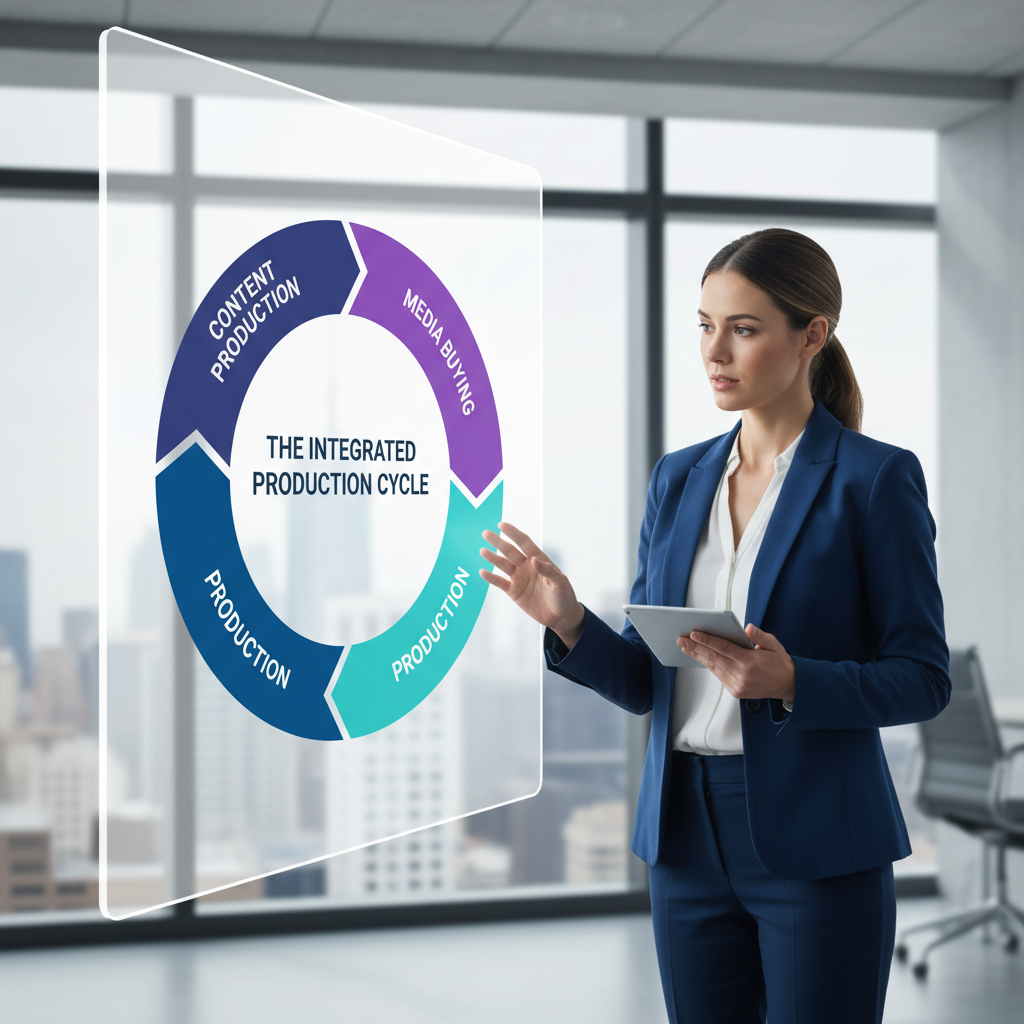
In a TikTok-first world, the ‘Big Idea’ has been replaced by ‘Big Data.’ Instead of one 60-second masterpiece, a full-service marketing agency focuses on a ‘Creative Lego Set.’ This involves filming various hooks, value propositions, and CTAs in a single session to create hundreds of permutations.
Transitioning to this model requires a partner who understands both cinematography and CRM automation. For instance, at iStudios Media, we integrate GoHighLevel and Apollo systems to track exactly which creative assets lead to high-intent sales calls, not just ‘likes’ or ‘views.’
Reducing Technical and Financial Friction
Hiring a separate video house and ad agency creates a ‘Technical Debt’ in your marketing stack. The video house delivers files in a format the ad agency didn’t request, or the ad agency lacks the raw files needed to make a quick crop for Instagram Stories. This friction is a silent killer of integrated production ROI.
- Unified Communication: One point of contact for both the creative vision and the media spend.
- Shared Incentives: The production team is incentivized by lead quality, not just a ‘pretty’ portfolio piece.
- Cost Efficiency: Eliminating the double-markup found when agencies outsource their production to third-party freelancers.
For a Series B startup in San Francisco, speed is the only currency that matters. An integrated video production partner allows you to move from concept to live campaign in a fraction of the time, capturing market share before competitors can even approve a storyboard.
The iStudios Advantage: Full-Stack Execution
We are not ‘marketing gurus’ or ‘growth hackers.’ We are structured, process-driven engineers and producers. iStudios Media serves as a performance partner for Bay Area businesses that need to scale without the headache of managing five different vendors.
Whether you are a medical practice owner needing patient acquisition or a VP of Marketing at an enterprise firm scaling recurring content, our integrated production ROI framework is designed to deliver measurable pipeline growth. We combine high-end cinematography with rigorous data analysis to ensure your brand doesn’t just look good—it performs.
Stop letting vendor fragmentation kill your margins. It is time to treat your creative and your media as a single, unified engine for growth.
Ready to Optimize Your CAC?
Don’t settle for ‘zombie ads’ that drain your budget. Book a strategy session with iStudios Media today and see how our integrated production model can transform your performance marketing ROI.
Frequently Asked Questions
How does integrated production ROI differ from traditional ROAS?
While ROAS measures the immediate return on ad spend, integrated production ROI accounts for the total efficiency of the creative lifecycle. It includes the cost savings from modular production, the increased longevity of assets through rapid iteration, and the reduction in CAC achieved by aligning creative strategy with algorithmic targeting requirements.
Why is separating creative and media teams risky for startups?
For startups, speed is critical. Separating these teams creates a ‘Feedback Loop Tax’ where data takes too long to inform creative changes. This latency leads to higher CAC, as underperforming ads continue to run while waiting for new assets, and creative teams remain ‘blind’ to what is actually converting.
What is the ‘Feedback Loop Tax’ in digital marketing?
The Feedback Loop Tax describes the lost revenue and inflated costs caused by slow communication between siloed agencies. When media buyers identify a winning trend but have to wait weeks for a production house to deliver new assets, the brand loses the window of opportunity, effectively paying a ‘tax’ on their inefficiency.
Can integrated video production work for B2B companies?
Absolutely. For B2B firms in the Bay Area, integrated production is vital for creating high-trust content like case studies and founder interviews that are optimized for LinkedIn and Google Ads. By integrating production, you ensure these high-value assets are tracked directly through to CRM conversion and pipeline revenue.