📋 Table of Contents
According to a 2024 report by Markletic, 71% of event organizers claim that connecting the remote and in-person audience is their biggest challenge. In the high-stakes environment of San Francisco tech summits, hybrid event production is no longer just about placing a camera in the back of a room; it is about engineering equity of experience for every attendee, regardless of their zip code.
For Series A-C founders and enterprise marketing directors, the goal is clear: prevent your remote audience from feeling like second-class citizens watching a static TV show. Achieving this requires a shift from passive broadcasting to interactive community building. This guide outlines the technical requirements to bridge the physical-digital divide.
The Core Pillars of a Technical Event Blueprint
True synchronous engagement relies on the invisible architecture of your network and signal flow rather than just the visible flash of the stage lighting.
- Low-Latency Protocols: Moving away from standard HLS (which has 15-30 second delays) to WebRTC or SRT allows for real-time Q&A where remote participants can respond to speakers instantly.
- Unified Audio Engineering: A dedicated mix-minus setup ensures that remote speakers can be heard in the room without creating a feedback loop for the livestream.
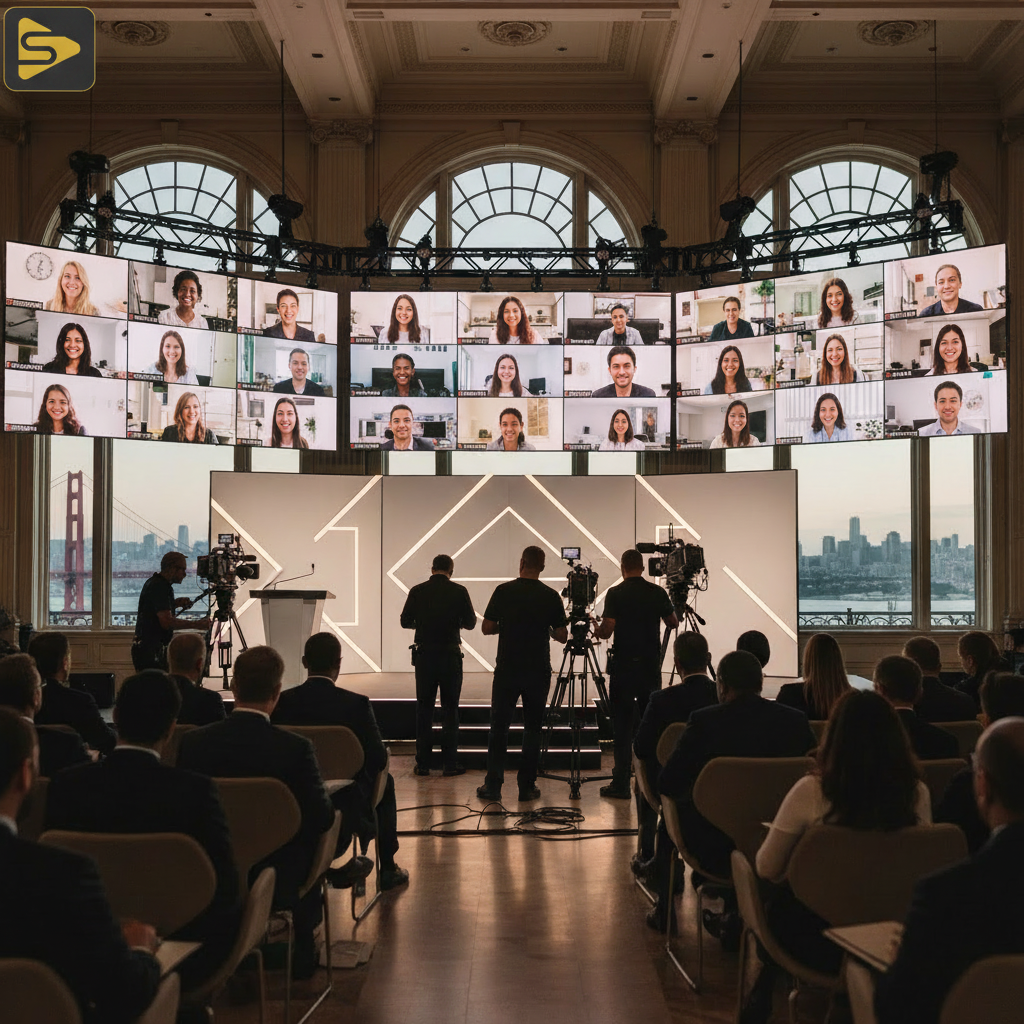
- Bi-Directional Visuals: Placing large-scale confidence monitors in the physical venue that display the faces of remote attendees creates a “digital twin” presence that encourages speakers to address both audiences.
The real kicker? Most event producers treat the livestream as an afterthought, but in a hybrid model, the digital feed is your primary brand ambassador for 90% of your potential reach.
Bay Area Livestreaming Services: Beyond the One-Off Video Shoot
Professional event execution requires a level of redundancy that a freelance videographer or a basic one-off video shoot simply cannot provide in a live environment. In our experience with mid-market clients, the difference between a successful summit and a technical disaster often comes down to fail-safe redundancy.
- Dual-ISP Bonding: Never rely on venue Wi-Fi alone; we utilize primary fiber backed by cellular bonding to ensure zero-downtime.
- Cloud-Based Switching: Utilizing platforms like vMix or Blackmagic Constellation allows for hardware-level reliability with cloud-based backup feeds.
- Spatial Audio Design: Implementing 360-degree sound design prevents remote attendee fatigue by mimicking the natural acoustics of the physical room.
If you are planning a high-stakes product launch or investor summit, you need a partner who understands the integrated production and performance required to scale. Need a reliable partner for your next summit? Schedule a free consultation with our production leads.
Latency Optimization for Synchronous Engagement
Synchronous engagement is impossible if your remote audience is living 20 seconds in the past while your physical audience is reacting to a live joke. Here is the thing: the “broadcast delay” is the silent killer of virtual attendee retention.
To solve this, we implement latency optimization strategies that prioritize speed over high-bitrate fluff. By leveraging sub-second latency protocols, remote attendees can participate in live polls alongside the in-person crowd, creating a unified data set for your marketing team to analyze in your CRM and marketing automation platform.
| Feature | Standard Livestream | High-Performance Hybrid |
|---|---|---|
| Latency | 15 – 45 Seconds | < 1 Second (WebRTC) | One-way / Chat only | Bi-directional / Video Q&A |
| Audio | Stereo Mix | Mix-Minus / Spatial Audio |
| Redundancy | Single Stream | Dual-ISP / Cloud Backup |

The Phygital Concierge and AI-Driven Integration
One of the most effective ways to unify the experience is through a “Phygital” concierge—an AI-powered chatbot that serves both the person sitting in the front row and the person watching from London. This ensures that help-desk support and networking opportunities are equitable.
Furthermore, we are seeing a massive shift toward using AI for real-time translation. According to Harvard Business Review, inclusive communication is a key driver of global brand equity. Modern hybrid event production now includes AI-driven captions that translate the speaker’s words into 20+ languages in real-time for the remote feed.
At iStudios Media, we use Ingest.blog (https://ingest.blog), our internal AI content engine, to help clients turn these live insights into long-term SEO content velocity, ensuring the event lives on long after the final curtain.
Calculating Hybrid Event ROI: Data-Driven Decisions
Marketing directors often struggle with the cost-to-value ratio of hybrid setups. Typical Bay Area pricing for professional event live streaming ranges from $1,500–$8,000 per day, but the ROI is found in the data capture.
- Attendee Journey Mapping: Track every click, question, and poll response from your remote audience.
- Content Atomization: A 2-day event can be sliced into 50+ social clips, 10 blog posts, and a multi-part podcast series.
- Lead Nurture: Automatically sync attendee data into your CRM to trigger immediate post-event follow-ups.
What most people miss is that a hybrid event is not a cost center; it is a high-velocity lead generation machine. By integrating your technical event blueprint with your paid media strategy, you can retarget attendees with precision.
Fail-Safe Redundancy: The Professional Standard
The contrarian truth? Most “tech-forward” events fail because they over-complicate the software while under-funding the hardware. A $50,000 software stack is useless if the venue’s single ISP line gets cut by a construction crew outside.
We advocate for a “Hardware-First” mentality. This includes on-site engineers who manage local signal flow, ensuring that even if the external internet flickers, the in-room experience remains flawless and the recording continues uninterrupted for later distribution via HubSpot or other marketing platforms.
Actionable Takeaway for This Week
If you are planning an event, audit your current streaming protocol today. If you are using standard RTMP, you likely have a 20-second delay that is killing your engagement. Switch to a provider that supports SRT or WebRTC to immediately boost the “live” feeling of your broadcast. Ready to elevate your production? Contact iStudios Media for a technical walkthrough of your next Bay Area summit.
Frequently Asked Questions
What is the typical cost for hybrid event production in the Bay Area?
Industry-reported ranges for professional hybrid production typically fall between $2,500 and $15,000 per project for corporate videos, while event live streaming services usually range from $1,500 to $8,000 per day. This depends heavily on the number of cameras, crew size, and the complexity of the technical event blueprint.
How do you solve the latency issue in hybrid events?
We solve latency by utilizing WebRTC or SRT protocols instead of traditional HLS streaming. This reduces the delay from 30 seconds down to sub-one-second, allowing for synchronous engagement between the physical stage and remote participants during Q&A sessions and live polling.
Can we use a freelance videographer for a hybrid tech summit?
While a freelance videographer is great for a one-off video shoot, a full-scale hybrid summit requires a structured agency team. You need specialized roles including a technical director, audio engineer for mix-minus, and a streaming technician to manage redundancy and signal flow that a single person cannot handle.
What are the benefits of a ‘Digital Twin’ in event production?
A Digital Twin approach uses integrated mobile apps and visual displays to allow in-person and remote attendees to collaborate on the same tasks in real-time. This bridges the equity gap, ensuring remote participants are active contributors rather than passive observers of the broadcast.