
📋 Table of Contents
According to recent data from HubSpot, 58% of marketers say generating high-quality leads is their biggest challenge in the current fiscal year. For Bay Area founders and marketing directors, the problem isn’t just getting traffic—it’s ensuring that B2B lead generation systems effectively filter high-intent buyers from the noise of the open web.
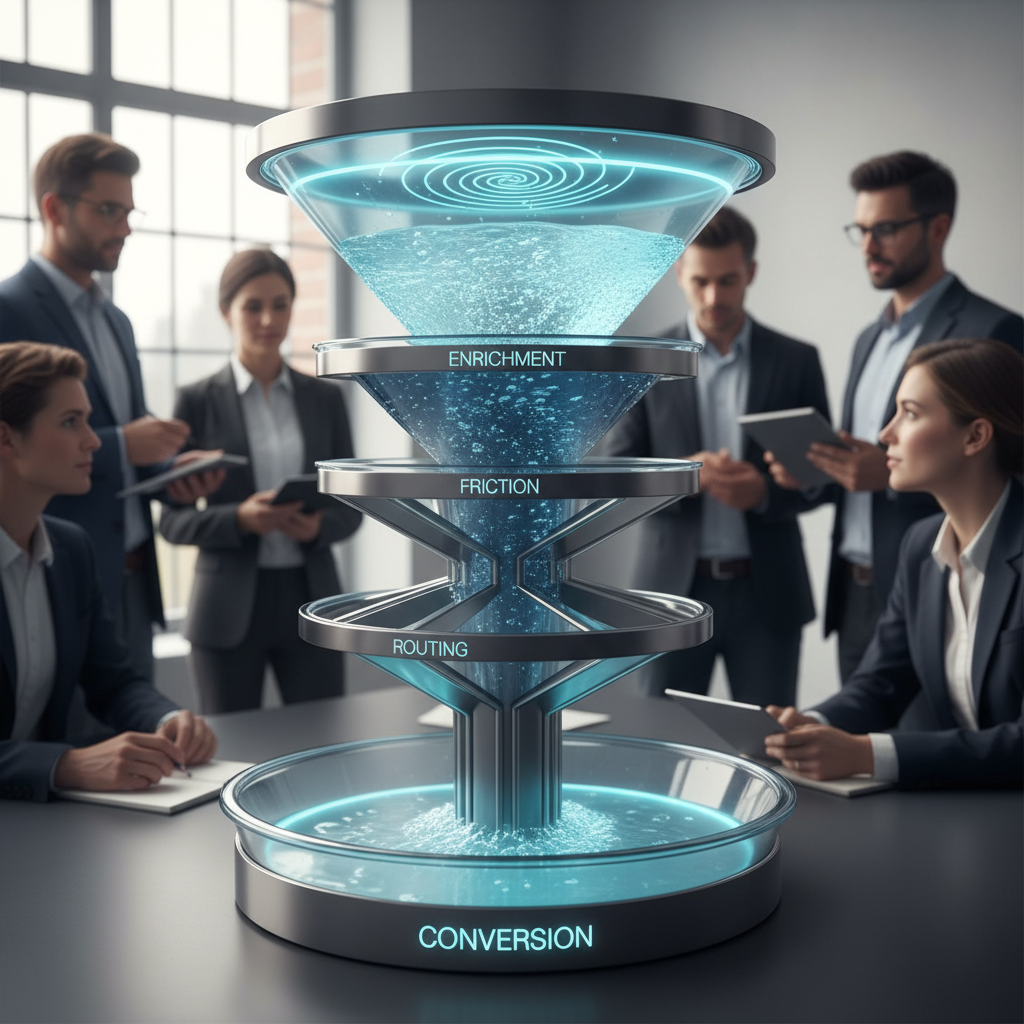
The reality is that the traditional ‘long-form’ is dying, replaced by sophisticated, multi-stage technical frameworks that prioritize user experience and data integrity. In this guide, we’ll break down the exact 4-stage engineering approach we use at iStudios Media to help scaling businesses turn anonymous visitors into qualified pipeline opportunities without sacrificing lead quality.
Key Takeaways for Decision-Makers
- Friction is a Filter: Strategic friction helps disqualify low-intent users while capturing high-value data.
- Automated Enrichment: Use APIs to reduce manual input, increasing completion rates by up to 30%.
- Real-Time Routing: Connect your forms directly to your CRM to reduce lead response time to under five minutes.
- Mobile Optimization: Ensure your technical stack supports biometric or social O-Auth for friction-less mobile conversion.
Stage 1: Psychological Momentum and the ‘Invisible’ Form
The first stage of a high-capture framework is about reducing the cognitive load on the prospect by utilizing lead enrichment API technology to do the heavy lifting. Instead of asking for a company name, size, and industry, top-tier systems identify the user’s corporate IP address before they even type a single character.
Here’s the thing: nobody wants to fill out a 10-field form for a whitepaper anymore. By using tools like Clearbit or 6sense, you can effectively eliminate 70% of manual input. This ‘invisible’ form structure allows you to present only the most critical fields—usually just a work email—while the backend populates the rest of the firmographic data.
What most people miss is that psychological momentum is built by asking easy, low-threat questions first. In our work with Series B SaaS founders, we’ve found that starting with a simple industry-related question via conditional logic forms increases the likelihood of form completion significantly compared to starting with personal contact information.

Stage 2: Strategic Friction and Lead Quality Scoring
While most agencies focus on ‘Form Friction Reduction’ to maximize quantity, high-growth B2B companies understand that some friction is actually beneficial. This is the core of a sophisticated lead capture framework: knowing when to make the user work for the content.
For example, a typical Bay Area mid-market client might use a multi-step form where the first step is frictionless (email only), but the second step requires specific pain-point identification. This allows you to implement lead quality scoring in real-time. If a user identifies as a ‘Student’ or ‘Freelancer,’ the system can route them to a self-service resource rather than a high-touch sales queue.
The real kicker? You should be validating work emails in real-time. By blocking generic domains (Gmail, Yahoo) at the source, you ensure your sales team isn’t chasing ‘ghost’ leads. This is especially vital when moving away from a one-off video shoot mindset toward a full-funnel integrated strategy.
| Feature | Low-Intent Form | High-Capture Framework |
|---|---|---|
| Field Count | 8-12 static fields | 3-4 dynamic fields |
| Data Source | User input only | API enrichment + User input |
| Validation | None/Basic | Real-time SMTP/MX lookup |
Stage 3: Automated CRM Lead Routing and Orchestration
Data is only as valuable as the speed at which it is processed. Once a lead passes through your B2B lead generation form, the technical orchestration layer must immediately trigger CRM lead routing protocols based on the enriched data points collected in Stage 1.
But wait—don’t just dump every lead into a general bucket. Professional-grade systems use logic to route leads based on:
- Geography: Routing Bay Area prospects to local account executives.
- Company Size: Directing enterprise-level leads to senior directors while mid-market leads go to AEs.
- Intent Signal: Prioritizing ‘Demo Request’ leads over ‘Ebook Download’ leads in the CRM view.
For our clients using our marketing automation platform, we integrate these forms directly with lead nurture sequences. This ensures that even if a lead isn’t ready for a call today, they are entered into a zero-party data strategy where we progressively profile them over time. If you’re struggling to scale your content distribution to match this lead flow, we often recommend Ingest.blog, our internal AI content engine, to help maintain high-velocity SEO efforts.
Need a technical audit of your current lead flow? Schedule a free consultation with our performance team to identify leaks in your conversion funnel.
Stage 4: Post-Submission Experience and Conversion Optimization
The final stage of the framework is often the most neglected: the ‘Thank You’ page. Most companies treat this as a dead end, but for high-capture B2B lead generation, it’s a secondary conversion opportunity. Instead of a static message, use this space for Conversion Rate Optimization (CRO) tactics like calendar embedding.
In our experience with mid-market clients, offering an immediate meeting booking via Calendly or HubSpot Meetings on the success page can increase sales-qualified lead (SQL) rates by up to 20%. This strikes while the iron is hot, removing the friction of the ‘we will call you in 24 hours’ waiting game.
What’s the contrarian take here? Stop gating every piece of content. In a privacy-first, cookieless environment, providing high-value ungated content builds the trust necessary for a prospect to eventually volunteer their zero-party data. If your only interaction with a prospect is a forced form fill, you’re competing with every freelance videographer or generic agency on price rather than value.
Technical Debt and Performance Audits
Before you deploy a complex multi-stage form, you must audit its impact on PageSpeed and Core Web Vitals. Heavy JavaScript-based forms can tank your SEO rankings if not loaded asynchronously. According to Google’s PageSpeed Insights, even a one-second delay in mobile load time can impact conversions by 20%.
- Use asynchronous loading for third-party scripts (Clearbit, HubSpot, etc.).
- Implement CSS-only loaders to provide immediate visual feedback.
- Ensure all forms are accessible (WCAG 2.1 compliant) to avoid legal and usability risks.
Practical Implementation: Your Monday Morning Checklist
You don’t need a massive engineering team to start implementing this framework. Start by auditing your highest-traffic landing page. Are you asking for information you could easily find on LinkedIn? If so, you’re creating unnecessary friction.
- Consolidate Fields: Reduce your initial form to 3 fields or fewer.
- Enable Enrichment: Connect a data provider to your form backend.
- Map to CRM: Ensure every field in your form has a corresponding property in your CRM.
- Test Routing: Submit a test lead and timing how long it takes to reach the correct salesperson.
At iStudios Media, we combine this technical precision with world-class video production and performance marketing. We don’t just build forms; we build revenue engines. Whether you are a Series A founder or a Marketing Director at an enterprise firm, your B2B lead generation should be as polished as your brand.
Ready to transform your lead capture? Contact iStudios Media today for a comprehensive growth audit and see how our integrated production and performance systems can scale your business.
Frequently Asked Questions
How do I balance lead quantity vs. lead quality in B2B?
The best approach is to use conditional logic. Ask a qualifying question early in the form. If the user doesn’t meet your Ideal Customer Profile (ICP), provide them with a helpful resource instead of a sales booking link. This keeps your sales pipeline clean while still providing value to all visitors.
What is the impact of form length on B2B conversion rates?
While shorter forms generally have higher conversion rates, they often result in lower lead quality. Our 4-stage framework solves this by using multi-step forms that feel short to the user but collect deep data through background enrichment APIs and progressive profiling over multiple sessions.
Should I use LinkedIn O-Auth for B2B lead generation?
Yes, especially for mobile users. LinkedIn O-Auth allows users to sign up with one click, providing you with verified professional data. However, always offer a standard email option as a fallback for users who are concerned about privacy or don’t want to link their social profiles.
How does CRM lead routing improve ROI?
Speed to lead is a primary driver of conversion. By automating lead routing, you ensure that high-intent prospects are contacted while their interest is at its peak. Research from Forbes suggests that responding within 5 minutes increases the odds of qualifying a lead by 21 times compared to waiting 30 minutes.
Is gated content still effective for B2B lead generation?
Gated content is evolving. Instead of gating basic blog posts, save the ‘gate’ for high-value proprietary data, tools, or deep-dive webinars. For everything else, use ‘soft gates’ where the content is accessible but users are prompted to subscribe for updates at natural break points.