📋 Table of Contents
- 1. The Core of Multi-City Event Coverage: Defining the Quadrants
- 2. Scaling SF Event Production for Series B and C Startups
- 3. The Technical Logic of Multi-Camera Conference Coverage
- 4. Crafting an Effective Event Highlight Reel Strategy
- 5. Geographic Market Tiering: Beyond San Francisco
- 6. Real-Time ROI Attribution and Agile Allocation
- 7. Risk Mitigation in Multi-City Event Coverage
- FAQs
According to a recent Freeman Trends Report, 82% of B2B marketers plan to increase or maintain their event budgets, yet nearly half struggle to prove direct ROI across fragmented activations. When you are managing multi-city event coverage for a Series C startup or a global enterprise, the traditional approach of hiring a local freelance videographer for a one-off video shoot often leads to inconsistent brand quality and wasted spend.
Marketing directors in the SF Bay Area face a unique challenge: How do you scale production at Moscone Center during Dreamforce while simultaneously covering a satellite summit in London or Austin? The answer isn’t just hiring more people; it is about strategic distribution. This guide introduces the 4-Quadrant Resource Allocation Framework—a system we use at iStudios Media to help clients move from reactive filming to predictive content engines.

1. The Core of Multi-City Event Coverage: Defining the Quadrants
Strategic resource allocation starts by acknowledging that not all event hours are created equal in terms of lead generation and brand equity.
- Quadrant 1: High Impact / High Complexity (The Flagship). These are your keynote sessions and product launches. They require multi-camera conference coverage, dedicated audio engineers, and real-time event live streaming.
- Quadrant 2: High Impact / Low Complexity (The Social Viral). Think executive fireside chats or VIP interviews. These require high-end photography and crisp 2-camera setups but minimal crew footprint.
- Quadrant 3: Low Impact / High Complexity (The Training/Internal). Deep-dive technical workshops. These often benefit from automated recording or lower-cost fixed-camera setups.
- Quadrant 4: Low Impact / Low Complexity (The B-Roll/Atmospheric). General floor buzz and attendee reactions.
The real kicker? Most brands overspend on Quadrant 4 and underspend on the technical precision of Quadrant 1. By tiering your multi-city event coverage, you ensure that your $50,000-per-minute premium brand films get the resources they deserve, while secondary markets utilize leaner, agile crews. For teams looking to scale content velocity without doubling headcount, leveraging our internal AI content engine, Ingest.blog, can help distribute these assets to social channels in near real-time.
Comparison of Resource Allocation by Quadrant
| Quadrant | Crew Requirement | Gear Tier | Output Type |
|---|---|---|---|
| Q1: Flagship | 4-6 members | Cinema 4K / Multi-Cam | Livestream / Keynote Film |
| Q2: Social | 1-2 members | Mirrorless / Prime Lenses | Reels / Executive Interviews |
| Q3: Internal | 1 member (or Auto) | Fixed PTZ Cameras | LMS / Training Content |
| Q4: B-Roll | 1 member (Roaming) | Gimbal / Handheld | Sizzle Reels / Stock |
2. Scaling SF Event Production for Series B and C Startups
Startups often burn through their Series B funding by treating every event as a Tier 1 priority, resulting in a “Franken-stack” of inconsistent footage.
In our experience with Series B SaaS founders, the most successful SF event production strategies involve a “Hub and Spoke” model. The Hub (San Francisco) gets the premium video production crew, while the Spokes (regional roadshows) utilize a standardized kit and a remote director. This maintains brand consistency without the cost of flying a 10-person team across the country.
What most people miss is the “Efficiency Frontier.” By applying the 4-Quadrant framework, we’ve seen mid-market clients cut up to 20% of event waste by eliminating redundant multi-camera conference coverage on sessions that have historically low replay value. Instead, those funds are redirected toward a high-converting event highlight reel strategy.
Need a partner who understands the speed of Bay Area tech? Schedule a free consultation to discuss your upcoming event calendar.
3. The Technical Logic of Multi-Camera Conference Coverage
High-stakes environments like the Moscone Center demand a level of redundancy that a standard freelance videographer simply cannot provide.
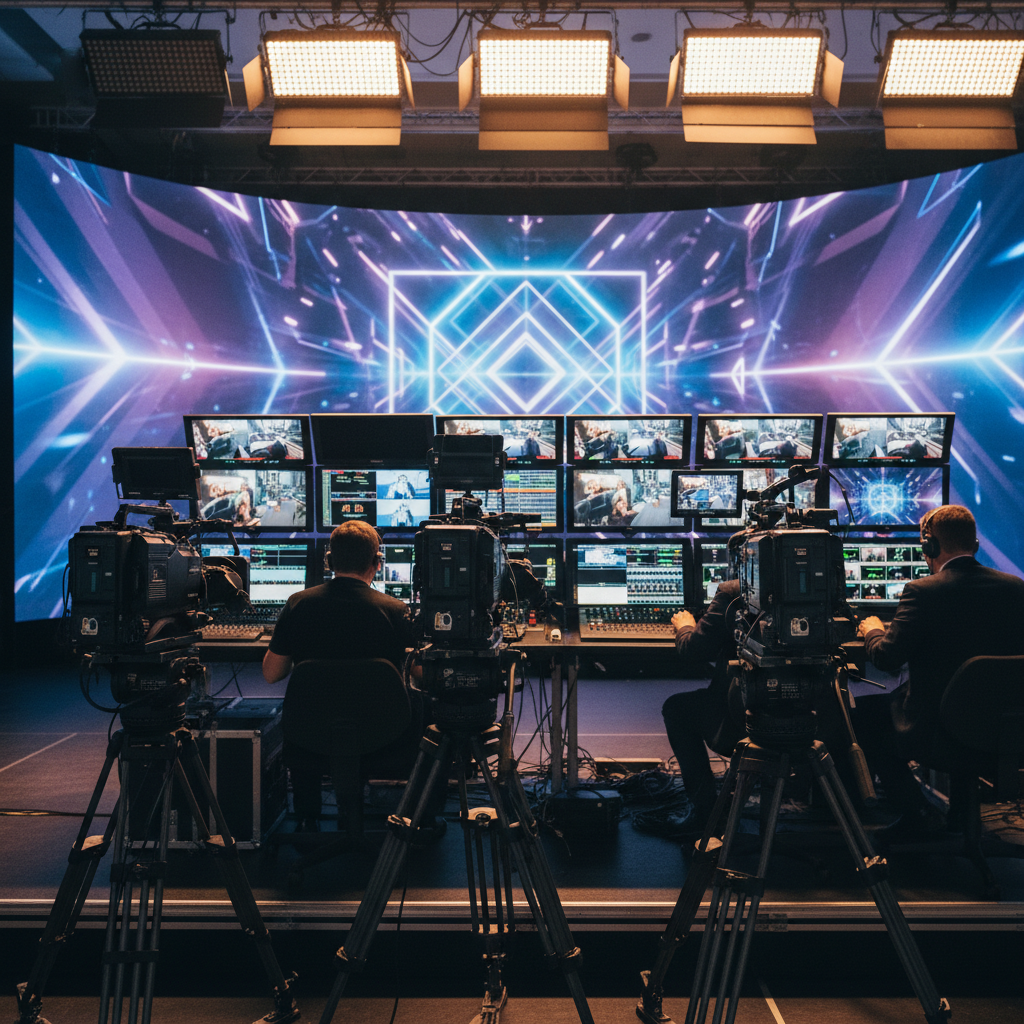
For multi-city event coverage, technical directors must prioritize signal flow and backup power. Here is the workflow we recommend for Tier 1 sessions:
- Primary & Secondary Capture: Always record ISOs (isolated feeds) for every camera, not just the switched program feed.
- Audio Redundancy: Use a primary board feed plus a secondary ambient room mic for safety.
- Instant Delivery: Utilize localized 10Gbps servers for on-site editors to begin the event highlight reel strategy while the session is still live.
4. Crafting an Effective Event Highlight Reel Strategy
A highlight reel is not just a montage of people smiling; it is a sales tool that should be mapped to your Google Ads and LinkedIn Ads campaigns.
The best event highlight reel strategy focuses on “Micro-Moments.” Instead of one 3-minute video that no one watches, create ten 15-second “value bombs” that address specific customer pain points. According to HubSpot’s video marketing data, short-form video has the highest ROI of any social media format. We integrate these assets directly into your marketing automation platform to nurture leads who couldn’t attend in person.
5. Geographic Market Tiering: Beyond San Francisco
While SF is the epicenter, your multi-city event coverage must account for the nuances of secondary markets like San Jose, Oakland, or even emerging tech hubs.
Here’s the thing: A one-size-fits-all approach fails because local labor laws and venue unions (like those in major SF hotels) impact your budget differently. We recommend a tiered spending approach:
- Tier 1 (SF/NYC): Full-stack production, 4K multi-cam, on-site editing.
- Tier 2 (Austin/Denver): 2-camera setups, remote post-production.
- Tier 3 (Local Pop-ups): Single operator, mobile-first content.
This geographic tiering allows you to maintain a presence in 10 cities for the price of 3, provided you have a centralized partner to manage the digital marketing and distribution of the resulting assets.
6. Real-Time ROI Attribution and Agile Allocation
The most sophisticated CMOs are moving toward “Agile Allocation,” where resources are shifted mid-event based on social sentiment and lead scanning data.
But wait—how do you actually execute this? If a breakout session in Quadrant 3 suddenly goes viral on LinkedIn, your multi-city event coverage team needs the flexibility to move a high-end crew to that room for the repeat session. This is why we avoid rigid, one-off contracts in favor of scalable growth partnerships. We use CRM automation to track which content pieces actually drive pipeline, allowing us to refine the quadrant placement for your next quarter.
Ready to stop guessing and start scaling? Contact iStudios Media today for a data-driven production plan.
7. Risk Mitigation in Multi-City Event Coverage
In a tightening economy, the low-priority quadrant (Quadrant 4) serves as your financial buffer.
The real insight? You don’t always need a $5,000 one-off video shoot for every small activation. By using the 4-Quadrant framework, you can identify where to utilize AI-powered marketing automation and user-generated content to fill the gaps. This protects the budget for your high-stakes commercial cinematography and brand films that actually move the needle for Series C investors.
Key Takeaways for Marketing Leaders:
- Audit your events: Classify every session into one of the four quadrants before booking a crew.
- Centralize Management: Use one partner for multi-city event coverage to ensure SEO and brand consistency.
- Think Micro: Shift your event highlight reel strategy toward high-frequency, short-form content.
- Leverage Automation: Integrate your event assets into your CRM and paid advertising workflows immediately.
Frequently Asked Questions
How do you handle union labor requirements for SF event production?
In major venues like Moscone Center, we work alongside IATSE crews. Our role shifts to creative direction and technical supervision, ensuring that while union rules are respected, the final multi-city event coverage meets high-end commercial standards without unnecessary cost overruns.
What is the typical lead time for multi-camera conference coverage?
For large-scale multi-city event coverage, we recommend a 3-6 month planning window. However, for Bay Area startups, we are built for agility and can often deploy multi-camera conference coverage teams within 2-4 weeks, depending on the complexity of the livestream production requirements.
Can one-off video shoots be integrated into a larger framework?
Yes, but they shouldn’t exist in a vacuum. We treat every one-off video shoot as a building block for your broader content marketing strategy, ensuring the footage is tagged and archived for future social media marketing and SEO use.
How does geographic tiering affect the quality of the event highlight reel strategy?
Geographic tiering doesn’t mean lower quality; it means smarter gear selection. A Tier 2 city might use high-end mirrorless cameras instead of cinema rigs, which still produces excellent 4K footage for a event highlight reel strategy while significantly reducing travel and shipping logistics.