📋 Table of Contents
According to Glassdoor data from 2024, the average total compensation for a Creative Director in San Francisco frequently exceeds $220,000 when accounting for equity and benefits. For many Series B founders, that single hire represents a fixed cost that can’t easily pivot when market conditions shift or production needs fluctuate.
When evaluating In-House vs. Agency Production, the decision isn’t just about hourly rates; it’s about the total cost of ownership (TCO) and the agility of your content supply chain. Many scaling teams find themselves at a crossroads: do you build an internal studio or leverage an integrated production partner who brings their own gear, specialized talent, and marketing automation expertise?
The real kicker? Most companies underestimate the ‘hidden tax’ of in-house teams—the equipment depreciation, the software subscriptions, and the creative burnout that occurs when one person is asked to be a videographer, editor, and strategist simultaneously.
The Total Cost of Ownership: Beyond the Salary
Hiring a full-time creative lead in the Bay Area involves much more than the base salary on the offer letter.
- Recruitment and Retention: In a high-comp market, the cost of replacing a specialized creative can reach 50% of their annual salary.
- Equipment and Overhead: A professional video production setup—including 4K cameras, lighting kits, and high-end editing bays—can easily require a $50,000+ upfront investment.
- The Talent Gap: A single hire is rarely a master of all trades. You might get a great editor who struggles with 3D animation or a visionary director who can’t manage Google Ads management.
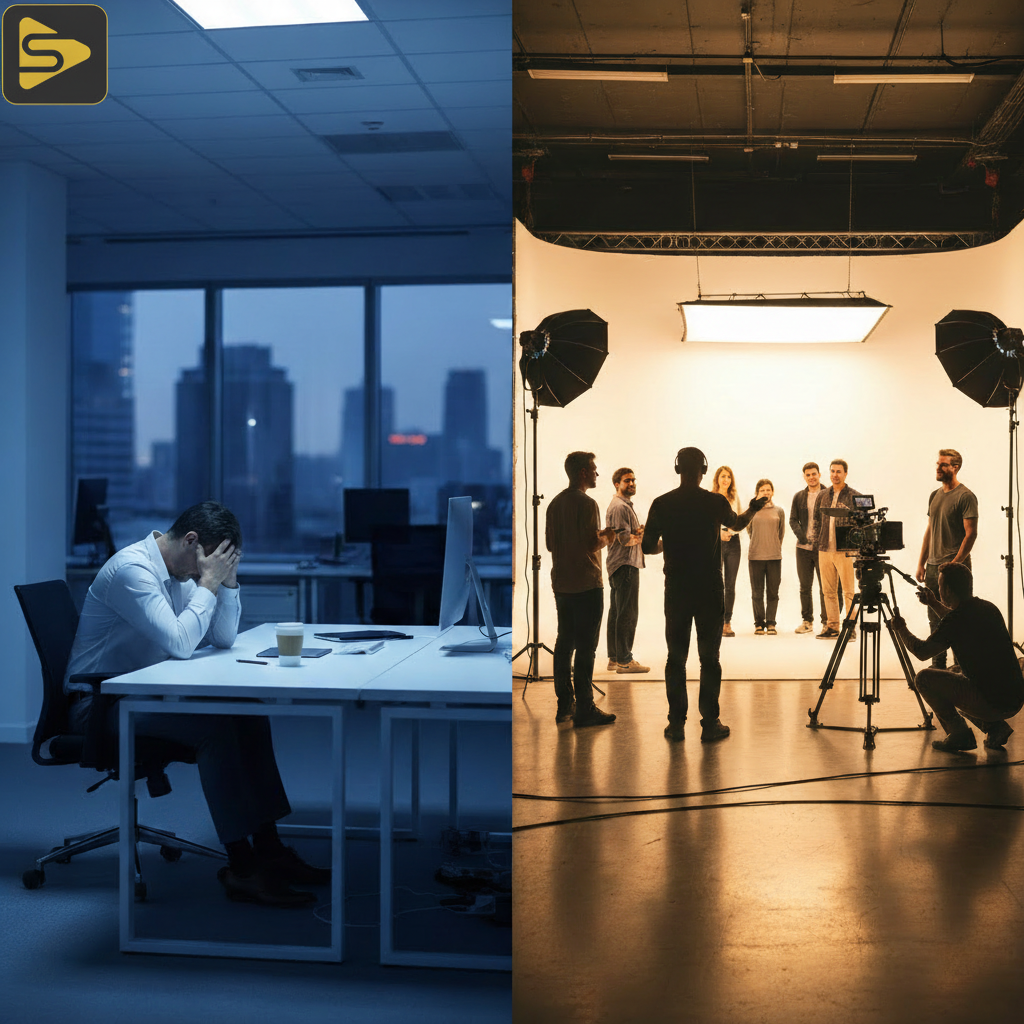
Comparison: In-House vs. Agency Production Costs
| Expense Category | In-House (Annual) | Agency Partner (Annual) |
|---|---|---|
| Talent (Salary/Fees) | $160k – $250k+ | $60k – $150k (Retainer) |
| Equipment & Software | $30k – $70k (Capex) | Included in Project/Retainer |
| Benefits & Payroll Tax | 25% – 35% of Salary | $0 |
| Scalability | Fixed Capacity | On-Demand Elasticity |
Agility and Velocity: Why Scaling Teams Choose Agencies
Agencies operate as a variable cost, allowing you to ramp up production for a product launch and scale back during quiet quarters without the pain of layoffs.
In our work with Series B SaaS founders, we often see that internal teams are excellent for high-volume, low-fidelity content like social snippets. However, when it comes to a high-stakes brand film or a multi-camera event live streaming setup, the specialized gear and crew density of an agency are irreplaceable.
But wait—there is a middle ground. Many sophisticated marketing directors now use a ‘Hybrid Model.’ They keep a nimble internal team for day-to-day social execution and partner with an agency for high-production-value assets. This de-risks the scale-up process and ensures that internal staff don’t become ‘too close to the product’ to innovate creatively.
Need to see how an integrated partner fits your workflow? Schedule a free consultation with our strategy team today.
The Invisible Costs of a Freelance Videographer Strategy
Relying on a freelance videographer for a one-off video shoot might seem cheaper on paper, but it often leads to vendor fragmentation.
- Inconsistency: Different freelancers bring different styles, leading to a disjointed brand identity over time.
- Project Management Overhead: Your marketing director ends up spending 20 hours a week managing five different vendors instead of focusing on strategy.
- Technical Debt: If a freelancer disappears, you may lose access to source files, raw footage, and project templates.
Here’s the thing: An integrated agency provides a ‘Content Supply Chain.’ At iStudios Media, we use Ingest.blog as our internal AI content engine to ensure that the high-fidelity video we produce for you is repurposed into SEO-optimized articles and social posts with maximum velocity.

Operational Efficiency and Unit Economics
The best way to measure In-House vs. Agency Production is through the lens of ‘Cost Per Finished Minute’ and ‘Return on Effort.’
According to HubSpot’s State of Marketing Report, video remains the highest-ROI media format, but only if the distribution is as professional as the production. A Bay Area creative agency costs more than a Fiverr gig, but the unit economics make sense when that one high-quality asset is used across LinkedIn Ads, your website, and sales decks for two years.
What most people miss is the ‘Talent Density’ an agency provides. When you hire an agency, you aren’t just getting a person; you’re getting a system that includes a creative director, a director of photography, an editor, and a digital strategist. This collective expertise ensures the content isn’t just pretty—it’s engineered to convert.
Deciding Which Model Fits Your Current Stage
The right choice often depends on your funding stage and internal capabilities.
- Seed to Series A: Usually better served by agencies or high-end freelancers to keep fixed overhead low while building brand authority.
- Series B to C: Often transition to a hybrid model where an internal project manager coordinates with an agency for specialized corporate video needs.
- Enterprise: May build large internal teams but still outsource ‘Hero’ campaigns to external agencies to gain a fresh perspective and access to the latest tech.
The contrarian truth? Sometimes, being ‘too close’ to your own product is a liability. Internal teams can develop ‘tunnel vision,’ leading to safe, repetitive content. An external partner provides the healthy friction necessary for creative breakthroughs.
Actionable Takeaway: Audit Your Creative Spend
This week, don’t just look at your agency invoices. Calculate the ‘Fully Loaded Cost’ of your internal creative resources. Include their seat in the office, their software licenses (Adobe Creative Cloud, Frame.io, etc.), and the time your leadership spends managing them. If your internal production cost per asset is higher than an agency’s project fee, it’s time to re-evaluate your resource allocation.
Ready to scale your content without the headcount headaches? Contact iStudios Media for a custom production and performance marketing plan that delivers measurable ROI in the Bay Area market.
Frequently Asked Questions
How do Bay Area creative agency costs compare to hiring in-house?
Typically, a mid-market agency retainer in the Bay Area ranges from $5,000 to $15,000 per month, which is often less than the fully loaded cost of one senior creative employee ($18k-$25k/mo). Agencies provide a broader skill set and eliminate the need for equipment capital expenditures, making them more cost-effective for scaling teams.
When should I choose a freelance videographer over an agency?
A freelance videographer is ideal for simple, one-off tasks like capturing raw footage of a presentation or a basic testimonial. However, for strategic brand films, multi-channel campaigns, or projects requiring high-end post-production and distribution strategy, an integrated agency provides better consistency and long-term ROI.
What are the risks of bringing all video production in-house?
The primary risks include high fixed overhead, equipment obsolescence, and creative stagnation. In a fast-moving market like San Francisco, internal teams can become overwhelmed by volume, leading to a drop in quality. Additionally, the cost of churn for specialized talent can disrupt your entire marketing calendar.
Does a hybrid production model work for startups?
Yes, the hybrid model is often the most efficient for Series B+ startups. By keeping a junior content creator in-house for daily social media needs and partnering with an agency for high-fidelity brand assets and performance marketing, companies can maintain both high velocity and premium quality.