📋 Table of Contents
For Series A-C startups in the San Francisco Bay Area, the ROI of full-stack content has shifted from a competitive advantage to a survival requirement. In an era where venture capital demands ‘growth at a reasonable cost,’ the traditional model of hiring a creative boutique for video and a separate agency for media buying is failing. This fragmentation creates a ‘Silo Tax’—a measurable 30% leakage in lead efficiency caused by the friction between content creation and data-driven distribution.
The High Cost of the Silo Tax in SF Tech Marketing
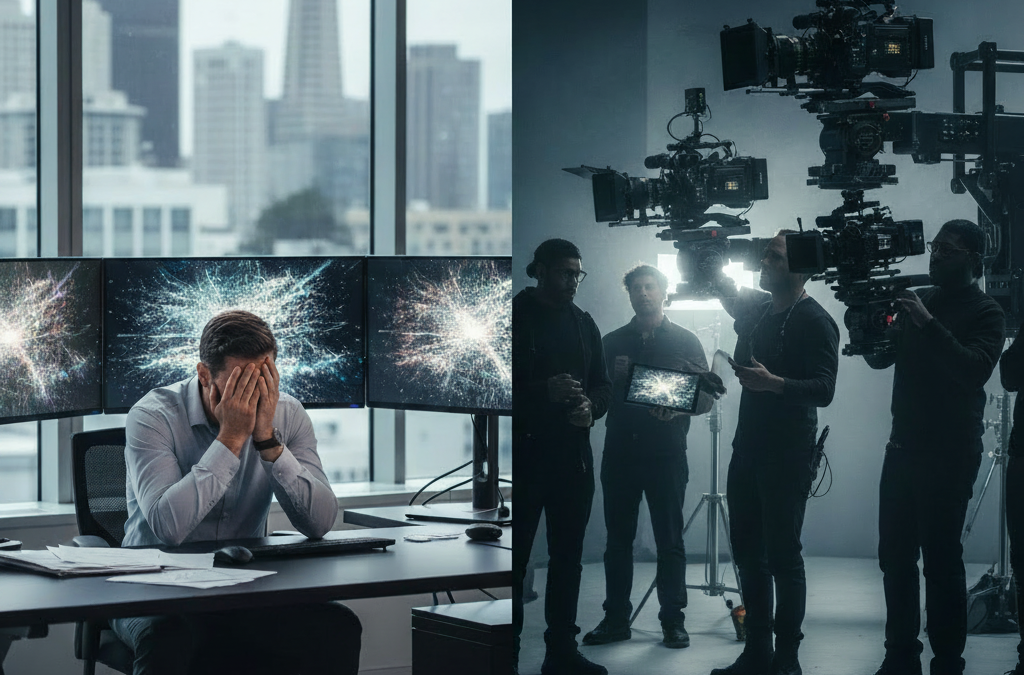
Consequently, many marketing directors find themselves managing a fractured ecosystem. When your production team doesn’t have access to your Google Ads conversion data, they are essentially ‘flying blind,’ creating high-fidelity assets that may not resonate with high-intent searchers. This lack of a feedback loop is the primary driver of inefficient Customer Acquisition Costs (CAC).

Why Traditional Agencies Fail Scalable Startups
- Creative Disconnect: High-end cinematography looks beautiful but often lacks the specific hooks required for performance creative on LinkedIn or Meta.
- Technical Friction: Moving 4K raw assets from a production house to a growth team takes days, slowing down your Lead Velocity Rate.
- Attribution Gaps: Without a full-stack media agency, it is nearly impossible to track which creative element drove the final conversion in your CRM.
The 30% Efficiency Leakage Explained
Furthermore, research suggests that companies using decoupled teams spend roughly 30% more to achieve the same lead volume as those using integrated models. According to Gartner research, marketing operations efficiency is directly tied to the integration of creative and analytical workflows. In the Silicon Valley landscape, this 30% could represent months of additional runway or the difference between hitting a Series B milestone and stalling out.
Maximizing ROI of Full-Stack Content through Integration
To reclaim this lost efficiency, sophisticated leaders are moving toward integrated ‘Growth-Creative’ pods. This model treats content not as a one-off project, but as a continuous engine where performance data informs the next shoot. By combining high-end video production for tech startups with real-time ad management, firms can pivot creative strategy in 48 hours rather than 4 weeks.
| Feature | Siloed Model (Traditional) | Full-Stack Model (iStudios) |
|---|---|---|
| Creative Direction | Subjective / Aesthetic-based | Data-driven / Signal-based |
| Feedback Loop | Monthly reports | Real-time CRM integration | 2-4 Weeks | 48-72 Hours |
| CAC Impact | Standard Market Rates | 25-35% Reduction |
The Shift to Signal-Based Production
Specifically, in a post-cookie digital environment, the creative itself has become the primary lever for targeting. Algorithms on platforms like Meta and LinkedIn now use visual cues and engagement signals to find your audience. Therefore, the ROI of full-stack content is maximized when your production team understands the technical requirements of the ad platform’s AI as well as they understand lighting and sound.
Strategic Advantages for Series A-C Founders
Moreover, for founders, the primary pain point is speed. You cannot afford to spend three months on a brand video that doesn’t convert. An integrated marketing ROI strategy ensures that every dollar spent on cinematography is also an investment in your sales pipeline.
Building a Content-Led Growth (CLG) Engine
- Unified Strategy: Aligning your CRM automation with your video hooks to ensure leads are nurtured immediately.
- Scalable Production: Using a production partner that can generate a hero brand film and 50 social-first cutdowns in a single session.
- Revenue-Centric Metrics: Moving past ‘views’ and focusing on Lead Velocity Rate and Pipeline Contribution.
How iStudios Media Eliminates the Efficiency Gap
As a premier Bay Area partner, iStudios Media functions as an extension of your growth team. We aren’t just a production house; we are a performance and automation partner. We bridge the gap between Hayward production studios and Silicon Valley boardroom goals by integrating GoHighLevel automation, Apollo outreach, and 6K cinematography under one roof.
The Feedback Loop: Why Data-Driven Production Wins
Actually, the most significant advantage of the full-stack approach is the feedback loop. When our media buyers see a specific value proposition performing well in Google Ads, that data is immediately funneled back to our editors. We then iterate on the creative to double down on what works, effectively reclaiming the 30% of spend typically wasted on underperforming assets.
Future-Proofing Your Content Against AI Noise
Additionally, as AI-generated content floods the market, the value of high-fidelity, human-led production increases. However, quality alone isn’t enough. The ROI of full-stack content in 2024 and 2025 will depend on how that quality is weaponized through sophisticated distribution and CRM systems.
Reallocating Lost Production Spend
- Eliminate Vendor Overhead: Stop paying for three different account managers at three different agencies.
- Reduce Asset Waste: Only produce content that has a defined place in your conversion funnel.
- Improve Attribution: Use integrated systems to see exactly which video led to which SQL.
Conclusion: The Path to Scalable Growth
Ultimately, SF tech firms must choose between the comfort of traditional silos and the efficiency of integrated production. By focusing on the ROI of full-stack content, you aren’t just making videos; you are building a revenue engine. Ready to audit your current lead efficiency? Connect with iStudios Media today to see how our integrated pods can accelerate your growth.
Frequently Asked Questions
How do you measure the ROI of full-stack content?
We measure ROI by tracking the decrease in Customer Acquisition Cost (CAC) and the increase in Lead Velocity Rate. By integrating production with performance data, we can attribute specific revenue outcomes to individual creative assets, providing a much clearer picture than traditional ‘view’ metrics used by siloed agencies.
Why is the ‘Silo Tax’ specifically 30%?
This figure represents the average loss in efficiency due to redundant management fees, asset mismatching, and slow feedback loops between disparate creative and growth teams. In high-cost markets like San Francisco, this inefficiency is amplified by higher media costs and competitive talent markets.
Can a full-stack media agency handle enterprise-level compliance?
Yes. A sophisticated full-stack partner like iStudios Media is built to operate within the security and HIPAA constraints required by medical practices and enterprise corporate comms. We provide the speed of a startup partner with the structural reliability of an enterprise vendor.
How does integrated production help with SEO?
Integrated production ensures that video content is optimized for ‘Zero-Click’ search results and Google’s Video Tab. By aligning technical SEO with high-end video production, we help tech firms capture more real estate on the SERP, leading to higher organic lead efficiency.